QUESTION IMAGE
Question
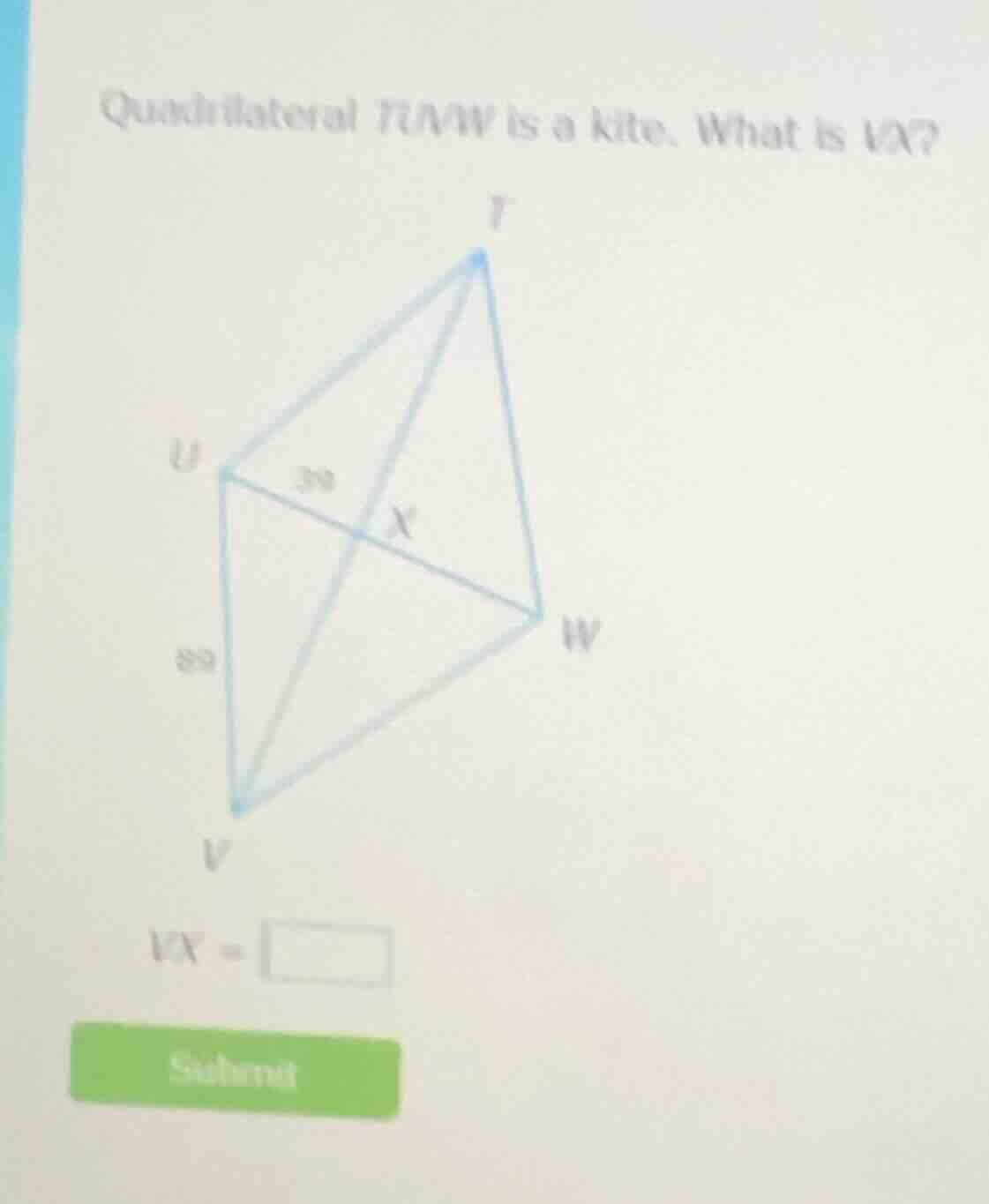
quadrilateral tuvw is a kite. what is vx?
vx = \boxed{}
Step1: Recall kite diagonal properties
In a kite, one diagonal is the perpendicular bisector of the other, and the triangles formed are congruent. Also, the diagonals intersect at right angles, and the two pairs of adjacent sides are equal. For kite \( TUVW \), sides \( TU = TW \) and \( VU = VW \), so diagonal \( TV \) bisects diagonal \( UW \), and triangles \( VUX \) and \( VWX \) are congruent, triangles \( TUX \) and \( TWX \) are congruent. Also, triangle \( VUX \) is a right triangle? Wait, no, actually, in a kite, the diagonals are perpendicular? Wait, no, the key property here is that in a kite, one diagonal is bisected by the other? Wait, no, the correct property is: In a kite, one of the diagonals is the perpendicular bisector of the other diagonal. Wait, actually, the two diagonals of a kite are perpendicular, and one diagonal is bisected by the other. Wait, let's check the sides: \( VU = 89 \), \( UX = 39 \), and we need to find \( VX \). Wait, triangle \( VUX \): if the diagonals are perpendicular, then triangle \( VUX \) is a right triangle with legs \( UX = 39 \) and \( VX \), and hypotenuse \( VU = 89 \)? Wait, no, that can't be, because \( 39^2 + VX^2 = 89^2 \)? Wait, no, maybe I got the sides wrong. Wait, in a kite, two pairs of adjacent sides are equal. So \( TU = TW \) and \( VU = VW \). So diagonal \( TV \) is the axis of symmetry, so it bisects \( UW \) at \( X \), and \( \angle VXU = 90^\circ \) (diagonals of a kite are perpendicular). So triangle \( VXU \) is a right triangle with hypotenuse \( VU = 89 \), one leg \( UX = 39 \), and the other leg \( VX \). So we can use the Pythagorean theorem: \( VX^2 + UX^2 = VU^2 \).
Step2: Apply Pythagorean theorem
So \( VX^2 + 39^2 = 89^2 \). Calculate \( 89^2 = 7921 \), \( 39^2 = 1521 \). Then \( VX^2 = 7921 - 1521 = 6400 \). Then \( VX = \sqrt{6400} = 80 \).

Snap & solve any problem in the app
Get step-by-step solutions on Sovi AI
Photo-based solutions with guided steps
Explore more problems and detailed explanations
\( 80 \)