QUESTION IMAGE
Question
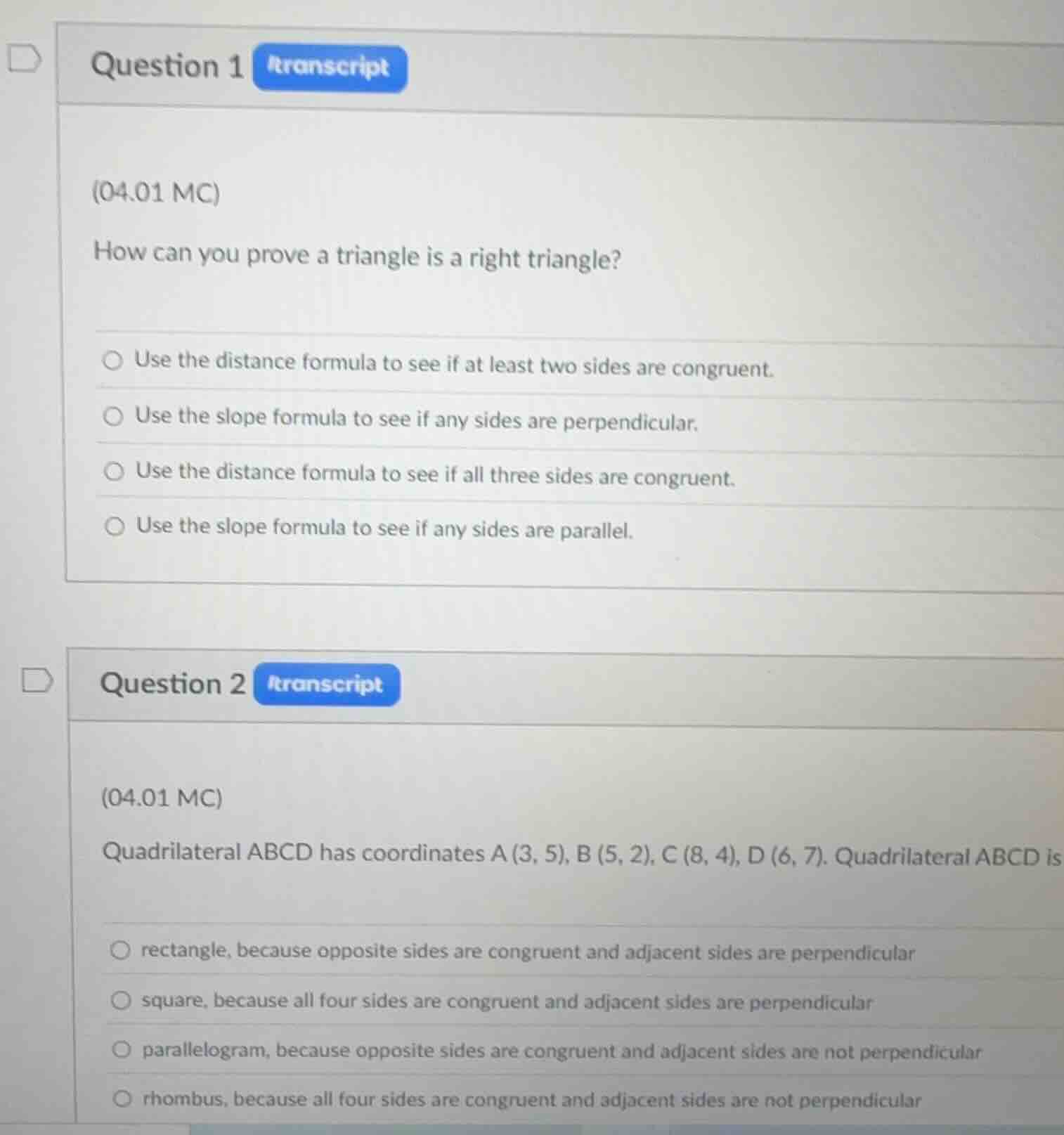
question 1 (04.01 mc) how can you prove a triangle is a right triangle? use the distance formula to see if at least two sides are congruent. use the slope formula to see if any sides are perpendicular. use the distance formula to see if all three sides are congruent. use the slope formula to see if any sides are parallel. question 2 (04.01 mc) quadrilateral abcd has coordinates a (3, 5), b (5, 2), c (8, 4), d (6, 7). quadrilateral abcd is rectangle, because opposite sides are congruent and adjacent sides are perpendicular square, because all four sides are congruent and adjacent sides are perpendicular parallelogram, because opposite sides are congruent and adjacent sides are not perpendicular rhombus, because all four sides are congruent and adjacent sides are not perpendicular
Question 1
To prove a triangle is a right triangle, we need to show one angle is \(90^\circ\). Perpendicular lines (sides) have slopes whose product is \(- 1\). Using the slope formula to check if any two sides are perpendicular (since perpendicular sides form a right angle) works. Checking congruent sides (first option) proves isosceles, all three congruent (third) proves equilateral, and parallel sides (fourth) don't relate to right angles.
Step 1: Recall distance formula
The distance formula between two points \((x_1,y_1)\) and \((x_2,y_2)\) is \(d = \sqrt{(x_2 - x_1)^2+(y_2 - y_1)^2}\). Also, slope formula is \(m=\frac{y_2 - y_1}{x_2 - x_1}\), and perpendicular slopes have product \(- 1\), parallel slopes are equal.
Step 2: Calculate lengths of sides
- Length of \(AB\): \(A(3,5)\), \(B(5,2)\)
\(AB=\sqrt{(5 - 3)^2+(2 - 5)^2}=\sqrt{2^2+(-3)^2}=\sqrt{4 + 9}=\sqrt{13}\)
- Length of \(BC\): \(B(5,2)\), \(C(8,4)\)
\(BC=\sqrt{(8 - 5)^2+(4 - 2)^2}=\sqrt{3^2+2^2}=\sqrt{9 + 4}=\sqrt{13}\)
- Length of \(CD\): \(C(8,4)\), \(D(6,7)\)
\(CD=\sqrt{(6 - 8)^2+(7 - 4)^2}=\sqrt{(-2)^2+3^2}=\sqrt{4 + 9}=\sqrt{13}\)
- Length of \(DA\): \(D(6,7)\), \(A(3,5)\)
\(DA=\sqrt{(3 - 6)^2+(5 - 7)^2}=\sqrt{(-3)^2+(-2)^2}=\sqrt{9 + 4}=\sqrt{13}\)
All four sides are congruent.
Step 3: Calculate slopes of sides
- Slope of \(AB\): \(m_{AB}=\frac{2 - 5}{5 - 3}=\frac{-3}{2}\)
- Slope of \(BC\): \(m_{BC}=\frac{4 - 2}{8 - 5}=\frac{2}{3}\)
- Product of \(m_{AB}\) and \(m_{BC}\): \(\frac{-3}{2}\times\frac{2}{3}=- 1\), so \(AB\perp BC\).
- Slope of \(CD\): \(m_{CD}=\frac{7 - 4}{6 - 8}=\frac{3}{-2}=-\frac{3}{2}\)
- Slope of \(DA\): \(m_{DA}=\frac{5 - 7}{3 - 6}=\frac{-2}{-3}=\frac{2}{3}\)
- Product of \(m_{BC}\) and \(m_{CD}\): \(\frac{2}{3}\times(-\frac{3}{2})=-1\), \(BC\perp CD\) and so on. All adjacent sides are perpendicular. Since all four sides are congruent and adjacent sides are perpendicular, it's a square? Wait, no, wait: Wait, let's recalculate slopes. Wait, \(AB\) slope: \(\frac{2 - 5}{5 - 3}=\frac{-3}{2}\), \(BC\) slope: \(\frac{4 - 2}{8 - 5}=\frac{2}{3}\), product is \(-1\), so perpendicular. \(CD\) slope: \(\frac{7 - 4}{6 - 8}=\frac{3}{-2}=-\frac{3}{2}\), \(DA\) slope: \(\frac{5 - 7}{3 - 6}=\frac{-2}{-3}=\frac{2}{3}\), product of \(CD\) and \(DA\) is \(-1\). Also, lengths: \(AB = \sqrt{13}\), \(BC=\sqrt{13}\), \(CD=\sqrt{13}\), \(DA=\sqrt{13}\). So all sides congruent, adjacent sides perpendicular. But wait, the options: Wait, the options are square (all four sides congruent, adjacent perpendicular), rectangle (opposite congruent, adjacent perpendicular), parallelogram (opposite congruent, adjacent not perpendicular), rhombus (all four congruent, adjacent not perpendicular). Since adjacent sides are perpendicular, rhombus is out (rhombus has adjacent sides not perpendicular unless it's a square). Rectangle has opposite sides congruent (which is true here, but also all sides congruent). Wait, but in our calculation, all four sides are congruent. So if all four sides are congruent and adjacent sides are perpendicular, it's a square. Wait, but let's check again. Wait, \(AB\) length: \(\sqrt{(5 - 3)^2+(2 - 5)^2}=\sqrt{4 + 9}=\sqrt{13}\), \(BC\): \(\sqrt{(8 - 5)^2+(4 - 2)^2}=\sqrt{9 + 4}=\sqrt{13}\), \(CD\): \(\sqrt{(6 - 8)^2+(7 - 4)^2}=\sqrt{4 + 9}=\sqrt{13}\), \(DA\): \(\sqrt{(3 - 6)^2+(5 - 7)^2}=\sqrt{9 + 4}=\sqrt{13}\). So all sides equal. Adjacent sides have slopes with product \(-1\), so perpendicular. So it's a square. But wait, the option D says "rhombus, because all four sides are congruent and adjacent sides are not perpendicular" – no, adjacent sides are perpendicular. Option B: "square, because all four sides are congruent and adjacent sides are perpendicular" – that's correct. Wait, but wait, maybe I made a mistake. Wait, let's check coordinates again. \(A(3,5)\), \(B(5,2)\), \(C(8,4)\), \(D(6,7)\). Let's plot mentally: \(A(3,5)\), \(B(5,2)\) (down 3, right 2), \(C(8,4)\) (right 3, up 2), \(D(6,7)\) (left 2, up 3), back to \(A\) (left 3, down 2). So the sides are all length \(\sq…

Snap & solve any problem in the app
Get step-by-step solutions on Sovi AI
Photo-based solutions with guided steps
Explore more problems and detailed explanations
B. Use the slope formula to see if any sides are perpendicular.