QUESTION IMAGE
Question
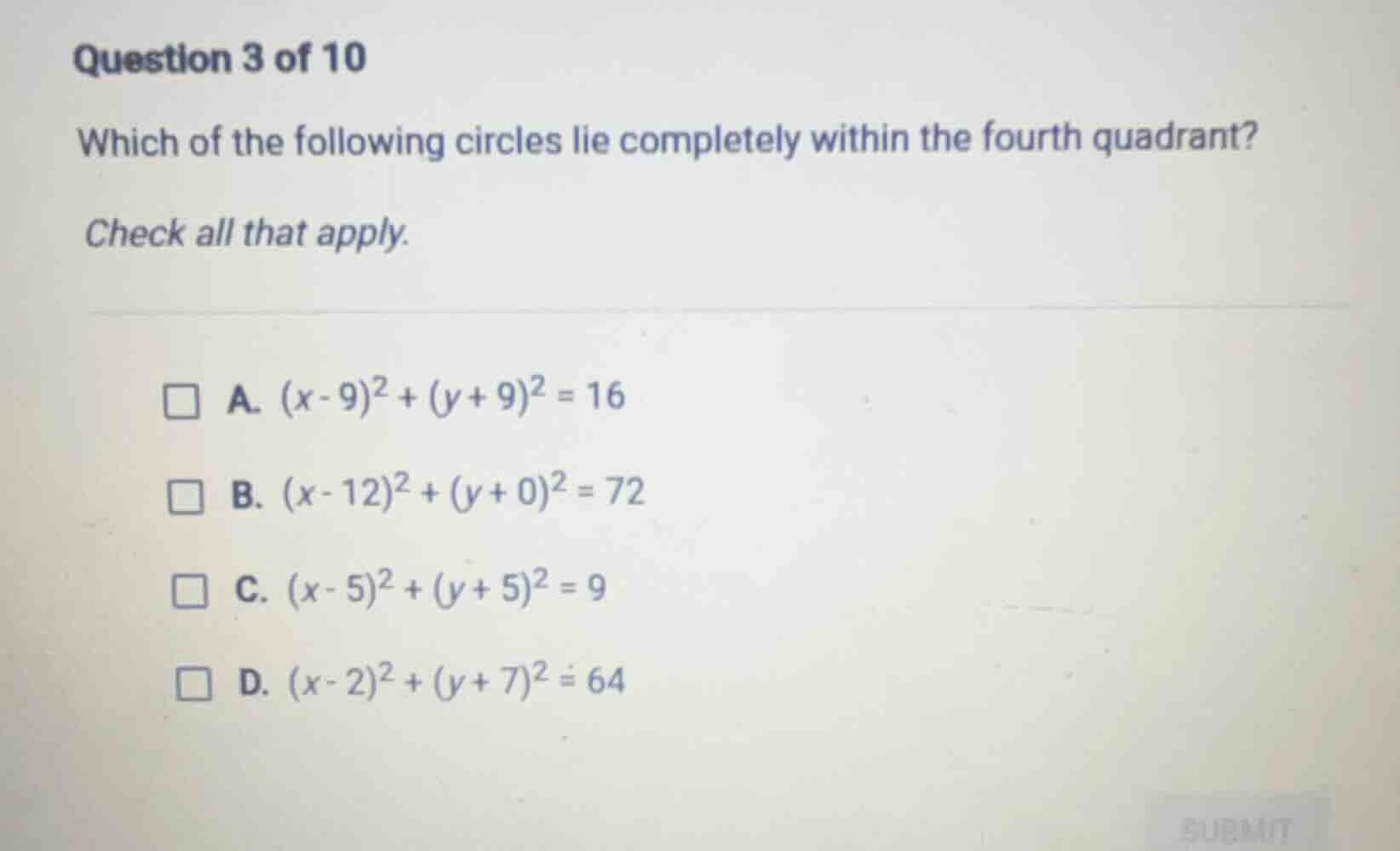
question 3 of 10
which of the following circles lie completely within the fourth quadrant?
check all that apply.
a. ((x - 9)^2 + (y + 9)^2 = 16)
b. ((x - 12)^2 + (y + 0)^2 = 72)
c. ((x - 5)^2 + (y + 5)^2 = 9)
d. ((x - 2)^2 + (y + 7)^2 = 64)
Step1: Recall the circle equation form
The standard form of a circle is \((x - h)^2+(y - k)^2 = r^2\), where \((h,k)\) is the center and \(r\) is the radius. For a circle to be completely in the fourth quadrant, the center \((h,k)\) must satisfy \(h>0\), \(k<0\), and the distance from the center to the axes ( \(h\) for the \(y\)-axis, \(\vert k\vert\) for the \(x\)-axis) must be greater than or equal to the radius.
Step2: Analyze Option A
Center of A: \((h,k)=(9, - 9)\), radius \(r = \sqrt{16}=4\). Distance from center to \(y\)-axis is \(h = 9\), distance to \(x\)-axis is \(\vert k\vert=9\). Since \(9>4\) (distance to \(y\)-axis > radius) and \(9 > 4\) (distance to \(x\)-axis > radius), the circle is completely in the fourth quadrant.
Step3: Analyze Option B
Center of B: \((h,k)=(12,0)\), radius \(r=\sqrt{72}\approx8.485\). The \(y\)-coordinate of the center is \(0\), so the circle touches the \(x\)-axis ( \(y = 0\) is the boundary of the fourth quadrant and other quadrants). It does not lie completely within the fourth quadrant.
Step4: Analyze Option C
Center of C: \((h,k)=(5,-5)\), radius \(r = \sqrt{9}=3\). Distance to \(y\)-axis is \(h = 5>3\), distance to \(x\)-axis is \(\vert k\vert=5>3\). So the circle is completely in the fourth quadrant.
Step5: Analyze Option D
Center of D: \((h,k)=(2,-7)\), radius \(r=\sqrt{64}=8\). Distance to \(y\)-axis is \(h = 2\), and \(2<8\) (distance to \(y\)-axis < radius), so the circle will cross the \(y\)-axis (enter the first or second quadrant) and is not completely in the fourth quadrant.

Snap & solve any problem in the app
Get step-by-step solutions on Sovi AI
Photo-based solutions with guided steps
Explore more problems and detailed explanations
A. \((x - 9)^2+(y + 9)^2=16\)
C. \((x - 5)^2+(y + 5)^2=9\)