QUESTION IMAGE
Question
question 4 of 10
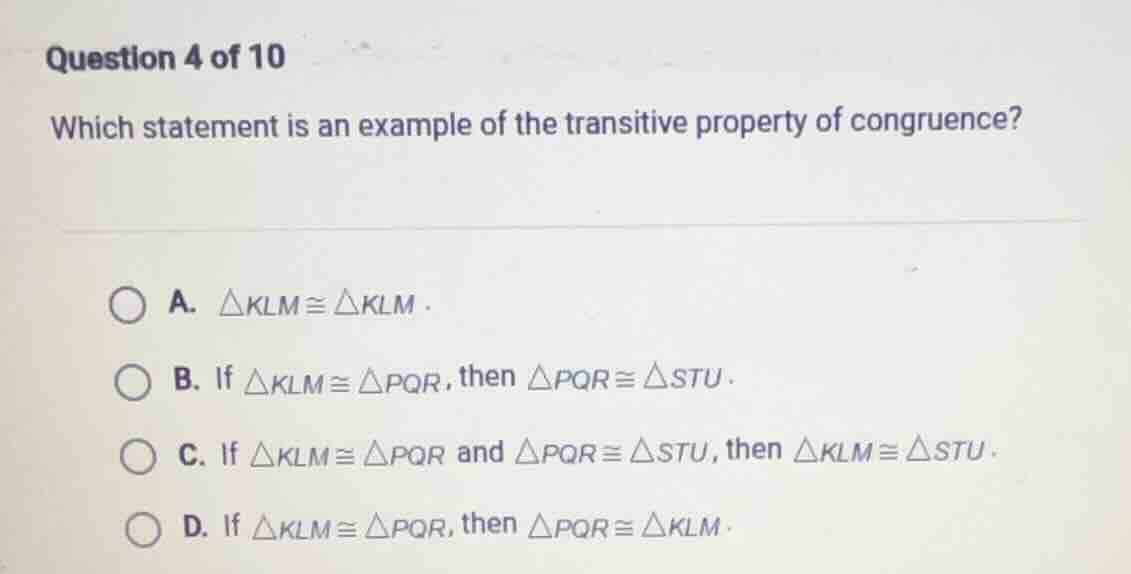
which statement is an example of the transitive property of congruence?
a. $\triangle klm \cong \triangle klm$
b. if $\triangle klm \cong \triangle pqr$, then $\triangle pqr \cong \triangle stu$
c. if $\triangle klm \cong \triangle pqr$ and $\triangle pqr \cong \triangle stu$, then $\triangle klm \cong \triangle stu$
d. if $\triangle klm \cong \triangle pqr$, then $\triangle pqr \cong \triangle klm$
The transitive property of congruence states that if figure A is congruent to figure B, and figure B is congruent to figure C, then figure A is congruent to figure C. Let's analyze each option:
- Option A: This shows a triangle is congruent to itself, which is the reflexive property, not transitive.
- Option B: There's no logical connection given to show the transitive property; it just states two congruences without the proper relationship.
- Option C: It follows the transitive property structure: If \( \triangle KLM \cong \triangle PQR \) (A ≅ B) and \( \triangle PQR \cong \triangle STU \) (B ≅ C), then \( \triangle KLM \cong \triangle STU \) (A ≅ C).
- Option D: This is the symmetric property of congruence (if A ≅ B, then B ≅ A), not transitive.

Snap & solve any problem in the app
Get step-by-step solutions on Sovi AI
Photo-based solutions with guided steps
Explore more problems and detailed explanations
C. If \( \triangle KLM \cong \triangle PQR \) and \( \triangle PQR \cong \triangle STU \), then \( \triangle KLM \cong \triangle STU \)