QUESTION IMAGE
Question
question 12 (1 point)
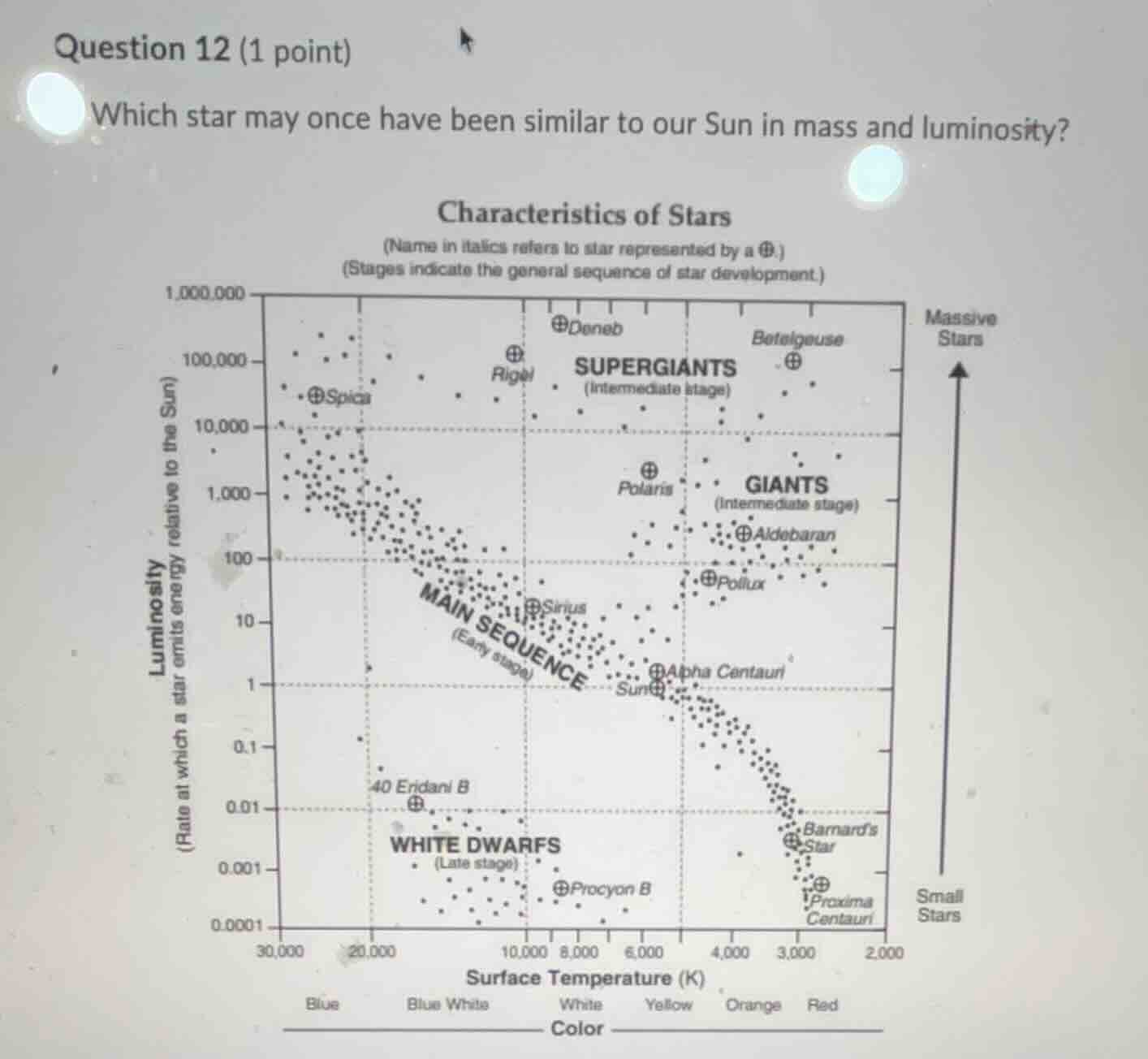
which star may once have been similar to our sun in mass and luminosity?
characteristics of stars
(name in italics refers to star represented by a ⊕.)
(stages indicate the general sequence of star development.)
chart showing luminosity relative to the sun vs surface temperature (k) with star groups: supergiants, giants, main sequence, white dwarfs, and labeled stars like spica, rigel, deneb, betelgeuse, polaris, aldebaran, pollux, sirius, alpha centauri, sun, 40 eridani b, procyon b, barnard’s star, proxima centauri
Our Sun is currently in the main sequence stage, with a luminosity of ~1 (relative to the Sun) and a surface temperature around 5800 K. Stars with similar initial mass evolve from main sequence to giant/white dwarf stages. White dwarfs are the final stage for Sun-like stars, and 40 Eridani B is a white dwarf, meaning it was once a main sequence star with mass and luminosity similar to our Sun.

Snap & solve any problem in the app
Get step-by-step solutions on Sovi AI
Photo-based solutions with guided steps
Explore more problems and detailed explanations
40 Eridani B