QUESTION IMAGE
Question
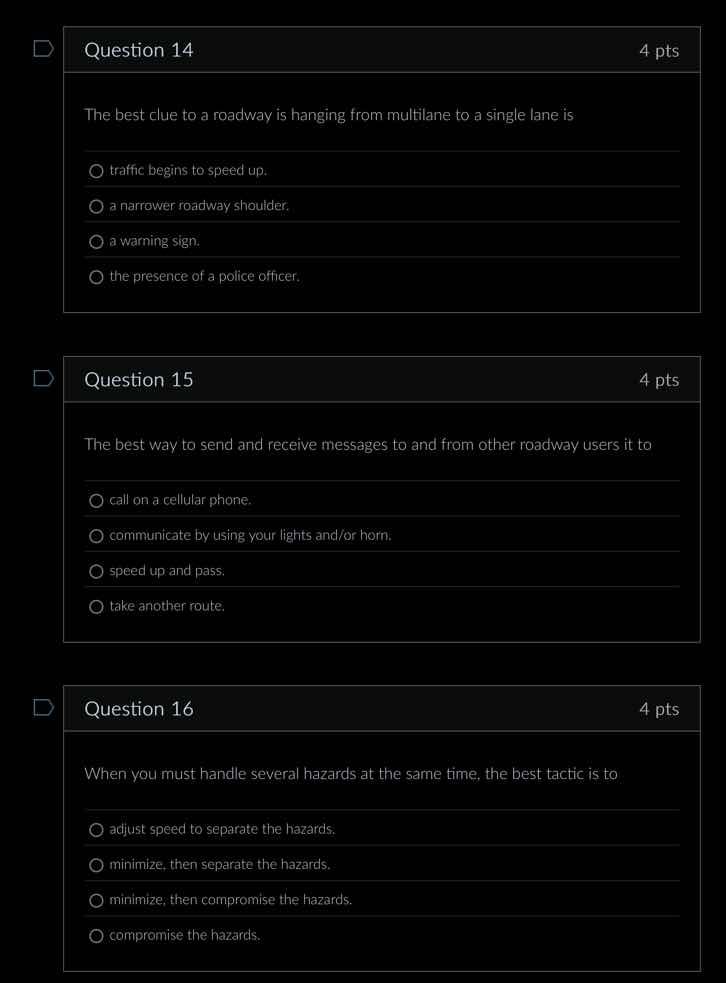
question 14
the best clue to a roadway is hanging from multilane to a single lane is
traffic begins to speed up.
a narrower roadway shoulder.
a warning sign.
the presence of a police officer.
question 15
the best way to send and receive messages to and from other roadway users it to
call on a cellular phone.
communicate by using your lights and/or horn.
speed up and pass.
take another route.
question 16
when you must handle several hazards at the same time, the best tactic is to
adjust speed to separate the hazards.
minimize, then separate the hazards.
minimize, then compromise the hazards.
compromise the hazards.
Question 14
To determine the best clue for a roadway changing from multi - lane to single - lane, we analyze each option:
- Traffic speeding up is not a reliable clue for lane reduction. Usually, lane reduction causes traffic to slow down.
- A narrower roadway shoulder is not the primary clue for lane change from multi - lane to single - lane.
- Warning signs are typically placed to alert drivers of upcoming lane changes (like from multi - lane to single - lane), so this is the correct clue.
- The presence of a police officer is not a standard clue for lane reduction.
To find the best way to communicate with other roadway users:
- Using a cellular phone while driving is dangerous and not a proper way to communicate with other roadway users.
- Using lights (like turn signals, high - beams in appropriate situations) and the horn is the standard way to send and receive messages (e.g., signaling a turn, alerting a driver of a hazard) to other roadway users.
- Speeding up and passing is a driving maneuver, not a communication method.
- Taking another route is a way to avoid a situation, not to communicate.
When handling multiple hazards:
- Adjusting speed to separate the hazards allows you to deal with one hazard at a time, as different hazards may require different responses and separating them in time (by adjusting speed) makes it easier to manage.
- Minimizing then separating is not the standard tactic. The key is to first separate the hazards by adjusting speed.
- Minimizing then compromising is not a correct driving tactic for handling hazards.
- Compromising the hazards is not a valid approach as it does not address the hazards properly.

Snap & solve any problem in the app
Get step-by-step solutions on Sovi AI
Photo-based solutions with guided steps
Explore more problems and detailed explanations
C. a warning sign.