QUESTION IMAGE
Question
question 14
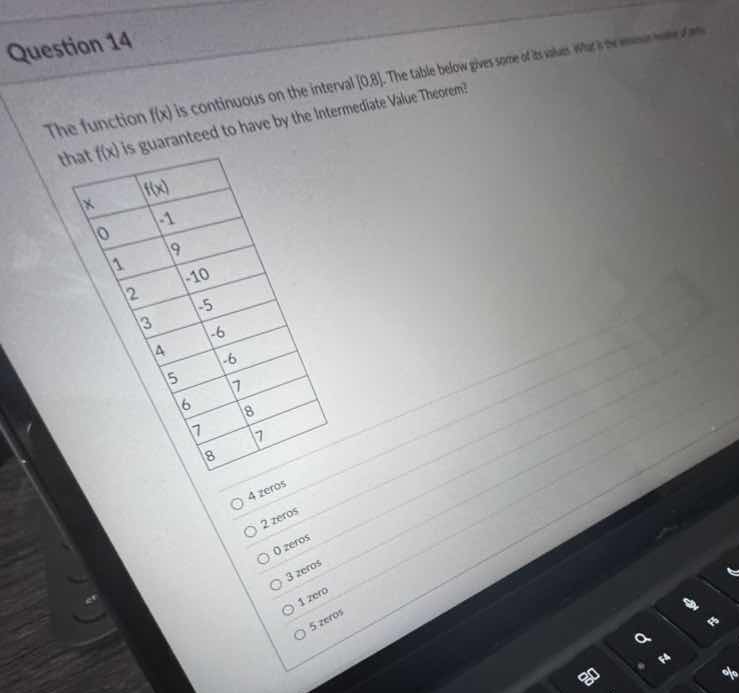
the function f(x) is continuous on the interval 0,8. the table below gives some of its values. what is the minimum number of zeros that f(x) is guaranteed to have by the intermediate value theorem?
| x | f(x) |
|---|---|
| 1 | 9 |
| 2 | -10 |
| 3 | -5 |
| 4 | -6 |
| 5 | -6 |
| 6 | 7 |
| 7 | 8 |
| 8 | 7 |
options:
4 zeros
2 zeros
0 zeros
3 zeros
1 zero
5 zeros
Step1: Check sign changes (0 to 1)
$f(0)=-1$, $f(1)=9$: sign changes from negative to positive, so there is at least 1 zero in $(0,1)$.
Step2: Check sign changes (1 to 2)
$f(1)=9$, $f(2)=-10$: sign changes from positive to negative, so there is at least 1 zero in $(1,2)$.
Step3: Check sign changes (2 to 3)
$f(2)=-10$, $f(3)=-5$: no sign change, no guaranteed zero.
Step4: Check sign changes (3 to 6)
$f(3)=-5$, $f(4)=-6$, $f(5)=-6$, $f(6)=7$: sign changes from negative to positive at $(5,6)$, so there is at least 1 zero in $(5,6)$.
Step5: Check sign changes (6 to 8)
$f(6)=7$, $f(7)=8$, $f(8)=7$: no sign change, no guaranteed zero.
Step6: Count guaranteed zeros
Total guaranteed zeros: 1 + 1 + 1 = 3.

Snap & solve any problem in the app
Get step-by-step solutions on Sovi AI
Photo-based solutions with guided steps
Explore more problems and detailed explanations
3 zeros