QUESTION IMAGE
Question
question 15
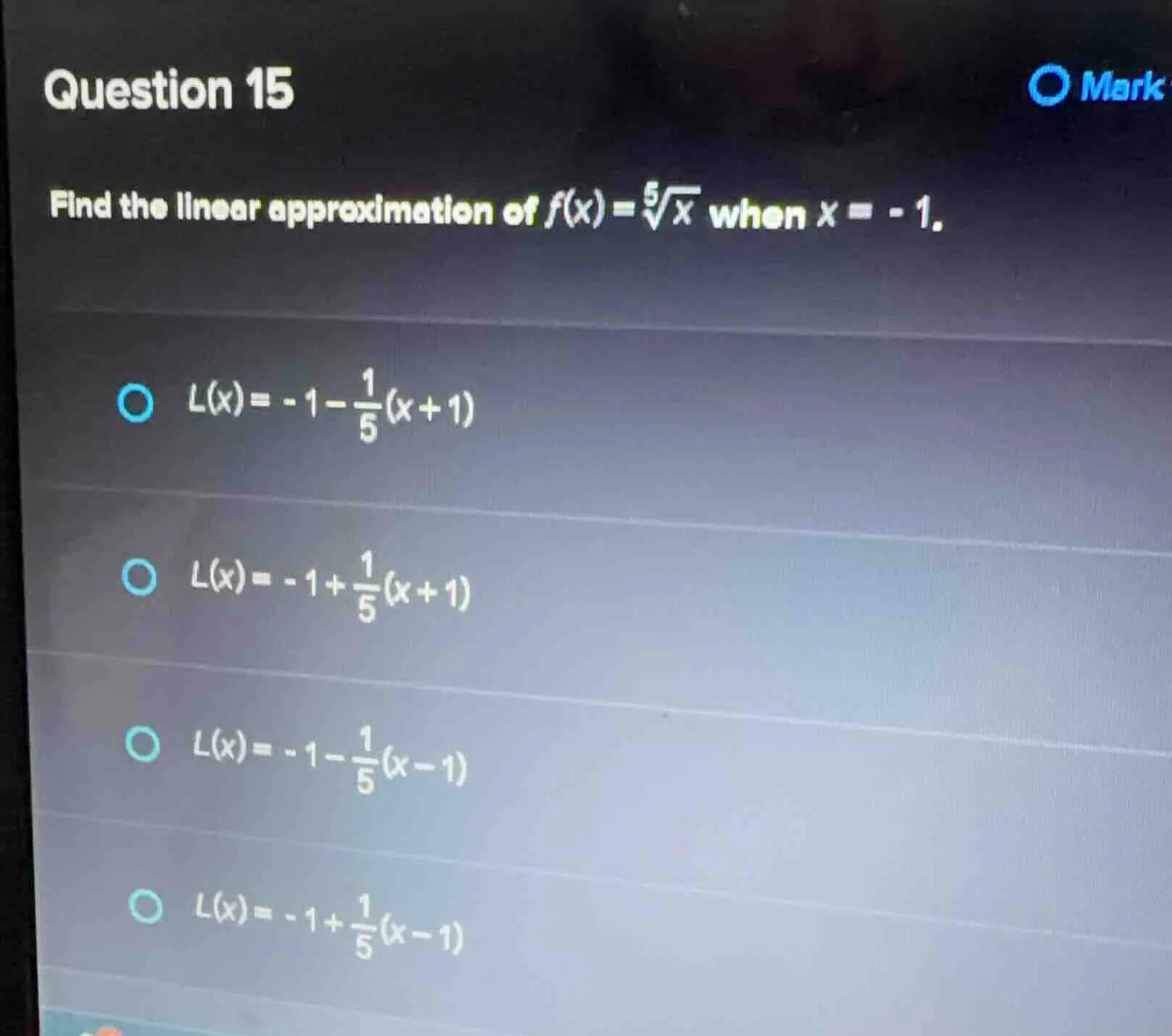
find the linear approximation of $f(x)=\sqrt5{x}$ when $x = -1$.
$\bigcirc$ $l(x)= -1-\frac{1}{5}(x + 1)$
$\bigcirc$ $l(x)= -1+\frac{1}{5}(x + 1)$
$\bigcirc$ $l(x)= -1-\frac{1}{5}(x - 1)$
$\bigcirc$ $l(x)= -1+\frac{1}{5}(x - 1)$
Step1: Rewrite function as power form
$f(x) = x^{\frac{1}{5}}$
Step2: Compute $f(-1)$
$f(-1) = (-1)^{\frac{1}{5}} = -1$
Step3: Find derivative $f'(x)$
$f'(x) = \frac{1}{5}x^{-\frac{4}{5}} = \frac{1}{5x^{\frac{4}{5}}}$
Step4: Compute $f'(-1)$
$f'(-1) = \frac{1}{5(-1)^{\frac{4}{5}}} = \frac{1}{5(1)} = \frac{1}{5}$
Step5: Apply linear approx formula
Linear approximation formula: $L(x) = f(a) + f'(a)(x-a)$, where $a=-1$
$L(x) = -1 + \frac{1}{5}(x - (-1)) = -1 + \frac{1}{5}(x+1)$

Snap & solve any problem in the app
Get step-by-step solutions on Sovi AI
Photo-based solutions with guided steps
Explore more problems and detailed explanations
L(x) = -1 + $\frac{1}{5}$(x+1)