QUESTION IMAGE
Question
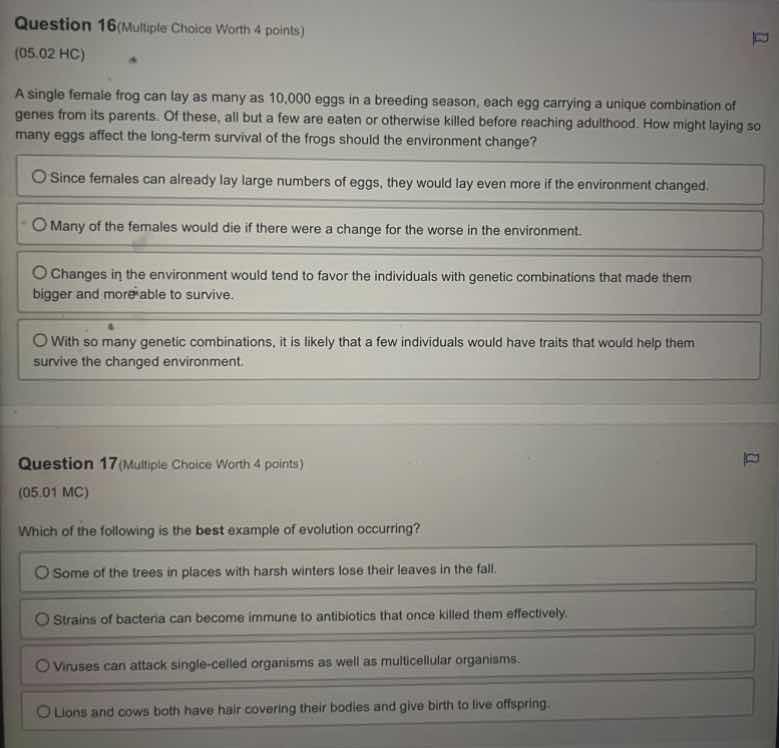
question 16 (multiple choice worth 4 points)
(05.02 hc)
a single female frog can lay as many as 10,000 eggs in a breeding season, each egg carrying a unique combination of genes from its parents. of these, all but a few are eaten or otherwise killed before reaching adulthood. how might laying so many eggs affect the long - term survival of the frogs should the environment change?
- since females can already lay large numbers of eggs, they would lay even more if the environment changed.
- many of the females would die if there were a change for the worse in the environment.
- changes in the environment would tend to favor the individuals with genetic combinations that made them bigger and more able to survive.
- with so many genetic combinations, it is likely that a few individuals would have traits that would help them survive the changed environment.
question 17 (multiple choice worth 4 points)
(05.01 mc)
which of the following is the best example of evolution occurring?
- some of the trees in places with harsh winters lose their leaves in the fall.
- strains of bacteria can become immune to antibiotics that once killed them effectively.
- viruses can attack single - celled organisms as well as multicellular organisms.
- lions and cows both have hair covering their bodies and give birth to live offspring.
Question 16
- Option 1: No basis for females laying more eggs with environment change; the question is about survival, not egg - laying quantity increase.
- Option 2: The question is about how laying many eggs affects survival, not about female death due to environmental change.
- Option 3: The key is genetic variation from many eggs, not just size - related traits for survival.
- Option 4: Laying many eggs creates a lot of genetic combinations. When the environment changes, it's probable that a few individuals with suitable traits (from this genetic variation) will survive. This option correctly links the large number of eggs (and thus genetic variation) to long - term survival in a changing environment.
- Option 1: Trees losing leaves in fall is a seasonal adaptation, not evolution (evolution is a change in a population over time).
- Option 2: Bacteria strains becoming immune to antibiotics means that the population of bacteria has changed over time (those with resistance survive and reproduce), which is evolution.
- Option 3: This is just a statement about the host range of viruses, not evolution.
- Option 4: Lions and cows having similar traits shows a common ancestry, not evolution occurring (evolution is a change in a population).

Snap & solve any problem in the app
Get step-by-step solutions on Sovi AI
Photo-based solutions with guided steps
Explore more problems and detailed explanations
D. With so many genetic combinations, it is likely that a few individuals would have traits that would help them survive the changed environment.