QUESTION IMAGE
Question
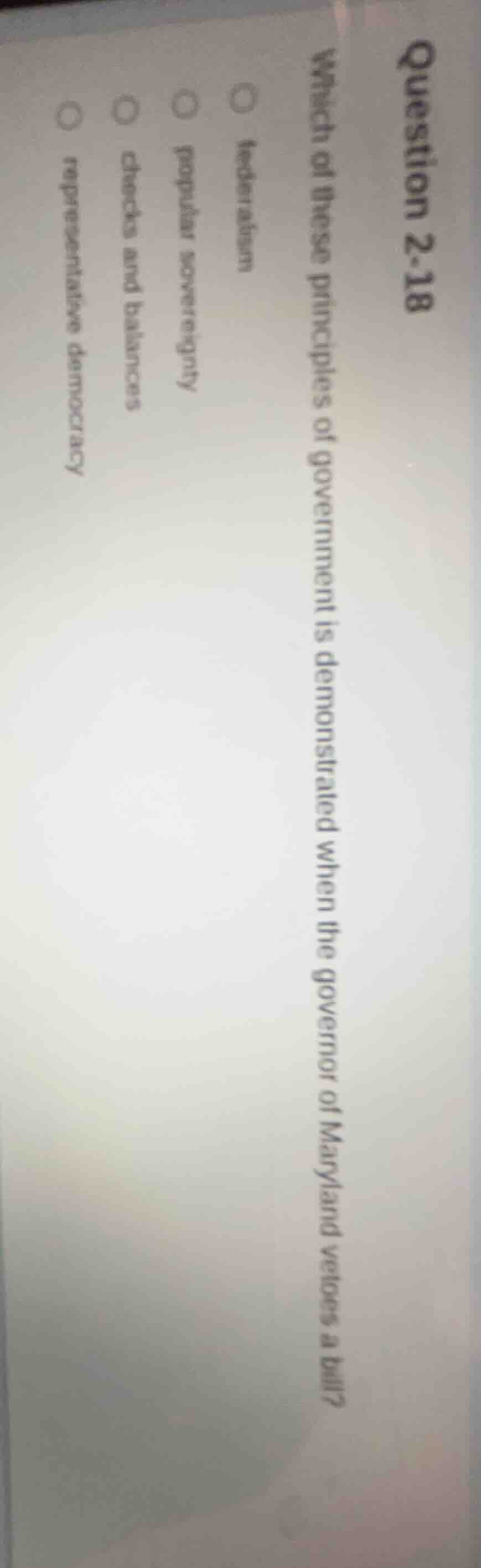
question 2-18\
which of these principles of government is demonstrated when the governor of maryland vetoes a bill?\
\bigcirc federalism\
\bigcirc popular sovereignty\
\bigcirc checks and balances\
\bigcirc representative democracy
Brief Explanations
To determine the principle, we analyze each option:
- Federalism: Deals with the division of power between state and federal governments, not directly related to a governor's veto.
- Popular Sovereignty: Focuses on the people's authority, not on the governor's veto power.
- Checks and Balances: This principle involves each branch of government (executive, legislative, judicial) having the ability to limit the powers of the other branches. A governor (executive branch) vetoing a bill (from the legislative branch) is an example of the executive branch checking the legislative branch's power, which aligns with checks and balances.
- Representative Democracy: Involves citizens electing representatives, not related to the veto power.

Snap & solve any problem in the app
Get step-by-step solutions on Sovi AI
Photo-based solutions with guided steps
Explore more problems and detailed explanations
The correct option is the one labeled "checks and balances" (the second option in the list: checks and balances).