QUESTION IMAGE
Question
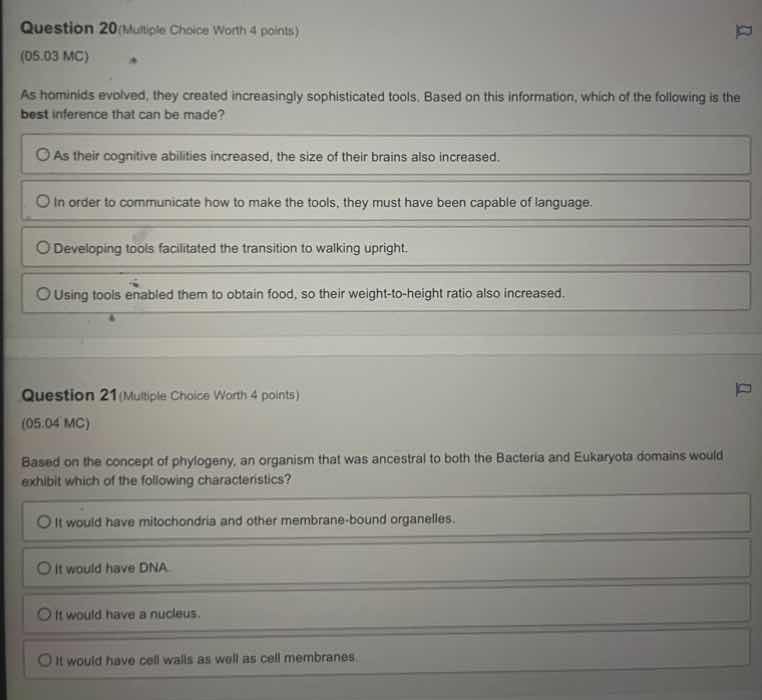
question 20 (multiple choice worth 4 points)
(06.03 mc)
as hominids evolved, they created increasingly sophisticated tools. based on this information, which of the following is the best inference that can be made?
- as their cognitive abilities increased, the size of their brains also increased.
- in order to communicate how to make the tools, they must have been capable of language.
- developing tools facilitated the transition to walking upright.
- using tools enabled them to obtain food, so their weight - to - height ratio also increased.
question 21 (multiple choice worth 4 points)
(05.04 mc)
based on the concept of phylogeny, an organism that was ancestral to both the bacteria and eukaryota domains would exhibit which of the following characteristics?
- it would have mitochondria and other membrane - bound organelles.
- it would have dna.
- it would have a nucleus.
- it would have cell walls as well as cell membranes.
Response
Question 20
Brief Explanations
To solve this, we analyze each option:
- Option 1: Tool sophistication in hominids' evolution is linked to cognitive (brain) development. As hominids evolved tools, their cognitive abilities (and brain size) likely increased, which is a valid inference.
- Option 2: Tool - making doesn't necessarily imply language ability (e.g., early tool - making could be through imitation without language).
- Option 3: Tool development and bipedalism (walking upright) have a less direct causal link compared to brain - tool relationship.
- Option 4: Tool use for food doesn't directly lead to a predictable weight - to - height ratio increase.
Brief Explanations
- Recall phylogeny and domain characteristics:
- Bacteria are prokaryotes (no membrane - bound organelles like mitochondria or nucleus). Eukaryota have membrane - bound organelles.
- The common ancestor of Bacteria and Eukaryota would have characteristics common to both. DNA is a universal genetic material, so the ancestor would have DNA.
- Option 1: Mitochondria are membrane - bound organelles, and Bacteria lack them, so the ancestor can't have mitochondria.
- Option 3: Bacteria lack a nucleus, so the ancestor can't have a nucleus.
- Option 4: Not all Bacteria (and thus the common ancestor) have cell walls (e.g., Mycoplasma), so this is not a universal characteristic.

Snap & solve any problem in the app
Get step-by-step solutions on Sovi AI
Photo-based solutions with guided steps
Explore more problems and detailed explanations
A. As their cognitive abilities increased, the size of their brains also increased.