QUESTION IMAGE
Question
question 32
1 part | -- of 2 points
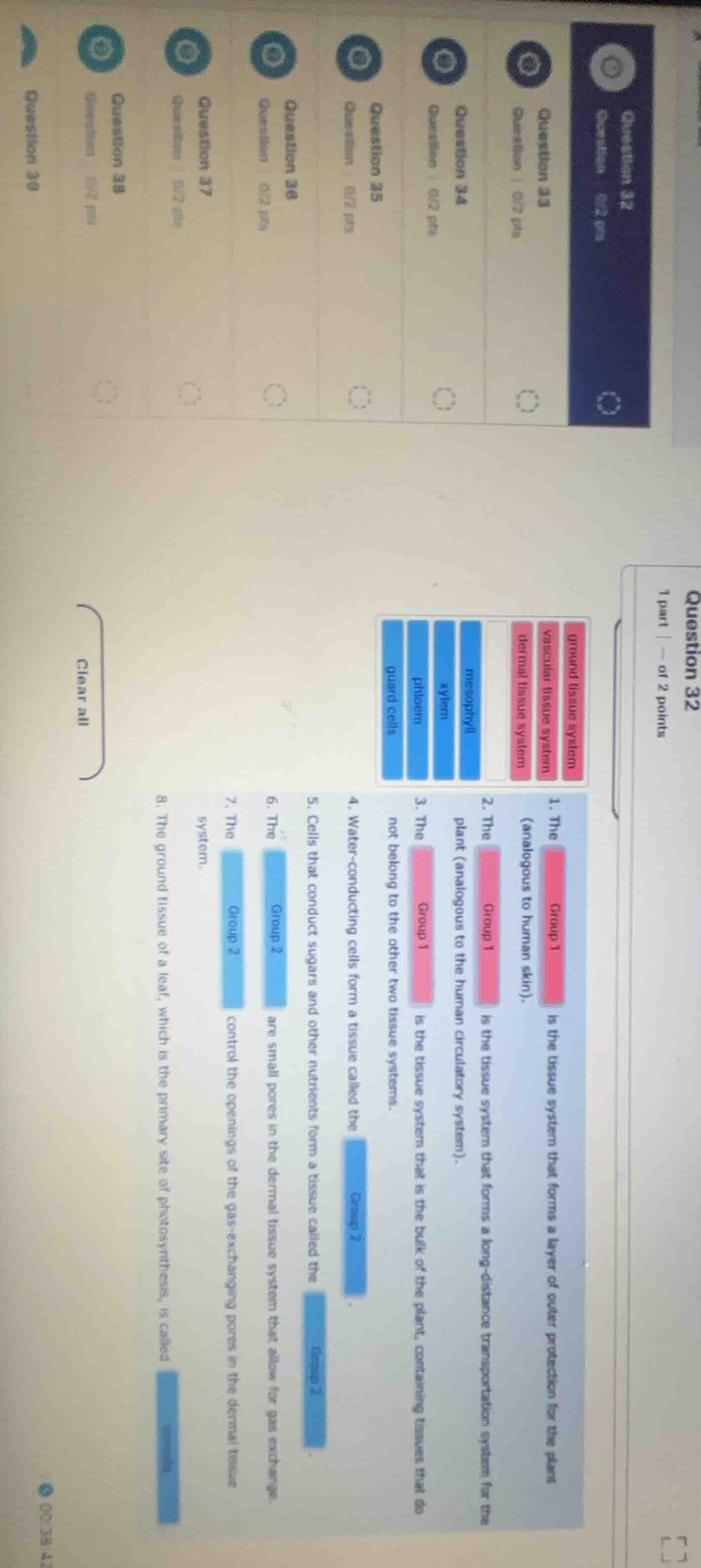
- the ______ is the tissue system that forms a layer of outer protection for the plant (analogous to human skin).
- the ______ is the tissue system that forms a long-distance transportation system for the plant (analogous to the human circulatory system).
- the ______ is the tissue system that is the bulk of the plant, containing tissues that do not belong to the other two tissue systems.
- water-conducting cells form a tissue called the ______.
- cells that conduct sugars and other nutrients form a tissue called the ______.
- the ______ are small pores in the dermal tissue system that allow for gas exchange.
- the ______ control the openings of the gas-exchanging pores in the dermal tissue system.
- the ground tissue of a leaf, which is the primary site of photosynthesis, is called ______
options:
ground tissue system
vascular tissue system
dermal tissue system
mesophyll
xylem
phloem
guard cells
clear all
question 32
question 0/2 pts
question 33
question 0/2 pts
question 34
question 0/2 pts
question 35
question 0/2 pts
question 36
question 0/2 pts
question 37
question 0/2 pts
question 38
question 0/2 pts
question 39
Brief Explanations
- The dermal tissue system acts as the plant's outer protective layer, analogous to human skin.
- The vascular tissue system is responsible for long-distance transport of water and nutrients in plants, similar to the human circulatory system.
- The ground tissue system makes up the bulk of the plant, with tissues not involved in outer protection or long-distance transport.
- Xylem is the plant tissue composed of water-conducting cells.
- Phloem is the plant tissue that conducts sugars and other organic nutrients.
- Stomata are the small pores in the dermal tissue that facilitate gas exchange.
- Guard cells are the specialized cells that open and close the stomatal pores.
- Mesophyll is the ground tissue in leaves where most photosynthesis takes place.

Snap & solve any problem in the app
Get step-by-step solutions on Sovi AI
Photo-based solutions with guided steps
Explore more problems and detailed explanations
- Group 1: dermal tissue system
- Group 1: vascular tissue system
- Group 1: ground tissue system
- Group 2: xylem
- Group 2: phloem
- Group 2: stomata
- Group 2: guard cells
- Group 2: mesophyll