QUESTION IMAGE
Question
question 1
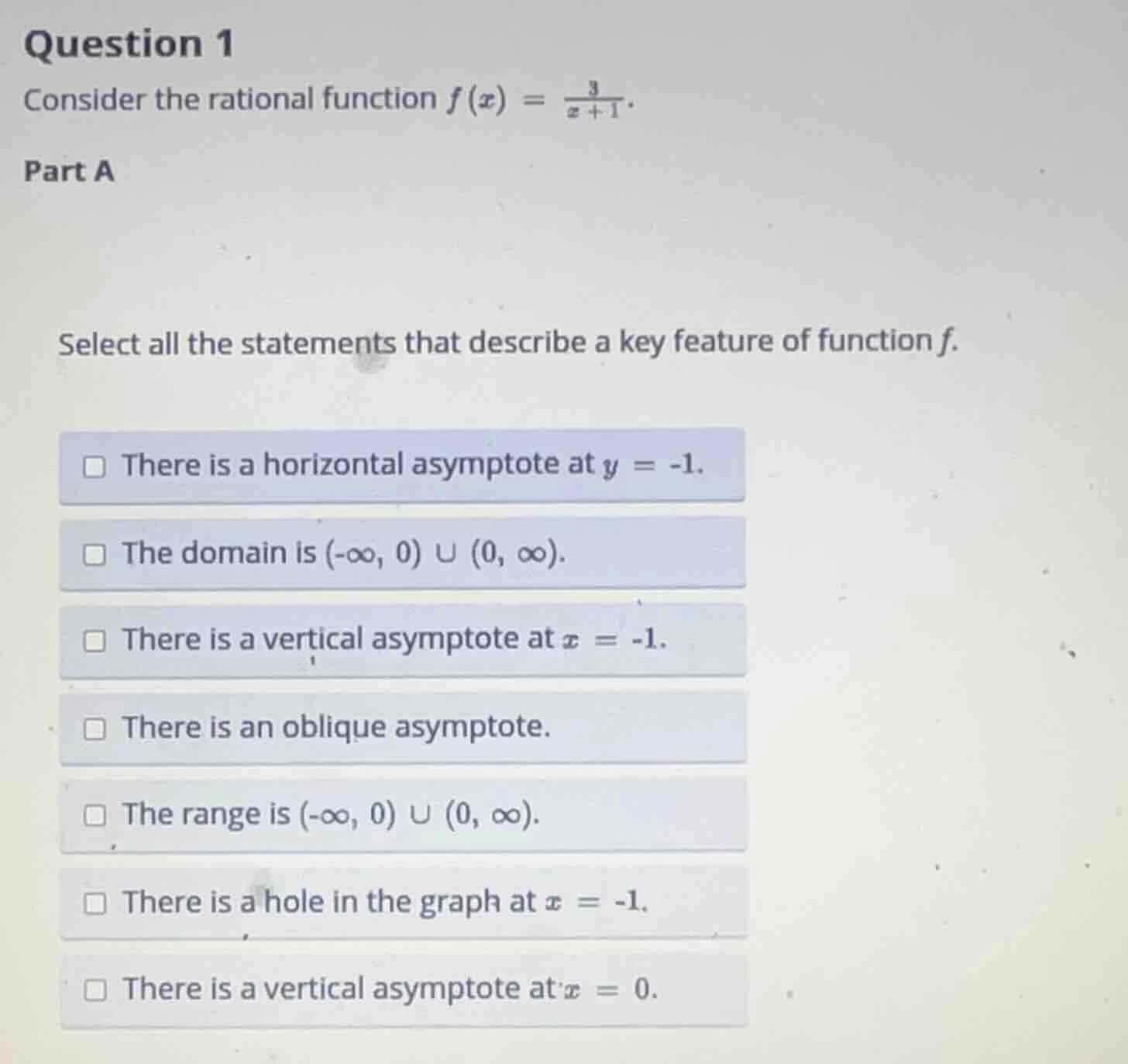
consider the rational function $f(x)=\frac{3}{x + 1}$.
part a
select all the statements that describe a key feature of function $f$.
- there is a horizontal asymptote at $y=-1$.
- the domain is $(-\infty,0)\cup(0,\infty)$.
- there is a vertical asymptote at $x=-1$.
- there is an oblique asymptote.
- the range is $(-\infty,0)\cup(0,\infty)$.
- there is a hole in the graph at $x=-1$.
- there is a vertical asymptote at $x = 0$.
Step1: Find vertical asymptote
Set denominator to 0: $x+1=0 \implies x=-1$
Step2: Find horizontal asymptote
Compare degrees: numerator degree 0, denominator degree 1. Horizontal asymptote is $y=0$.
Step3: Determine domain
Exclude $x=-1$: Domain is $(-\infty, -1) \cup (-1, \infty)$
Step4: Determine range
The function can never equal 0, so range is $(-\infty, 0) \cup (0, \infty)$
Step5: Check for oblique asymptote
Oblique asymptotes exist when numerator degree = denominator degree +1; not true here.
Step6: Check for holes
No common factors in numerator/denominator, so no holes.

Snap & solve any problem in the app
Get step-by-step solutions on Sovi AI
Photo-based solutions with guided steps
Explore more problems and detailed explanations
- There is a vertical asymptote at $x = -1$.
- The range is $(-\infty, 0) \cup (0, \infty)$.