QUESTION IMAGE
Question
question #8
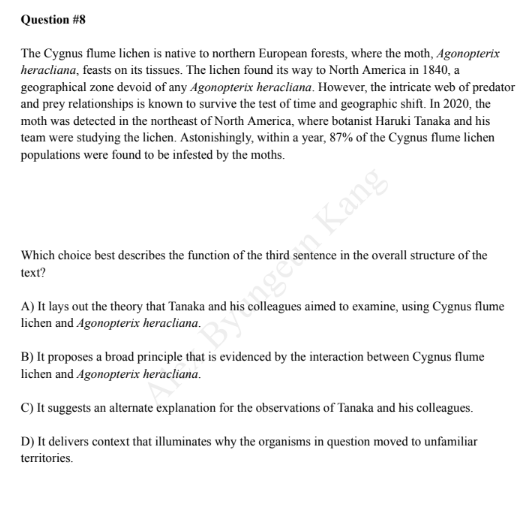
the cygnus flume lichen is native to northern european forests, where the moth, agonopterix heracliana, feasts on its tissues. the lichen found its way to north america in 1840, a geographical zone devoid of any agonopterix heracliana. however, the intricate web of predator and prey relationships is known to survive the test of time and geographic shift. in 2020, the moth was detected in the northeast of north america, where botanist haruki tanaka and his team were studying the lichen. astonishingly, within a year, 87% of the cygnus flume lichen populations were found to be infested by the moths.
which choice best describes the function of the third sentence in the overall structure of the text?
a) it lays out the theory that tanaka and his colleagues aimed to examine, using cygnus flume lichen and agonopterix heracliana.
b) it proposes a broad principle that is evidenced by the interaction between cygnus flume lichen and agonopterix heracliana.
c) it suggests an alternate explanation for the observations of tanaka and his colleagues.
d) it delivers context that illuminates why the organisms in question moved to unfamiliar territories.
The third sentence states a general principle: no predator or prey relationship survives time/geographic shifts. The following sentences (moth detection in 2020, rapid infestation) provide evidence supporting this principle through the specific interaction of the lichen and moth. Other options are incorrect: A (no theory to examine), C (no alternate explanation), D (no context for organism movement).

Snap & solve any problem in the app
Get step-by-step solutions on Sovi AI
Photo-based solutions with guided steps
Explore more problems and detailed explanations
B. It proposes a broad principle that is evidenced by the interaction between Cygnus flume lichen and Agonopterix heracliana.