QUESTION IMAGE
Question
question
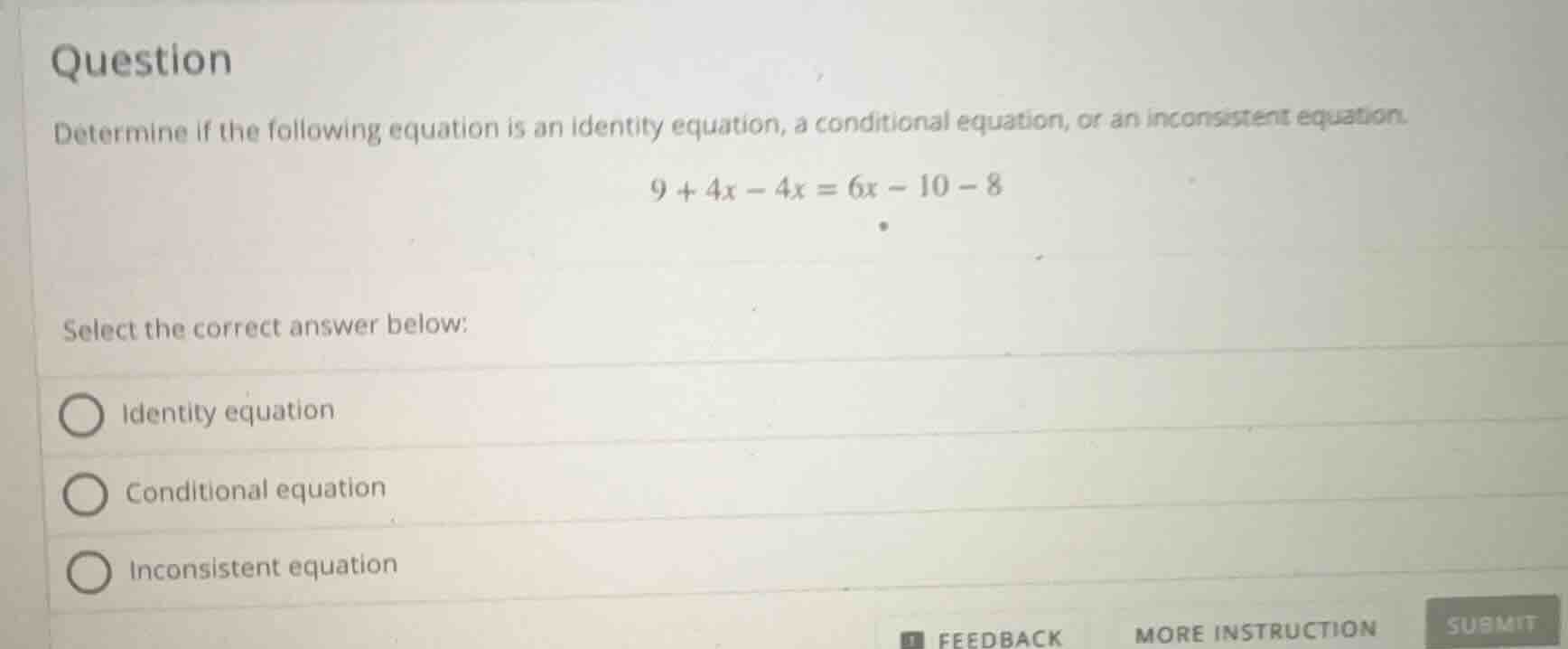
determine if the following equation is an identity equation, a conditional equation, or an inconsistent equation.
9 + 4x - 4x = 6x - 10 - 8
select the correct answer below:
○ identity equation
○ conditional equation
○ inconsistent equation
Step1: Simplify left side
Simplify \(9 + 4x - 4x\). The \(4x - 4x\) cancels out, so we get \(9\).
Step2: Simplify right side
Simplify \(6x - 10 - 8\). Combine the constants: \(-10 - 8=-18\), so the right side is \(6x - 18\).
Step3: Analyze the equation
Now our equation is \(9 = 6x - 18\). This is a linear equation that has a single solution for \(x\) (it's not true for all \(x\) like an identity, and it's not a contradiction like an inconsistent equation). Wait, no—wait, let's re - check. Wait, original left side: \(9 + 4x-4x = 9\). Right side: \(6x-10 - 8=6x - 18\). So the equation is \(9=6x - 18\). But wait, maybe I made a mistake. Wait, no—wait, let's solve for \(x\). Add 18 to both sides: \(9 + 18=6x\), \(27 = 6x\), \(x=\frac{27}{6}=\frac{9}{2}\). But wait, no—wait, the question is about identity (true for all \(x\)), conditional (true for some \(x\)), or inconsistent (true for no \(x\)). Wait, no, wait my initial simplification: left side \(9 + 4x-4x = 9\). Right side \(6x-10 - 8=6x - 18\). So the equation is \(9=6x - 18\). But this is a conditional equation? Wait, no—wait, no, I think I messed up. Wait, no, let's re - do:
Wait, the left side: \(9+4x - 4x=9\) (since \(4x-4x = 0\)). The right side: \(6x-10 - 8=6x-(10 + 8)=6x - 18\). So the equation is \(9=6x - 18\). Now, let's see if this is an identity (always true), conditional (sometimes true), or inconsistent (never true). Let's rearrange: \(6x=9 + 18=27\), so \(x=\frac{27}{6}=\frac{9}{2}\). So the equation is true only when \(x = \frac{9}{2}\), so it's a conditional equation? Wait, no—wait, no, wait I think I made a mistake. Wait, no, the options are identity (true for all \(x\)), conditional (true for some \(x\)), inconsistent (true for no \(x\)). Wait, but let's check again. Wait, left side: \(9+4x - 4x=9\). Right side: \(6x-10 - 8=6x - 18\). So the equation is \(9 = 6x-18\). Let's see if it's inconsistent: suppose we solve for \(x\), we get a solution, so it's not inconsistent. It's not an identity because it's not true for all \(x\) (e.g., if \(x = 0\), left side is 9, right side is - 18, not equal). So it's a conditional equation, true only when \(x=\frac{9}{2}\). Wait, but wait, maybe I made a mistake in the right - hand side. Let's re - calculate the right - hand side: \(6x-10 - 8=6x-(10 + 8)=6x - 18\), that's correct. Left side: \(9+4x - 4x = 9\), correct. So the equation is \(9=6x - 18\), which has a solution \(x=\frac{9}{2}\), so it's a conditional equation. Wait, but wait, the answer options: identity, conditional, inconsistent. So the correct answer is conditional equation? Wait, no, wait I think I messed up. Wait, no, let's check again. Wait, the left side is 9, right side is \(6x-18\). So if we set \(9 = 6x-18\), we can solve for \(x\), so there is a solution, so it's a conditional equation (true for some \(x\)).
Wait, but maybe I made a mistake. Let's check with \(x=\frac{9}{2}\): left side \(9+4\times\frac{9}{2}-4\times\frac{9}{2}=9+(18)-(18)=9\). Right side \(6\times\frac{9}{2}-10 - 8=27-10 - 8=9\). So it works for \(x = \frac{9}{2}\), but not for other \(x\) (e.g., \(x = 0\): left side 9, right side - 18, not equal). So it's a conditional equation.

Snap & solve any problem in the app
Get step-by-step solutions on Sovi AI
Photo-based solutions with guided steps
Explore more problems and detailed explanations
Conditional equation