QUESTION IMAGE
Question
question
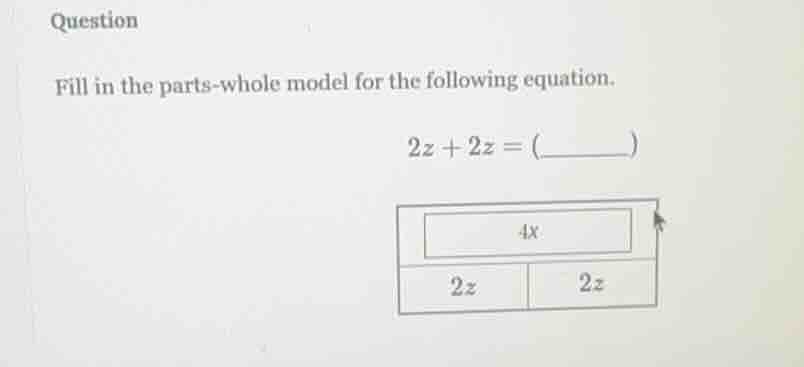
fill in the parts - whole model for the following equation.
$2z + 2z = (\underline{quadquad})$
(there is a diagram with a rectangle divided into three parts: the top part is labeled $4x$, the bottom part is divided into two equal rectangles labeled $2z$ and $2z$ respectively.)
Step1: Combine like terms
We have the expression \(2z + 2z\). Since both terms have the same variable \(z\) with coefficient 2, we can add the coefficients. The formula for combining like terms \(az + bz=(a + b)z\), here \(a = 2\) and \(b = 2\). So \(2+2 = 4\), then \(2z+2z = 4z\).
Step2: Verify with the model
Looking at the parts - whole model, the two parts are \(2z\) and \(2z\), and when we combine them (find the whole), we should get the sum of these two parts. From the calculation above, the sum of \(2z\) and \(2z\) is \(4z\).

Snap & solve any problem in the app
Get step-by-step solutions on Sovi AI
Photo-based solutions with guided steps
Explore more problems and detailed explanations
\(4z\)