QUESTION IMAGE
Question
question
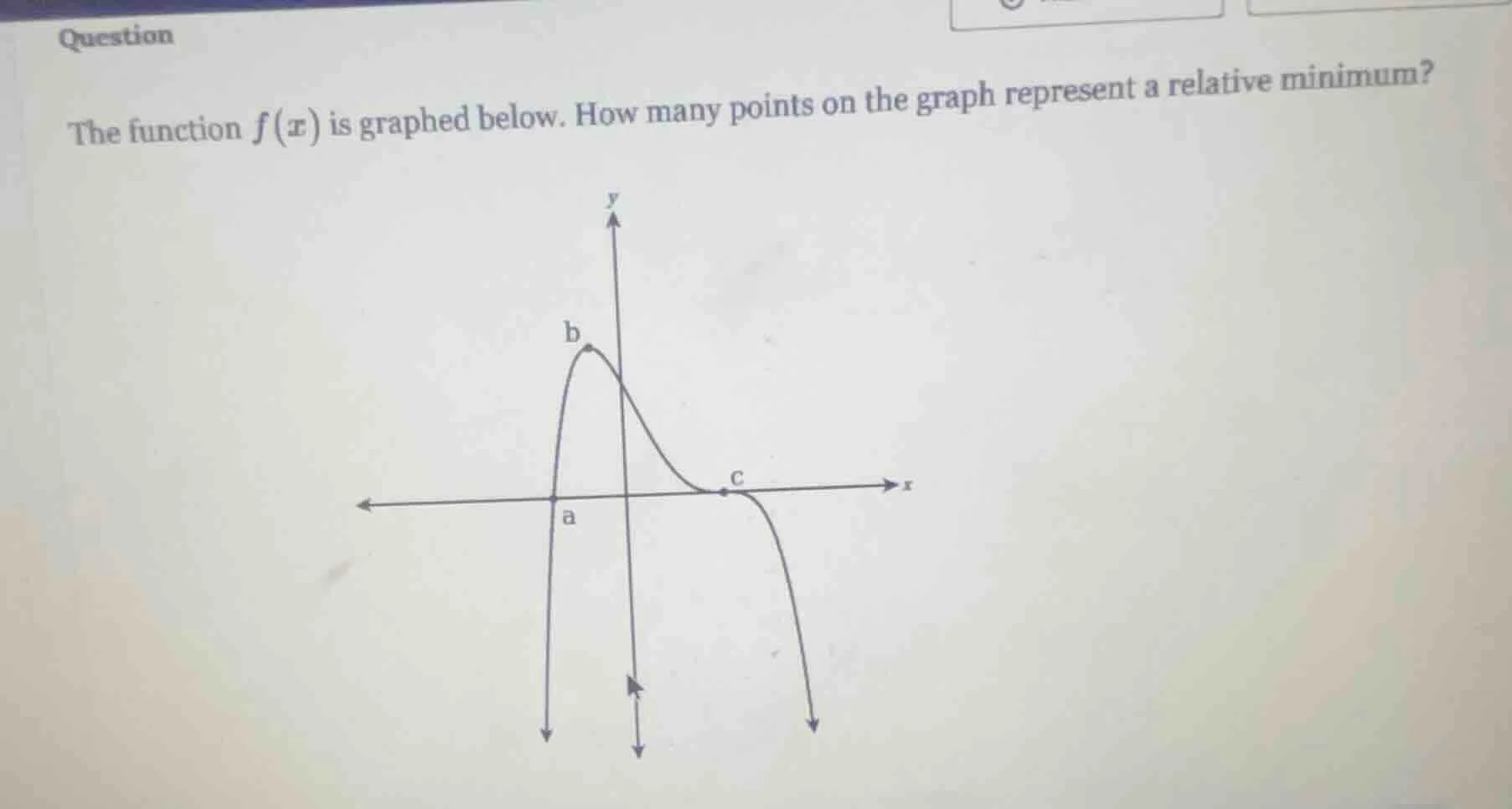
the function $f(x)$ is graphed below. how many points on the graph represent a relative minimum?
Step1: Recall relative minimum definition
A relative minimum is a point where the function changes from decreasing to increasing (or is lower than its immediate neighbors).
Step2: Analyze each point
- Point a: The function comes from below (downward) and goes upward after a? No, looking at the graph, left of a the function is going down, right of a it goes up to b? Wait, no, let's see the graph. The graph at a: left side (x < a) the function is going down (since the left end is going down), at a, then it goes up to b. Wait, no, actually, let's check the behavior around each point.
- Point b: It's a peak (relative maximum), since the function increases before b and decreases after b.
- Point c: The function before c: let's see, from b, the function decreases, then at c, what's the behavior? After c, the function decreases further? Wait, no, the graph at c: before c, the function is decreasing (from b to c, it's decreasing), and after c, it's decreasing more? Wait, no, maybe I misread. Wait, the graph: from the left, comes up to a, then up to b (a peak), then down, then at c, it's a point where before c, the function is decreasing, and after c, is it decreasing or increasing? Wait, the graph after c goes down, so c: before c, the function is decreasing (from b to c: decreasing), after c: decreasing. So c is not a minimum. Wait, maybe I made a mistake. Wait, the key is: a relative minimum is a point where \( f(x) \) is less than \( f(x + h) \) and \( f(x - h) \) for small \( h > 0 \).
Wait, let's re-express:
- Point a: Let's check the neighborhood. Left of a: the function is going down (so \( f(x) \) for \( x < a \) is less than \( f(a) \)? No, wait, if the function comes from the bottom (left side, going up to a? Wait, the left end of the graph: the leftmost part is going down (since the arrow is down), so as x approaches a from the left, the function is increasing (because from very left, it's going down, then at a, it starts going up? Wait, no, the graph: the left part (x very small) is going down (arrow down), then at a, it's a root (crosses x-axis), then goes up to b (a peak), then down, then at c, it's a point on x-axis, then down. Wait, maybe the only point is a? Wait, no, let's think again.
Wait, the definition: a relative minimum occurs where the function changes from decreasing to increasing. So the slope changes from negative to positive.
- Point a: Left of a: the function's slope (derivative) is positive? Wait, no, if the function is coming from below (left side, going up to a), then left of a, the function is increasing (slope positive), at a, then after a, it continues increasing to b? Wait, maybe I misread the graph. Let's look again: the graph has a at x-axis, then goes up to b (a peak), then down, then at c (on x-axis), then down. Wait, maybe the left side: the function comes from the bottom (left, going up), hits a (x-axis), then goes up to b (peak), then down, then at c (x-axis), then down. So:
- Point a: Before a (x < a), the function is increasing (since it comes from below, goes up to a), after a (x > a), it continues increasing to b. So a is not a minimum (since it's increasing on both sides? No, wait, if before a, it's increasing (from left, coming up to a), and after a, increasing to b, then a is a point where the function is increasing on both sides? No, that can't be. Wait, maybe the left side is decreasing. Wait, the arrow on the left is down, so as x approaches \( -\infty \), the function goes to \( -\infty \), then comes up to a (x-axis), so left of a, the function is increasing (since it goes f…

Snap & solve any problem in the app
Get step-by-step solutions on Sovi AI
Photo-based solutions with guided steps
Explore more problems and detailed explanations
1