QUESTION IMAGE
Question
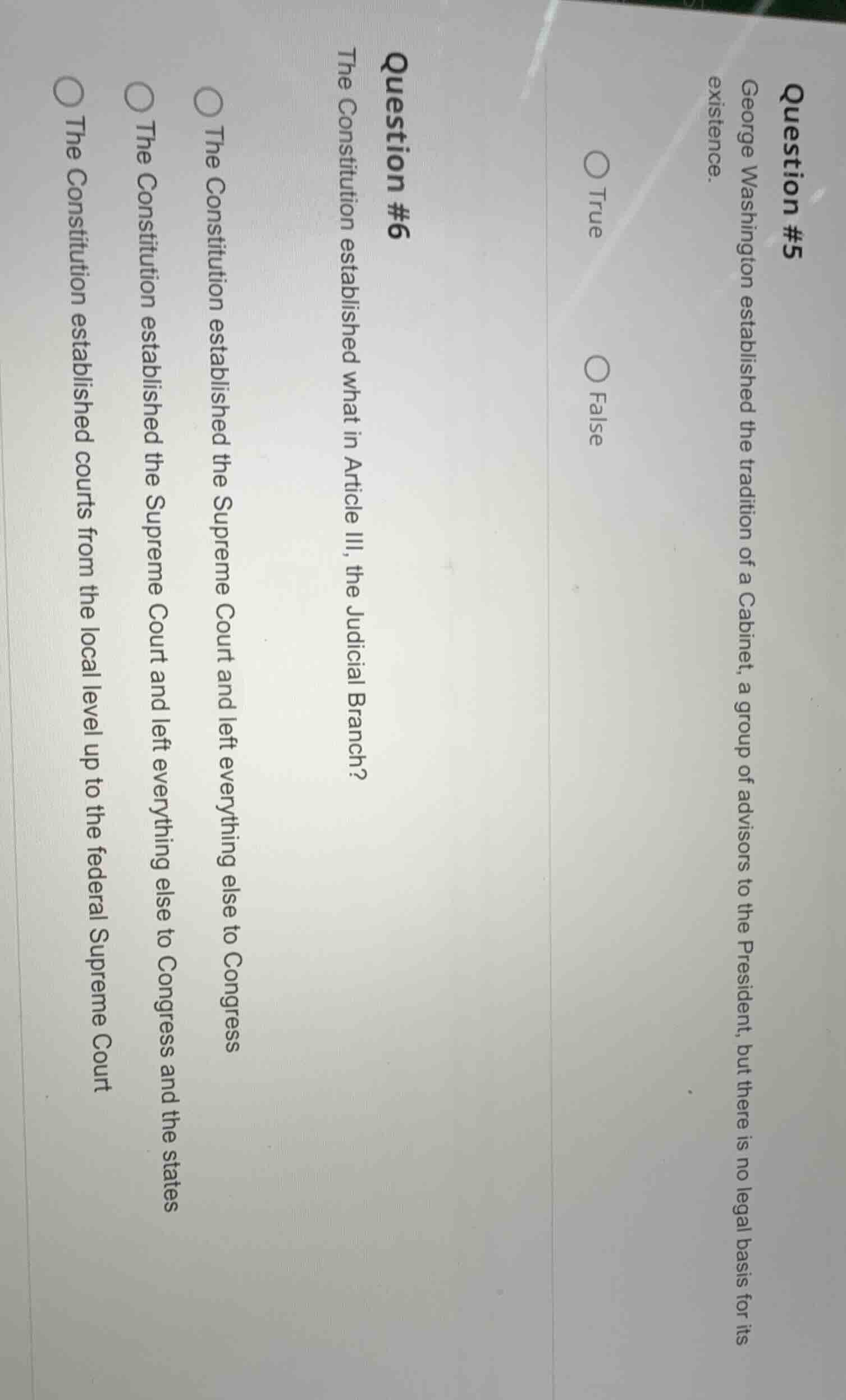
question #5
george washington established the tradition of a cabinet, a group of advisors to the president, but there is no legal basis for its
existence.
true
false
question #6
the constitution established what in article iii, the judicial branch?
the constitution established the supreme court and left everything else to congress
the constitution established the supreme court and left everything else to congress and the states
the constitution established courts from the local level up to the federal supreme court
Question #5
George Washington established the Cabinet tradition, and while there's no legal basis (Constitution doesn't mandate it), the statement about its existence's legal basis being absent is correct? Wait, no—wait, the question is "George Washington established the tradition of a Cabinet... but there is no legal basis for its existence." Is this true? The Cabinet isn't established by the Constitution; Washington started it, and it's a tradition. So the statement is True? Wait, no, the options are True or False. Wait, the statement: "George Washington established the tradition of a Cabinet, a group of advisors to the President, but there is no legal basis for its existence." Is this true? The Constitution doesn't create the Cabinet; it's a tradition from Washington. So the statement is correct, so True? Wait, no, maybe I misread. Wait, the question is whether the statement is True or False. Let's confirm: The Cabinet is not mentioned in the Constitution. Washington created the tradition. So the statement "George Washington established the tradition... but there is no legal basis for its existence" is True.
Article III of the US Constitution establishes the Supreme Court and leaves the creation of lower federal courts (and state courts) to Congress and the states? Wait, the options: Let's recall Article III. Article III establishes the Supreme Court and gives Congress the power to create inferior (lower) federal courts. Also, state courts are established by states. So the correct option is "The Constitution established the Supreme Court and left everything else to Congress and the states"? Wait, the options:
- The Constitution established the Supreme Court and left everything else to Congress
- The Constitution established the Supreme Court and left everything else to Congress and the states
- The Constitution established courts from the local level up to the federal Supreme Court
Article III: "The judicial Power of the United States, shall be vested in one supreme Court, and in such inferior Courts as the Congress may from time to time ordain and establish." Also, state courts are under state authority. So the Constitution only established the Supreme Court, and Congress can create inferior federal courts, states create their own. So the second option: "The Constitution established the Supreme Court and left everything else to Congress and the states" is correct? Wait, the options:
First option: "left everything else to Congress" – no, because states have their own courts. Second option: "left everything else to Congress and the states" – yes, because Congress can create inferior federal courts, states create state courts. Third option: "established courts from local to federal" – no, the Constitution only established the Supreme Court; local courts are state or local, not established by Constitution. So the correct option is the second one: "The Constitution established the Supreme Court and left everything else to Congress and the states"

Snap & solve any problem in the app
Get step-by-step solutions on Sovi AI
Photo-based solutions with guided steps
Explore more problems and detailed explanations
True