QUESTION IMAGE
Question
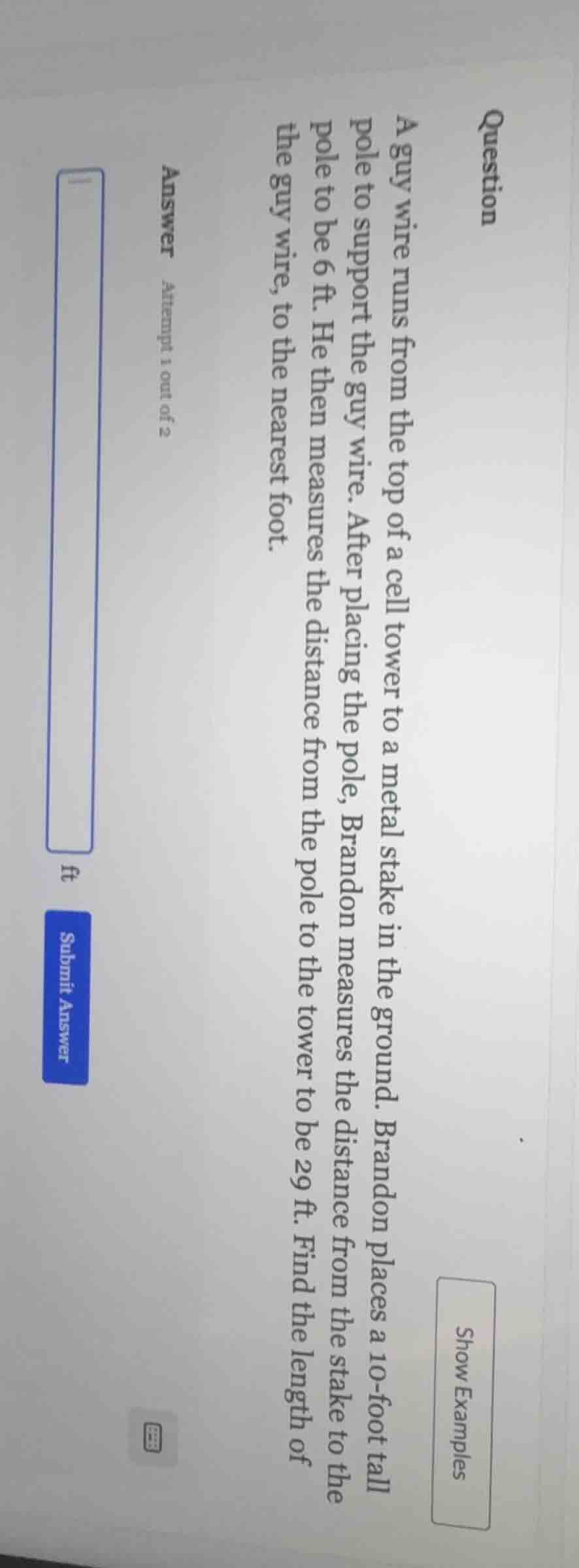
question a guy wire runs from the top of a cell tower to a metal stake in the ground. brandon places a 10 - foot tall pole to support the guy wire. after placing the pole, brandon measures the distance from the stake to the pole to be 6 ft. he then measures the distance from the pole to the tower to be 29 ft. find the length of the guy wire, to the nearest foot. answer attempt 1 out of 2 ft submit answer show examples
Step1: Identify similar triangles
The triangle formed by the cell tower, the ground from the tower to the stake, and the guy wire is similar to the triangle formed by the pole, the ground from the pole to the stake, and the segment of the guy wire above the pole. Let the length of the guy wire be \( L \), the height of the tower be \( H \) (we can find \( H \) using similar triangles), the height of the pole is \( h = 10\) ft, the distance from the stake to the pole is \( d_1 = 6\) ft, and the distance from the pole to the tower is \( d_2 = 29\) ft. So the total distance from the stake to the tower is \( D=d_1 + d_2=6 + 29=35\) ft. By similar triangles, \(\frac{H}{D}=\frac{h}{d_1}\), so \( H=\frac{h\times D}{d_1}=\frac{10\times35}{6}=\frac{350}{6}=\frac{175}{3}\) ft. But actually, we can also use the Pythagorean theorem directly if we consider the two right triangles. Wait, maybe a better way: The ratio of the height of the pole to the distance from stake to pole should be equal to the ratio of the height of the tower to the distance from stake to tower. Wait, no, the guy wire is the hypotenuse. Let's denote the length of the guy wire as \( x \). The triangle with the pole: height 10, base 6, so the hypotenuse (part of the guy wire above the pole? No, wait, the guy wire is from the top of the tower to the stake. The pole is just a similar triangle. So the two triangles are similar: one with height 10, base 6, and the other with height \( H \), base 35 (6 + 29). So \( \frac{10}{6}=\frac{H}{35} \), so \( H=\frac{10\times35}{6}=\frac{350}{6}\approx58.33\) ft. Then, the length of the guy wire is the hypotenuse of the triangle with legs \( H \) and 35. Wait, but that seems complicated. Wait, maybe the problem is that the pole is used to find the angle, but actually, the two triangles (pole - stake - top of pole) and (tower - stake - top of tower) are similar right triangles. So the ratio of height to base is the same. So for the pole: height = 10, base = 6. For the tower: base = 6+29 = 35, height = let's say \( h \). So \( \frac{10}{6}=\frac{h}{35} \), so \( h=\frac{10\times35}{6}=\frac{350}{6}\approx58.33 \). Then the length of the guy wire is \( \sqrt{h^2 + 35^2} \). But that seems messy. Wait, maybe I made a mistake. Wait, the problem is probably that the two triangles are similar, so the ratio of the height of the pole to the length of the guy wire segment above the pole is equal to the ratio of the height of the tower to the length of the guy wire. No, maybe the problem is simpler: the triangle formed by the pole is a right triangle with legs 10 and 6, so the hypotenuse (the part of the guy wire from the stake to the top of the pole) is \( \sqrt{10^2+6^2}=\sqrt{100 + 36}=\sqrt{136}\approx11.66 \) ft. Then, the other triangle (tower - stake - top of tower) has the same angle, so the ratio of the hypotenuse (guy wire) to the hypotenuse of the pole triangle is equal to the ratio of the base of the tower triangle to the base of the pole triangle. The base of the tower triangle is 6 + 29 = 35, base of pole triangle is 6. So \( \frac{x}{\sqrt{10^2 + 6^2}}=\frac{35}{6} \), so \( x=\frac{35\times\sqrt{136}}{6} \). Wait, but that's not right. Wait, no, the two triangles are similar, so all corresponding sides are in proportion. So the legs are in proportion, so the hypotenuses are also in proportion. So the ratio of the base of the big triangle (35) to the base of the small triangle (6) is \( \frac{35}{6} \). So the length of the guy wire (hypotenuse of big triangle) is \( \frac{35}{6} \) times the hypotenuse of the small triangle (pole -…

Snap & solve any problem in the app
Get step-by-step solutions on Sovi AI
Photo-based solutions with guided steps
Explore more problems and detailed explanations
68