QUESTION IMAGE
Question
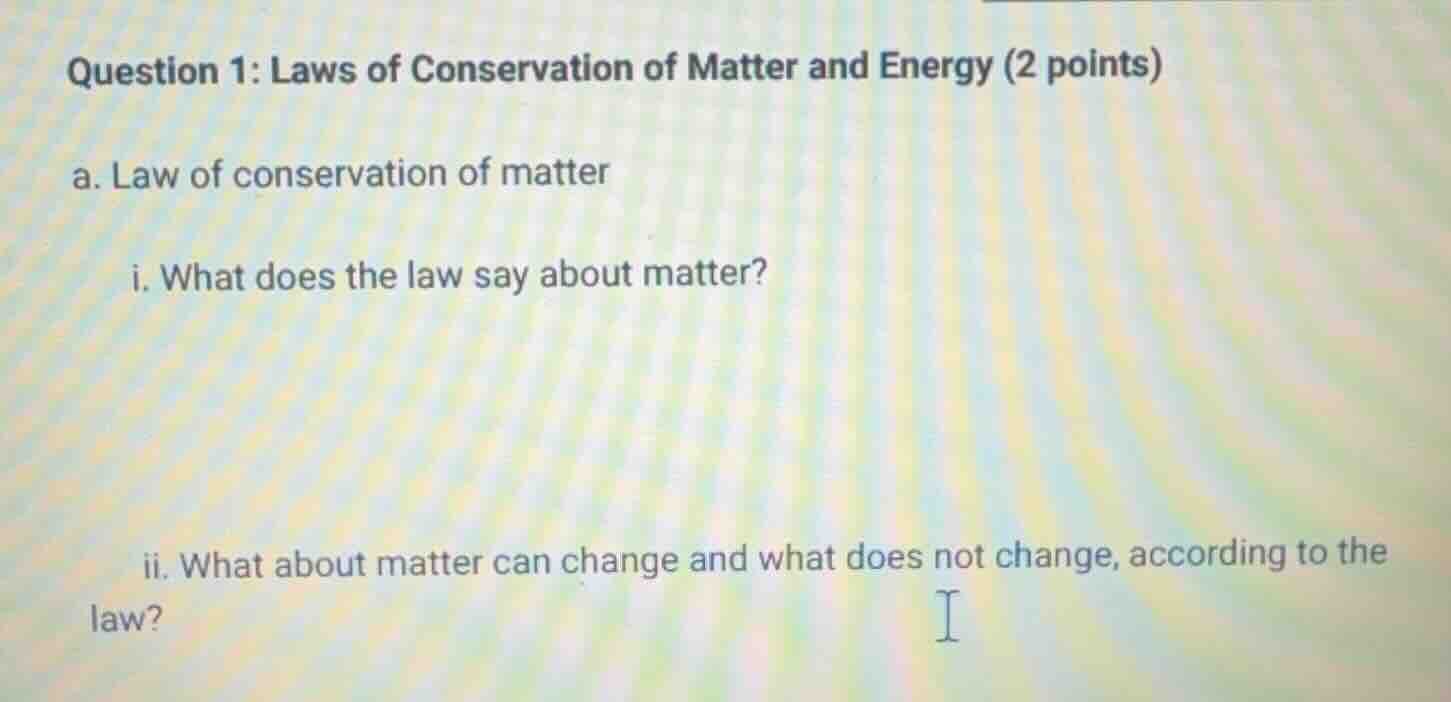
question 1: laws of conservation of matter and energy (2 points)
a. law of conservation of matter
i. what does the law say about matter?
ii. what about matter can change and what does not change, according to the law?
i.
The Law of Conservation of Matter (also known as the Law of Conservation of Mass) states that matter cannot be created or destroyed in an isolated system during a chemical reaction or physical change. In other words, the total amount of matter remains constant, even though it may change its form or undergo rearrangements at the atomic or molecular level.
According to the Law of Conservation of Matter:
- What does not change: The total mass (or amount) of matter in an isolated system remains constant. The number of atoms of each element also remains the same because atoms are neither created nor destroyed—they are just rearranged through chemical bonds or physical processes.
- What can change: The form or arrangement of matter can change. For example, in a chemical reaction, reactants (initial substances) can be transformed into products (new substances) with different chemical properties and physical states (like solid, liquid, gas). In a physical change, like melting ice to water or evaporating water to steam, the substance changes its state but remains the same chemically, and its form (or phase) is altered.

Snap & solve any problem in the app
Get step-by-step solutions on Sovi AI
Photo-based solutions with guided steps
Explore more problems and detailed explanations
The Law of Conservation of Matter states that matter cannot be created or destroyed in an isolated system during a chemical reaction or physical change. The total amount of matter remains constant.