QUESTION IMAGE
Question
question 2
lesson 5-15 practice (im g7)
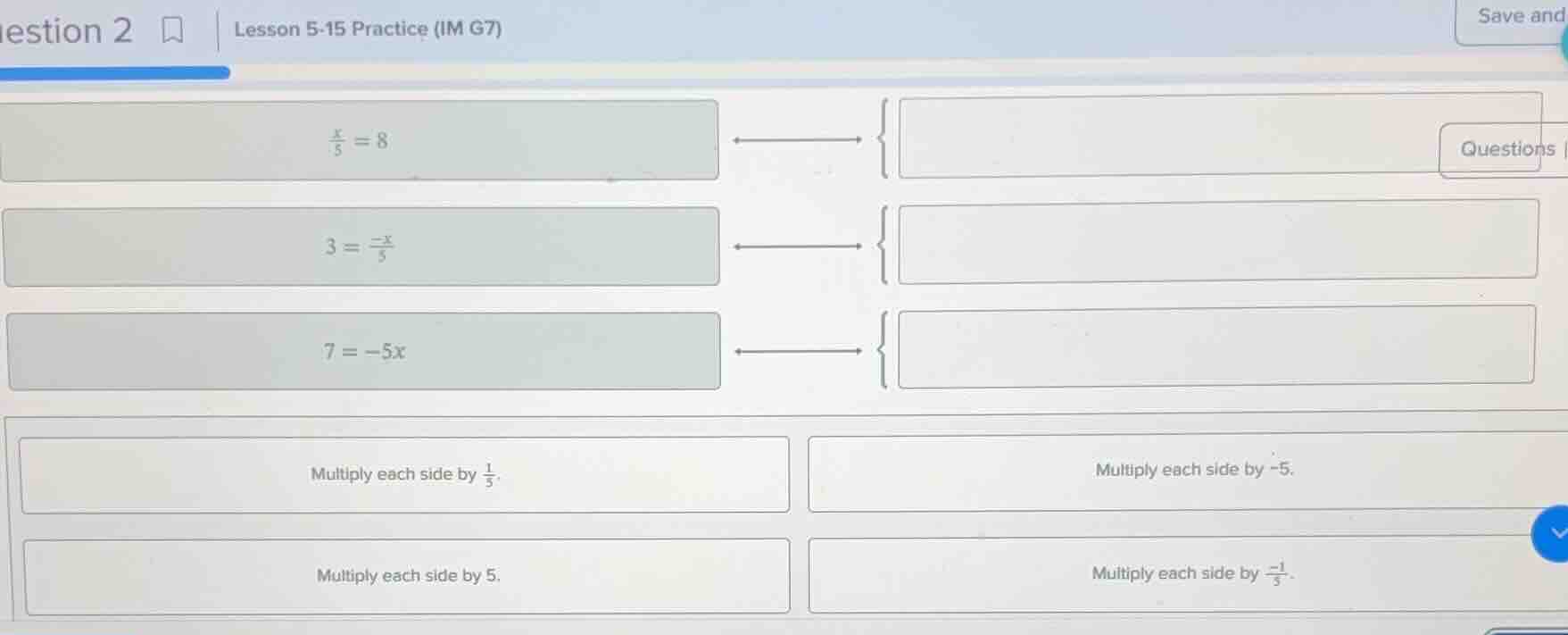
\\(\frac{x}{5} = 8\\)
\\(3 = \frac{-x}{5}\\)
\\(7 = -5x\\)
multiply each side by \\(\frac{1}{5}\\).
multiply each side by -5.
multiply each side by 5.
multiply each side by \\(\frac{-1}{5}\\).
for $\boldsymbol{\frac{x}{5} = 8}$:
Step1: Isolate \( x \)
To solve for \( x \) in the equation \( \frac{x}{5} = 8 \), we need to eliminate the denominator of 5. We can do this by multiplying both sides of the equation by 5.
$$\frac{x}{5} \times 5 = 8 \times 5$$
Step2: Simplify
Simplifying both sides, the 5 in the numerator and denominator on the left side cancels out, leaving us with \( x \), and on the right side, \( 8 \times 5 = 40 \). So \( x = 40 \). The operation used is "Multiply each side by 5."
for $\boldsymbol{3 = \frac{-x}{5}}$:
Step1: Isolate \( x \)
To solve for \( x \) in the equation \( 3 = \frac{-x}{5} \), we first multiply both sides by 5 to get rid of the denominator.
$$3 \times 5 = \frac{-x}{5} \times 5$$
Step2: Simplify and solve for \( x \)
Simplifying, we get \( 15 = -x \). Then, to solve for \( x \), we multiply both sides by -1 (or we can think of it as multiplying each side by \( \frac{-1}{1} \), but another way is to multiply each side by -5? Wait, no. Wait, original equation: \( 3 = \frac{-x}{5} \). Let's do it correctly. Multiply both sides by 5: \( 15 = -x \). Then multiply both sides by -1: \( x = -15 \). But the operation to solve the equation (isolate \( x \)): first multiply by 5, but looking at the options, one of the options is "Multiply each side by \( \frac{-1}{5} \)"? Wait, no, let's re - examine. The equation is \( 3=\frac{-x}{5} \), which can be rewritten as \( \frac{-x}{5}=3 \). To solve for \( x \), we can multiply both sides by - 5? Wait, no, \( \frac{-x}{5}=3 \), multiply both sides by 5: \( -x = 15 \), then multiply by - 1: \( x=-15 \). But the operation to solve the equation (the step to isolate \( x \)): if we consider the operation to get from \( 3=\frac{-x}{5} \) to solving for \( x \), we can multiply each side by - 5? Wait, no, let's use the options given. The options are "Multiply each side by \( \frac{1}{5} \)", "Multiply each side by - 5", "Multiply each side by 5", "Multiply each side by \( \frac{-1}{5} \)". Let's do the algebra:
Starting with \( 3=\frac{-x}{5} \), multiply both sides by 5: \( 15=-x \), then multiply both sides by - 1: \( x = - 15 \). But the operation to solve the equation (the step that directly helps in isolating \( x \)): the equation \( 3=\frac{-x}{5} \) can be solved by multiplying each side by - 5? Wait, no, \( \frac{-x}{5}=3 \), multiply both sides by - 5: \( x=-15 \). Yes, that works. So \( \frac{-x}{5}\times(-5)=3\times(-5)\), which gives \( x = - 15 \). So the operation is "Multiply each side by - 5"? Wait, no, let's check the options again. The options are: "Multiply each side by \( \frac{1}{5} \)", "Multiply each side by - 5", "Multiply each side by 5", "Multiply each side by \( \frac{-1}{5} \)". Let's take the equation \( 3=\frac{-x}{5} \), and multiply each side by - 5: \( 3\times(-5)=\frac{-x}{5}\times(-5) \), which simplifies to \( - 15=x \), so \( x=-15 \). So the operation is "Multiply each side by - 5".
for $\boldsymbol{7=-5x}$:
Step1: Isolate \( x \)
To solve for \( x \) in the equation \( 7=-5x \), we need to divide both sides by - 5 (or multiply both sides by \( \frac{1}{-5} \)).
$$\frac{7}{-5}=\frac{-5x}{-5}$$
Step2: Simplify
Simplifying, we get \( x =-\frac{7}{5} \). The operation used is "Multiply each side by \( \frac{1}{-5} \)" (which is the same as dividing by - 5, and is equivalent to "Multiply each side by \( \frac{1}{-5} \)" or "Multiply each side by - \(\frac{1}{5}\)"). But looking at the options, one of the options is "Multiply each side by \( \frac{1}{-5} \)" (or "Multiply each side by - \(\frac{1}{5}\)") and another is "Multiply each side by - 5". Wait, let's do it with the multiplication property. The equation is \( 7=-5x \), multiply both sides by \( \frac{1}{-5} \): \( 7\times\frac{1}{-5}=-5x\times\frac{1}{-5} \), which simplifies to \( x =-\frac{7}{5} \). So the operation is "Multiply each side by \( \frac{1}{-5} \)" (or "Multiply each side by - \(\frac{1}{5}\)"). But looking at the options given in the problem (the ones at the bottom: "Multiply each side by \( \frac{1}{5} \)", "Multiply each side by - 5", "Multiply each side by 5", "Multiply each side by \( \frac{-1}{5} \)"), "Multiply each side by \( \frac{-1}{5} \)" is the same as multiplying by - \(\frac{1}{5}\), which is what we need.

Snap & solve any problem in the app
Get step-by-step solutions on Sovi AI
Photo-based solutions with guided steps
Explore more problems and detailed explanations
s:
- For \( \frac{x}{5}=8 \): Multiply each side by 5.
- For \( 3 = \frac{-x}{5} \): Multiply each side by - 5.
- For \( 7=-5x \): Multiply each side by \( \frac{-1}{5} \).
(If we were to present the matching:
\( \frac{x}{5}=8 \) matches with "Multiply each side by 5".
\( 3=\frac{-x}{5} \) matches with "Multiply each side by - 5" (because \( 3\times(-5)=\frac{-x}{5}\times(-5)\Rightarrow - 15 = x\Rightarrow x=-15 \)).
\( 7 = - 5x \) matches with "Multiply each side by \( \frac{-1}{5} \)" (because \( 7\times\frac{-1}{5}=-5x\times\frac{-1}{5}\Rightarrow x =-\frac{7}{5} \)).)