QUESTION IMAGE
Question
question 6
lesson 5-4 practice (im g7)
diagram a
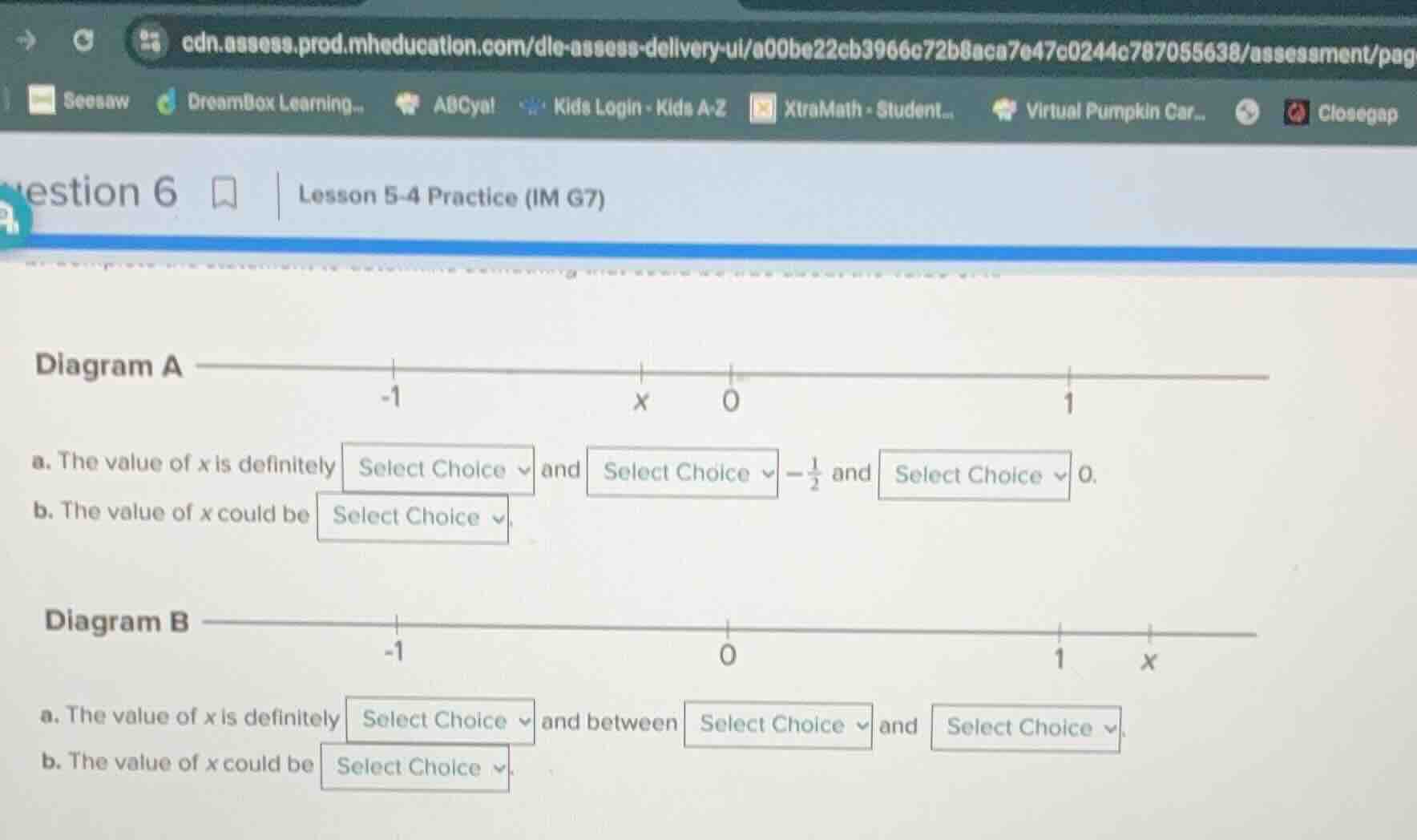
-1 x 0 1
a. the value of x is definitely select choice and select choice $-\frac{1}{2}$ and select choice 0.
b. the value of x could be select choice.
diagram b
-1 0 1 x
a. the value of x is definitely select choice and between select choice and select choice.
b. the value of x could be select choice.
To solve this problem, we analyze the number lines (Diagrams A and B) to determine the position of \( x \) relative to other numbers (like \(-1\), \( 0 \), \( 1 \), and \(-\frac{1}{2}\)).
Diagram A
The number line has marks at \(-1\), \( x \), \( 0 \), and \( 1 \).
- \( x \) lies between \(-1\) and \( 0 \) (since \(-1 < x < 0\)).
- The distance from \( x \) to \( 0 \) is less than the distance from \( x \) to \(-1\) (visually, \( x \) is closer to \( 0 \) than to \(-1\)). Thus, \( x \) is greater than \(-\frac{1}{2}\) (because \(-\frac{1}{2}\) is the midpoint of \(-1\) and \( 0 \), and \( x \) is closer to \( 0 \)).
Part (a)
The value of \( x \) is definitely:
- Between \(-1\) and \( 0 \) (since \( x \) is to the right of \(-1\) and left of \( 0 \)).
- Greater than \(-\frac{1}{2}\) (since \( x \) is closer to \( 0 \) than to \(-1\), so \( x > -\frac{1}{2} \)).
- Less than \( 0 \) (since \( x \) is to the left of \( 0 \)).
Part (b)
A possible value for \( x \) (between \(-\frac{1}{2}\) and \( 0 \)) is \(-\frac{1}{4}\) (or any number like \(-\frac{1}{3}\), \(-0.2\), etc.).
Diagram B
The number line has marks at \(-1\), \( 0 \), \( 1 \), and \( x \).
- \( x \) lies to the right of \( 1 \) (since \( x > 1 \)).
Part (a)
The value of \( x \) is definitely:
- Greater than \( 1 \) (since \( x \) is to the right of \( 1 \)).
- Between \( 1 \) and \( 2 \) (assuming the spacing between \( 1 \) and \( x \) is similar to the spacing between \(-1\) and \( 0 \), or \( 0 \) and \( 1 \); visually, \( x \) is near \( 1 \) but to the right).
Part (b)
A possible value for \( x \) (greater than \( 1 \)) is \( \frac{3}{2} \) (or \( 1.5 \), \( 2 \), etc.).
Final Answers (Example Choices)
Diagram A
a. Between \(-1\) and \( 0 \); Greater than \(-\frac{1}{2}\); Less than \( 0 \).
b. \( -\frac{1}{4} \) (or any number between \(-\frac{1}{2}\) and \( 0 \)).
Diagram B
a. Greater than \( 1 \); Between \( 1 \) and \( 2 \); (and another bound, e.g., less than \( 2 \) if \( x \) is near \( 1 \)).
b. \( \frac{3}{2} \) (or any number greater than \( 1 \)).
(Note: The “Select Choice” dropdowns likely contain options like “between \(-1\) and \( 0 \)”, “greater than \(-\frac{1}{2}\)”, “less than \( 0 \)” for Diagram A, and “greater than \( 1 \)”, “between \( 1 \) and \( 2 \)” for Diagram B. Choose the options that match the analysis above.)

Snap & solve any problem in the app
Get step-by-step solutions on Sovi AI
Photo-based solutions with guided steps
Explore more problems and detailed explanations
To solve this problem, we analyze the number lines (Diagrams A and B) to determine the position of \( x \) relative to other numbers (like \(-1\), \( 0 \), \( 1 \), and \(-\frac{1}{2}\)).
Diagram A
The number line has marks at \(-1\), \( x \), \( 0 \), and \( 1 \).
- \( x \) lies between \(-1\) and \( 0 \) (since \(-1 < x < 0\)).
- The distance from \( x \) to \( 0 \) is less than the distance from \( x \) to \(-1\) (visually, \( x \) is closer to \( 0 \) than to \(-1\)). Thus, \( x \) is greater than \(-\frac{1}{2}\) (because \(-\frac{1}{2}\) is the midpoint of \(-1\) and \( 0 \), and \( x \) is closer to \( 0 \)).
Part (a)
The value of \( x \) is definitely:
- Between \(-1\) and \( 0 \) (since \( x \) is to the right of \(-1\) and left of \( 0 \)).
- Greater than \(-\frac{1}{2}\) (since \( x \) is closer to \( 0 \) than to \(-1\), so \( x > -\frac{1}{2} \)).
- Less than \( 0 \) (since \( x \) is to the left of \( 0 \)).
Part (b)
A possible value for \( x \) (between \(-\frac{1}{2}\) and \( 0 \)) is \(-\frac{1}{4}\) (or any number like \(-\frac{1}{3}\), \(-0.2\), etc.).
Diagram B
The number line has marks at \(-1\), \( 0 \), \( 1 \), and \( x \).
- \( x \) lies to the right of \( 1 \) (since \( x > 1 \)).
Part (a)
The value of \( x \) is definitely:
- Greater than \( 1 \) (since \( x \) is to the right of \( 1 \)).
- Between \( 1 \) and \( 2 \) (assuming the spacing between \( 1 \) and \( x \) is similar to the spacing between \(-1\) and \( 0 \), or \( 0 \) and \( 1 \); visually, \( x \) is near \( 1 \) but to the right).
Part (b)
A possible value for \( x \) (greater than \( 1 \)) is \( \frac{3}{2} \) (or \( 1.5 \), \( 2 \), etc.).
Final Answers (Example Choices)
Diagram A
a. Between \(-1\) and \( 0 \); Greater than \(-\frac{1}{2}\); Less than \( 0 \).
b. \( -\frac{1}{4} \) (or any number between \(-\frac{1}{2}\) and \( 0 \)).
Diagram B
a. Greater than \( 1 \); Between \( 1 \) and \( 2 \); (and another bound, e.g., less than \( 2 \) if \( x \) is near \( 1 \)).
b. \( \frac{3}{2} \) (or any number greater than \( 1 \)).
(Note: The “Select Choice” dropdowns likely contain options like “between \(-1\) and \( 0 \)”, “greater than \(-\frac{1}{2}\)”, “less than \( 0 \)” for Diagram A, and “greater than \( 1 \)”, “between \( 1 \) and \( 2 \)” for Diagram B. Choose the options that match the analysis above.)