QUESTION IMAGE
Question
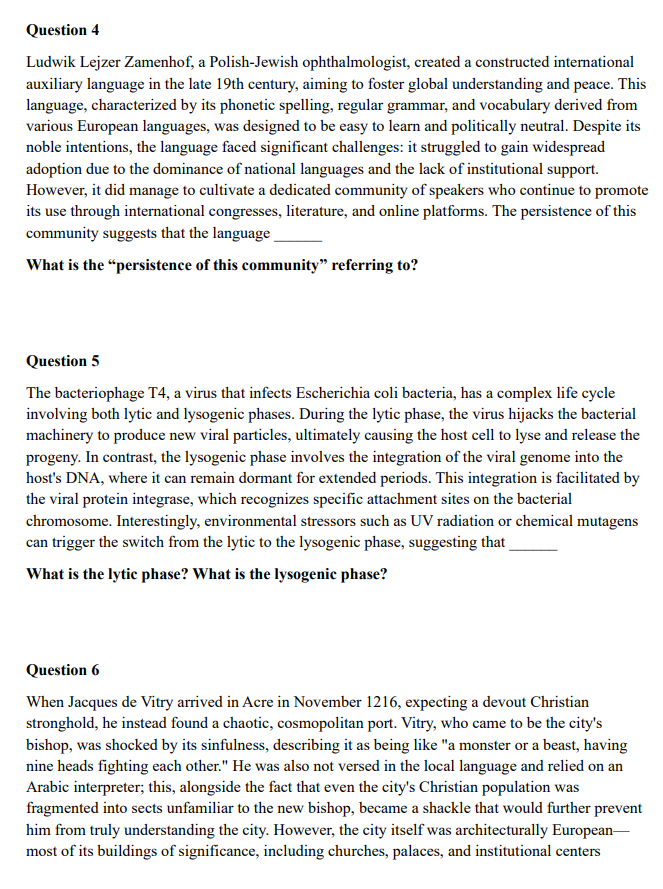
question 4
ludwik lejzer zamenhof, a polish - jewish ophthalmologist, created a constructed international auxiliary language in the late 19th century, aiming to foster global understanding and peace. this language, characterized by its phonetic spelling, regular grammar, and vocabulary derived from various european languages, was designed to be easy to learn and politically neutral. despite its noble intentions, the language faced significant challenges: it struggled to gain widespread adoption due to the dominance of national languages and the lack of institutional support. however, it did manage to cultivate a dedicated community of speakers who continue to promote its use through international congresses, literature, and online platforms. the persistence of this community suggests that the language ______
what is the \persistence of this community\ referring to?
question 5
the bacteriophage t4, a virus that infects escherichia coli bacteria, has a complex life cycle involving both lytic and lysogenic phases. during the lytic phase, the virus hijacks the bacterial machinery to produce new viral particles, ultimately causing the host cell to lyse and release the progeny. in contrast, the lysogenic phase involves the integration of the viral genome into the hosts dna, where it can remain dormant for extended periods. this integration is facilitated by the viral protein, which recognizes specific attachment sites on the bacterial chromosome. interestingly, environmental stressors such as uv radiation or chemical mutagens can trigger the switch from the lytic to the lysogenic phase, suggesting that ______
what is the lytic phase? what is the lysogenic phase?
question 6
when jacques de vitry arrived in acre in november 1216, expecting a devout christian stronghold, he instead found a chaotic, cosmopolitan port. vitry, who came to be the citys bishop, was shocked by its sinfulness, describing it as being like \a monster or a beast, having nine heads fighting each other.\ he was also not versed in the local language and relied on an arabic interpreter; this, alongside the fact that even the citys christian population was fragmented into sects unfamiliar to the new bishop, became a shackle that would further prevent him from truly understanding the city. however, the city itself was architecturally european—most of its buildings of significance, including churches, palaces, and institutional centers
Question 4
To determine what "the persistence of this community" refers to, we analyze the context. The text says the language (created by Zamenhof) faced challenges but cultivated a dedicated community of speakers who continue to promote its use through various means. So the persistence of this community refers to the continued existence and efforts of the dedicated group of speakers who promote the use of the constructed international auxiliary language (likely Esperanto, though not named) despite the challenges it faced in gaining widespread adoption.
- For the lytic phase: From the text, during the lytic phase, the bacteriophage T4 hijacks the bacterial machinery to produce new viral particles, and this ultimately causes the host (Escherichia coli) cell to lyse (break open) and release the progeny (new viral particles).
- For the lysogenic phase: The text states that in the lysogenic phase, the viral genome integrates into the host's (bacterial) DNA. The viral genome can remain dormant (inactive) for extended periods in this integrated state, and this integration is facilitated by a viral protein (integrase) that recognizes specific attachment sites on the bacterial chromosome.
The description of Acre when Jacques de Vitry arrived in 1216 reveals a city that was cosmopolitan and chaotic, not the devout Christian stronghold he expected. It had a sinful reputation (described as a "monster or a beast" by Vitry), a fragmented Christian population into unfamiliar sects, a language barrier (Vitry needed an Arabic interpreter), yet architecturally had European - style significant buildings (churches, palaces, institutional centers). This shows a city with a complex social, religious, and architectural landscape, different from Vitry's expectations of a devout Christian stronghold.

Snap & solve any problem in the app
Get step-by-step solutions on Sovi AI
Photo-based solutions with guided steps
Explore more problems and detailed explanations
The persistence of this community refers to the continued existence and active efforts of the dedicated group of speakers of the constructed international auxiliary language (created by Ludwik Lejzer Zamenhof) who keep promoting its use through international congresses, literature, and online platforms, even though the language struggled to gain widespread adoption due to the dominance of national languages and lack of institutional support.