QUESTION IMAGE
Question
question 6
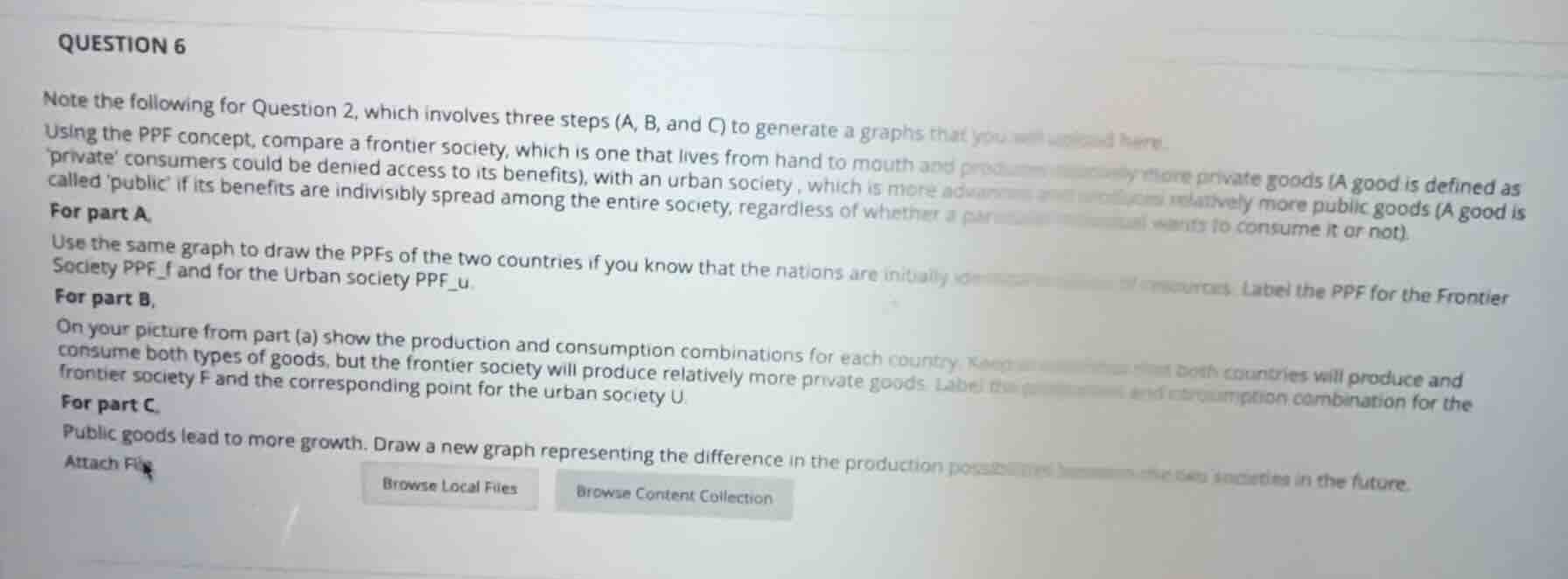
note the following for question 2, which involves three steps (a, b, and c) to generate a graphs that you will upload here.
using the ppf concept, compare a frontier society, which is one that lives from hand to mouth and produces relatively more private goods (a good is defined as private consumers could be denied access to its benefits), with an urban society, which is more advanced and produces relatively more public goods (a good is called public if its benefits are indivisibly spread among the entire society, regardless of whether a particular individual wants to consume it or not).
for part a,
use the same graph to draw the ppfs of the two countries if you know that the nations are initially identical in resources. label the ppf for the frontier society ppf_f and for the urban society ppf_u.
for part b,
on your picture from part (a) show the production and consumption combinations for each country. keep in mind that both countries will produce and consume both types of goods, but the frontier society will produce relatively more private goods. label the production and consumption combination for the frontier society f and the corresponding point for the urban society u.
for part c,
public goods lead to more growth. draw a new graph representing the difference in the production possibilities between the two societies in the future.
attach file
browse local files browse content collection
Part A:
- The Production Possibilities Frontier (PPF) graphs private goods on one axis and public goods on the other.
- Both societies start with identical resources, so their initial PPF curves share the same endpoints (maximum possible private goods production when no public goods are made, and vice versa).
- The frontier society (PPF_f) is skewed to prioritize private goods, so its curve is steeper on the public goods axis, showing a comparative advantage in private goods. The urban society (PPF_u) is skewed to prioritize public goods, so its curve is steeper on the private goods axis, showing a comparative advantage in public goods.
Part B:
- On the shared PPF graph from Part A, mark point F on PPF_f: this point is closer to the private goods axis, representing the frontier society's production/consumption bundle with more private goods than public goods.
- Mark point U on PPF_u: this point is closer to the public goods axis, representing the urban society's production/consumption bundle with more public goods than private goods. Both points lie on their respective PPF curves, meaning they are efficient production/consumption combinations.
Part C:
- Create a new PPF graph with private goods on one axis and public goods on the other.
- Draw the original PPF curves for both societies (PPF_f and PPF_u) as in Part A.
- Public goods drive long-term growth, so the urban society's new PPF (PPF_u2) shifts outward much more significantly than the frontier society's new PPF (PPF_f2). The urban society's PPF expands further because its focus on public goods (like infrastructure, education, healthcare) increases overall productive capacity more than the frontier society's focus on private goods.

Snap & solve any problem in the app
Get step-by-step solutions on Sovi AI
Photo-based solutions with guided steps
Explore more problems and detailed explanations
Part A:
A single graph with private goods on one axis and public goods on the other, featuring two intersecting PPF curves:
- PPF_f (Frontier Society): Skewed toward private goods, steeper on the public goods axis, sharing the same maximum private/public goods endpoints as PPF_u.
- PPF_u (Urban Society): Skewed toward public goods, steeper on the private goods axis, sharing the same maximum private/public goods endpoints as PPF_f.
Part B:
On the Part A graph:
- Point F (Frontier Society): Located on PPF_f, closer to the private goods axis, showing a bundle with more private goods than public goods.
- Point U (Urban Society): Located on PPF_u, closer to the public goods axis, showing a bundle with more public goods than private goods.
Part C:
A new graph with private goods on one axis and public goods on the other:
- Original curves: PPF_f and PPF_u as drawn in Part A.
- New curves:
- PPF_f2: A small outward shift of the original PPF_f.
- PPF_u2: A large outward shift of the original PPF_u, lying significantly further from the origin than PPF_f2, reflecting greater long-term growth from public goods investment.