QUESTION IMAGE
Question
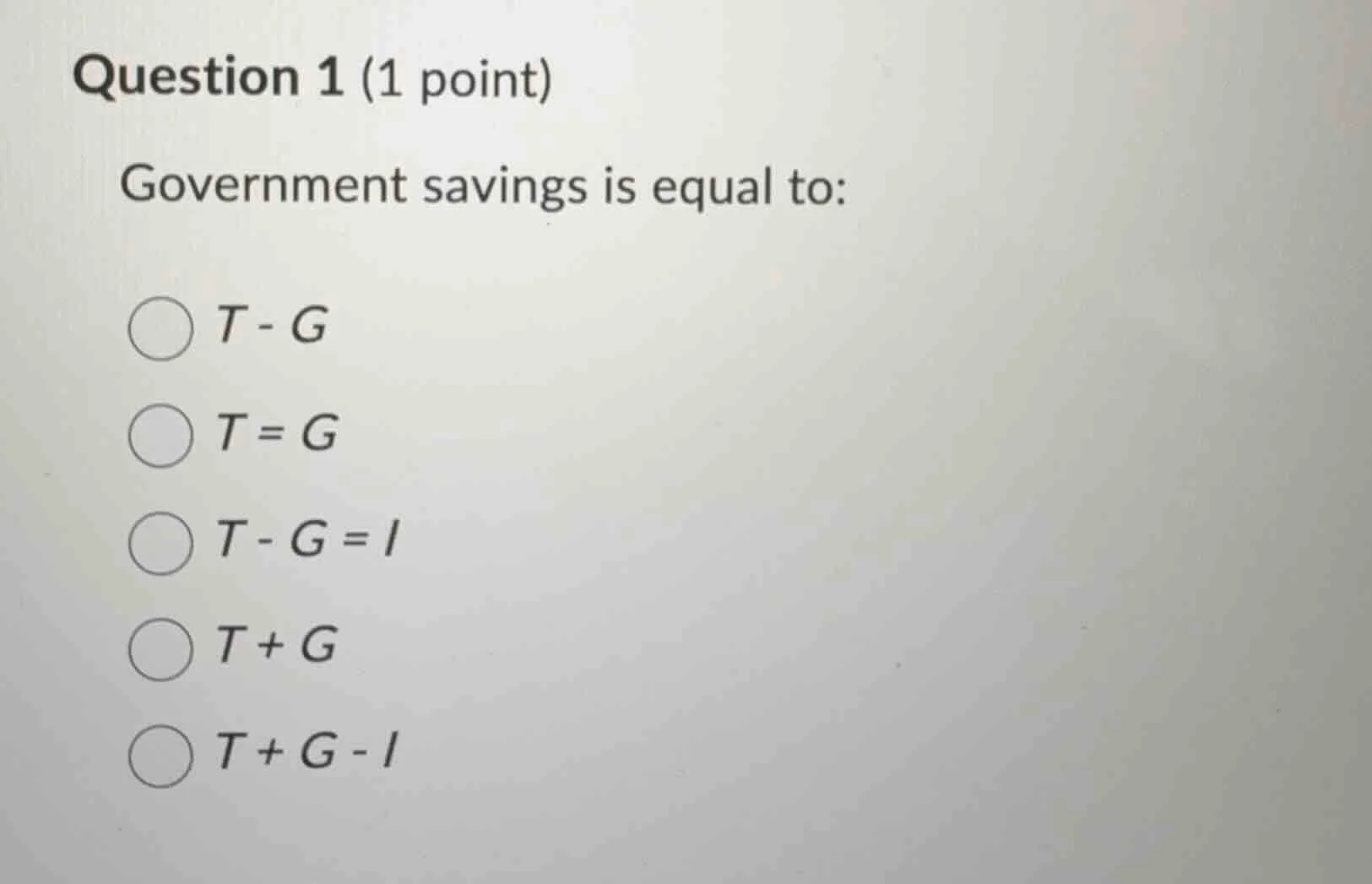
question 1 (1 point)
government savings is equal to:
○ $t - g$
○ $t = g$
○ $t - g = i$
○ $t + g$
○ $t + g - i$
Government savings (also called public savings) is defined as the difference between government tax revenue (\(T\)) and government spending (\(G\)). If \(T > G\), the government has a budget surplus (positive savings); if \(T < G\), it has a budget deficit (negative savings). The formula for government savings is \(T - G\). The other options are incorrect: \(T = G\) is a balanced budget (savings would be zero here, but it's not the formula for savings), \(T - G = I\) relates to investment in some macroeconomic identities but is not the definition of government savings, \(T + G\) and \(T + G - I\) do not represent government savings.

Snap & solve any problem in the app
Get step-by-step solutions on Sovi AI
Photo-based solutions with guided steps
Explore more problems and detailed explanations
A. \(T - G\)