QUESTION IMAGE
Question
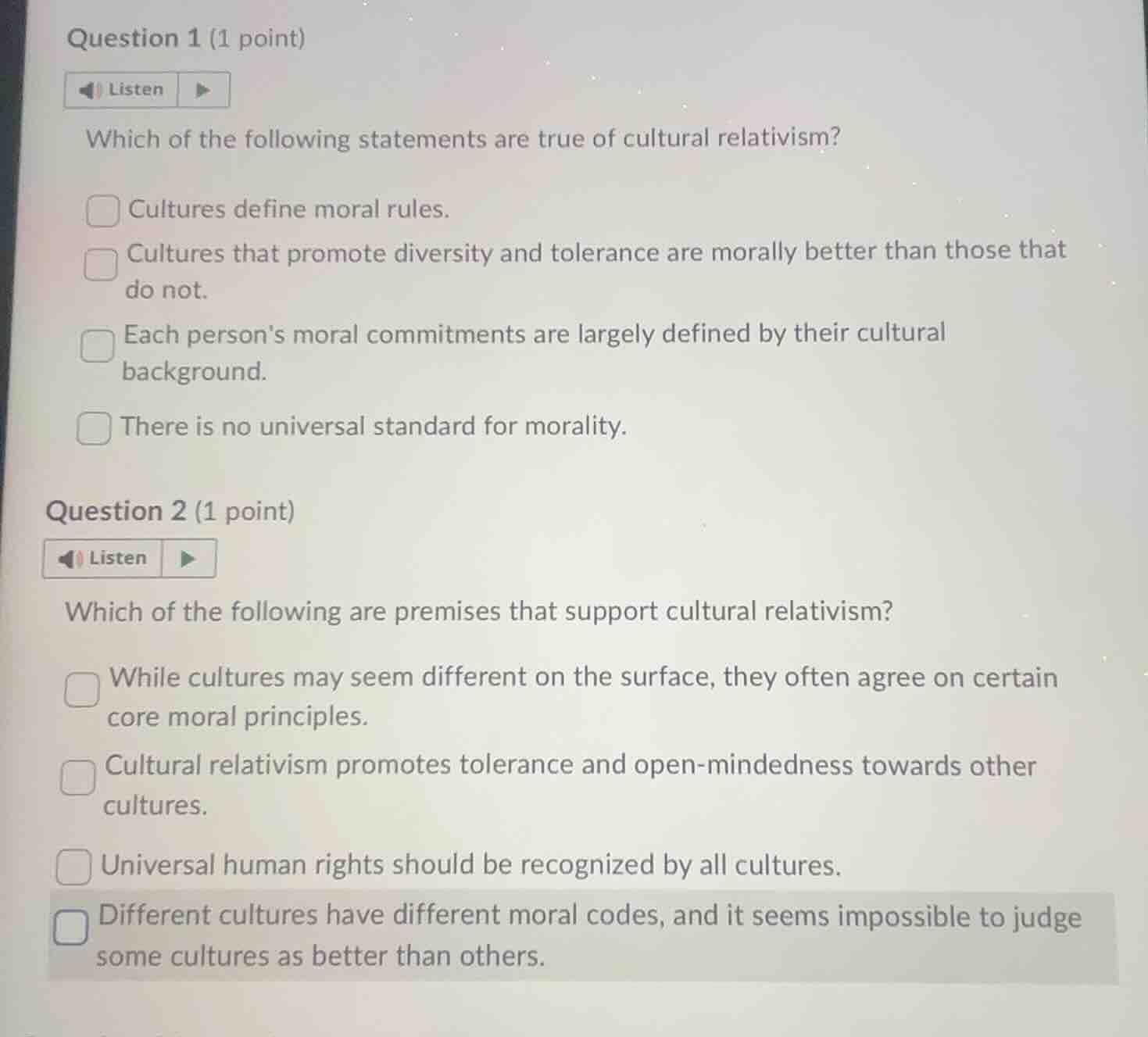
question 1 (1 point)
listen
which of the following statements are true of cultural relativism?
cultures define moral rules.
cultures that promote diversity and tolerance are morally better than those that do not.
each persons moral commitments are largely defined by their cultural background.
there is no universal standard for morality.
question 2 (1 point)
listen
which of the following are premises that support cultural relativism?
while cultures may seem different on the surface, they often agree on certain core moral principles.
cultural relativism promotes tolerance and open - mindedness towards other cultures.
universal human rights should be recognized by all cultures.
different cultures have different moral codes, and it seems impossible to judge some cultures as better than others.
For Question 1:
Cultural relativism centers on the idea that morality is culturally constructed, not universal.
- Cultures defining moral rules aligns with its core claim that moral frameworks are cultural products.
- Claiming some cultures are morally better relies on a universal standard, which relativism rejects.
- Individuals' moral commitments being shaped by culture is a key implication of the theory.
- Rejecting universal moral standards is a foundational tenet of cultural relativism.
For Question 2:
Premises for cultural relativism are statements that support its core claims.
- Shared core moral principles would argue against relativism, as it suggests universal morality.
- Tolerance as a benefit is a consequence, not a supporting premise.
- Universal human rights directly contradict relativism's rejection of universal standards.
- Divergent moral codes and the inability to judge cultures as better directly support the claim that morality is culturally relative.

Snap & solve any problem in the app
Get step-by-step solutions on Sovi AI
Photo-based solutions with guided steps
Explore more problems and detailed explanations
Question 1:
- Cultures define moral rules.
- Each person's moral commitments are largely defined by their cultural background.
- There is no universal standard for morality.
Question 2:
- Different cultures have different moral codes, and it seems impossible to judge some cultures as better than others.