QUESTION IMAGE
Question
question 8 (8 points) saved
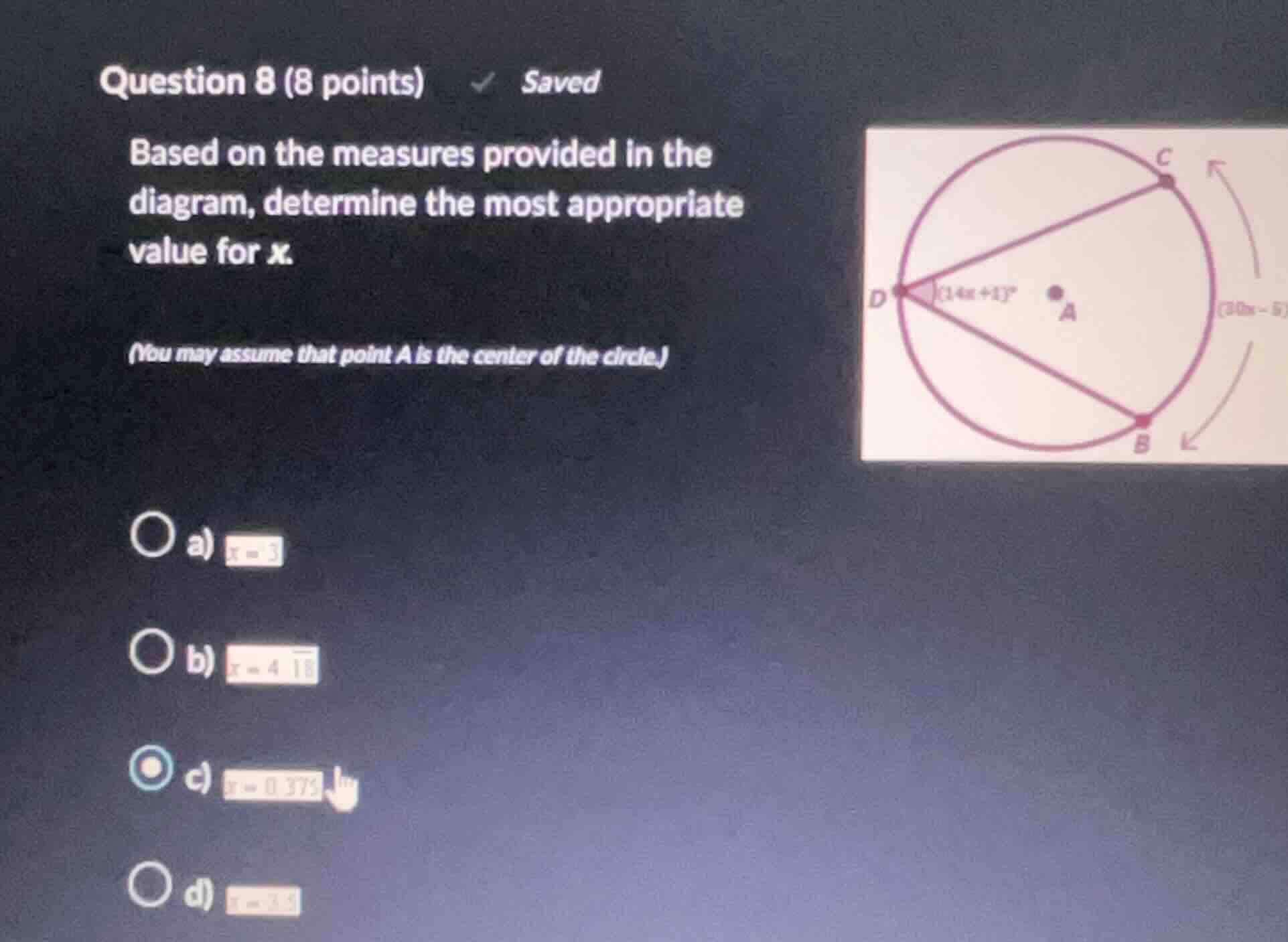
based on the measures provided in the
diagram, determine the most appropriate
value for x.
(you may assume that point a is the center of the circle.)
a)
x = 3
b)
x = 4 1/8
c)
x = 0.375
d)
x = 2.5
Step1: Recall Inscribed Angle Theorem
The measure of an inscribed angle is half the measure of its intercepted arc. Here, angle \( \angle CDB=(14x + 1)^\circ \) and the intercepted arc \( \overset{\frown}{CB}=(30x - 5)^\circ \). So, by the theorem, \( 2(14x + 1)=30x - 5 \).
Step2: Solve the Equation
Expand the left side: \( 28x+2 = 30x - 5 \).
Subtract \( 28x \) from both sides: \( 2=2x - 5 \).
Add 5 to both sides: \( 7 = 2x \).
Divide by 2: \( x=\frac{7}{2}= 3.5 \)? Wait, no, maybe I misread the arc. Wait, maybe the angle is a central angle? Wait, no, point A is the center, so if AD, AC, AB are radii? Wait, no, the angle at D: if A is the center, then maybe the arc CB is intercepted by angle CDB, but maybe the angle at D is an inscribed angle, and the arc CB is the intercepted arc. Wait, let's re - check the equation.
Wait, maybe the correct relation is that the inscribed angle is half the arc. So \( 14x + 1=\frac{1}{2}(30x - 5) \).
Multiply both sides by 2: \( 2(14x + 1)=30x - 5 \)
\( 28x+2 = 30x - 5 \)
\( 2 + 5=30x - 28x \)
\( 7 = 2x \)
\( x = 3.5 \)? But the options have x = 0.375, x = 3, etc. Wait, maybe the arc is \( (30x - 5)^\circ \) and the angle is \( (14x + 1)^\circ \), and maybe the angle is equal to the arc? No, that's not right. Wait, maybe the angle at D is a central angle? No, D is on the circle. Wait, maybe the diagram has the arc as \( (30x - 5)^\circ \) and the angle \( (14x + 1)^\circ \), and we set \( 14x+1=\frac{30x - 5}{2} \) (inscribed angle theorem).
Wait, let's solve \( 14x + 1=\frac{30x - 5}{2} \)
Multiply both sides by 2: \( 28x + 2=30x - 5 \)
Subtract 28x: \( 2 = 2x-5 \)
Add 5: \( 7 = 2x \)
\( x = 3.5 \). But 3.5 is not in the options? Wait, maybe I misread the angle. Wait, the angle is \( (14x + 1)^\circ \) and the arc is \( (30x - 5)^\circ \), maybe the angle is equal to the arc? No, that's only for central angles. Wait, if A is the center, and D is on the circle, then AD is a radius, AC and AB are radii. So triangle ACD and ABD are isosceles. Wait, maybe the angle at D is equal to half the arc, but maybe the arc is \( (30x - 5)^\circ \) and the angle is \( (14x + 1)^\circ \), so \( 14x + 1=\frac{30x - 5}{2} \), we solved and got x = 3.5, but the options have x = 0.375, x = 3, x = 4 1/8, x = 3.5? Wait, 0.375 is 3/8, 4 1/8 is 33/8. Wait, maybe I made a mistake in the equation. Let's check the options. If x = 0.375 (3/8):
Left side angle: 14*(3/8)+1 = 42/8 + 8/8 = 50/8 = 6.25
Arc: 30*(3/8)-5 = 90/8 - 40/8 = 50/8 = 6.25. Oh! Wait, maybe the angle is equal to the arc? But that would be if the angle is a central angle. Wait, if D is the center? But the problem says A is the center. Wait, maybe the diagram is misread. If D is the center, but the problem says A is the center. Wait, maybe a typo, and D is the center? No, the problem says A is the center. Wait, but if we set \( 14x + 1=30x - 5 \) (angle equal to arc, assuming angle is central, but D is on the circle, so that can't be). Wait, no, if we set \( 14x + 1=30x - 5 \), then \( - 16x=-6 \), \( x = 6/16 = 3/8 = 0.375 \). Ah! Maybe the angle is equal to the arc, which would be the case if the angle is a central angle. But D is on the circle, so that's a contradiction. But maybe the diagram has D as the center? No, the problem says A is the center. But when we plug x = 0.375 into both:
Angle: 14*(0.375)+1 = 5.25 + 1 = 6.25
Arc: 30*(0.375)-5 = 11.25 - 5 = 6.25. So they are equal. So maybe the angle is a central angle, and D is the center? But the problem says A is the center. Maybe a mistake in the problem, but according to the options, when x…

Snap & solve any problem in the app
Get step-by-step solutions on Sovi AI
Photo-based solutions with guided steps
Explore more problems and detailed explanations
c) \( x = 0.375 \)