QUESTION IMAGE
Question
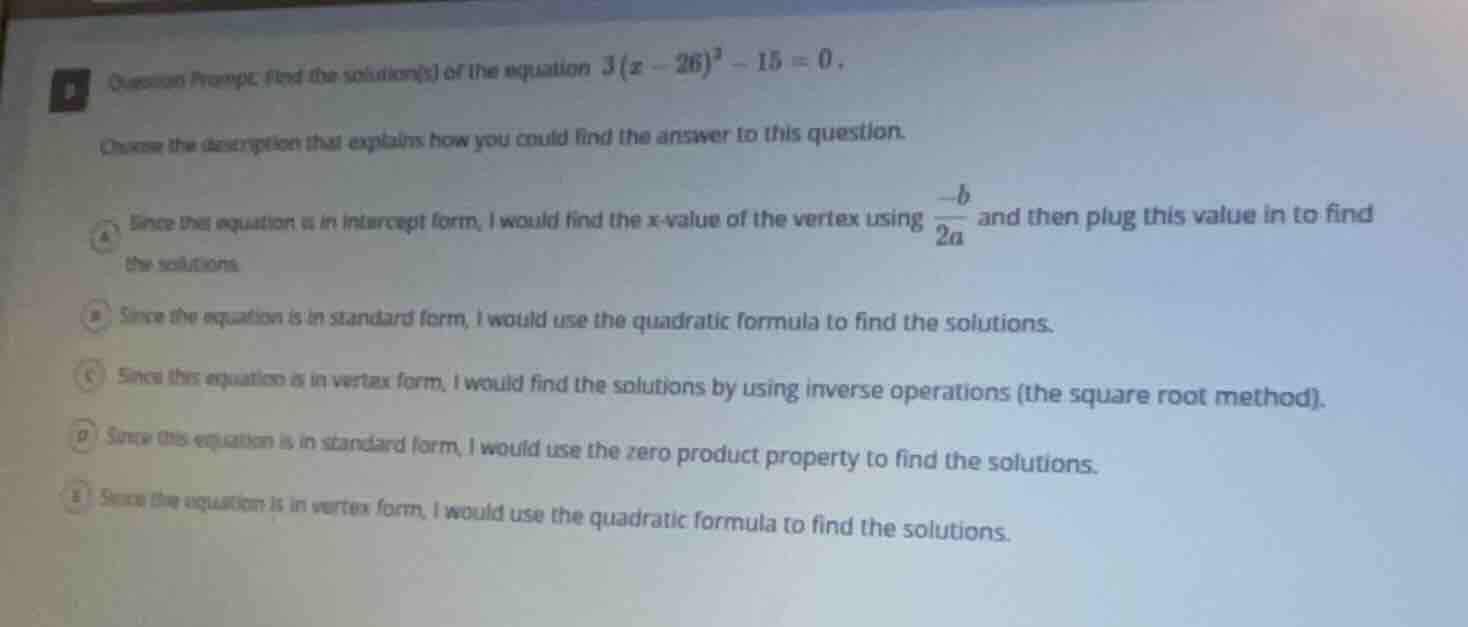
question prompt: find the solution(s) of the equation $3(x - 26)^2 - 15 = 0$.
choose the description that explains how you could find the answer to this question.
a. since the equation is in intercept form, i would find the x - value of the vertex using $\frac{-b}{2a}$ and then plug this value in to find the solutions.
b. since the equation is in standard form, i would use the quadratic formula to find the solutions.
c. since the equation is in vertex form, i would find the solutions by using inverse operations (the square root method).
d. since the equation is in standard form, i would use the zero product property to find the solutions.
e. since the equation is in vertex form, i would use the quadratic formula to find the solutions.
- First, analyze the form of the equation \(3(x - 26)^2-15 = 0\). The vertex form of a quadratic equation is \(y=a(x - h)^2+k\), and this equation matches that structure (here \(y = 0\), \(a = 3\), \(h = 26\), \(k=- 15\)).
- Option A: The formula \(\frac{-b}{2a}\) is for finding the vertex of a quadratic in standard form \(y=ax^{2}+bx + c\), not intercept form, and this equation is not in intercept form, so A is wrong.
- Option B: The equation is not in standard form (\(ax^{2}+bx + c = 0\)) initially, and we don't need the quadratic formula here as we can solve it using inverse operations, so B is wrong.
- Option C: Since the equation is in vertex form, we can use inverse operations (isolate the squared term and then take the square root). First, add 15 to both sides: \(3(x - 26)^2=15\), then divide by 3: \((x - 26)^2 = 5\), then take the square root: \(x-26=\pm\sqrt{5}\), and solve for \(x\). This matches the description in option C.
- Option D: The zero - product property is used when the quadratic is factored into a product of binomials equal to zero, and this equation is not in factored form, so D is wrong.
- Option E: The quadratic formula is used for standard - form quadratics, and this equation is in vertex form, so we don't use the quadratic formula here, so E is wrong.

Snap & solve any problem in the app
Get step-by-step solutions on Sovi AI
Photo-based solutions with guided steps
Explore more problems and detailed explanations
C. Since the equation is in vertex form, I would find the solutions by using inverse operations (the square root method).