QUESTION IMAGE
Question
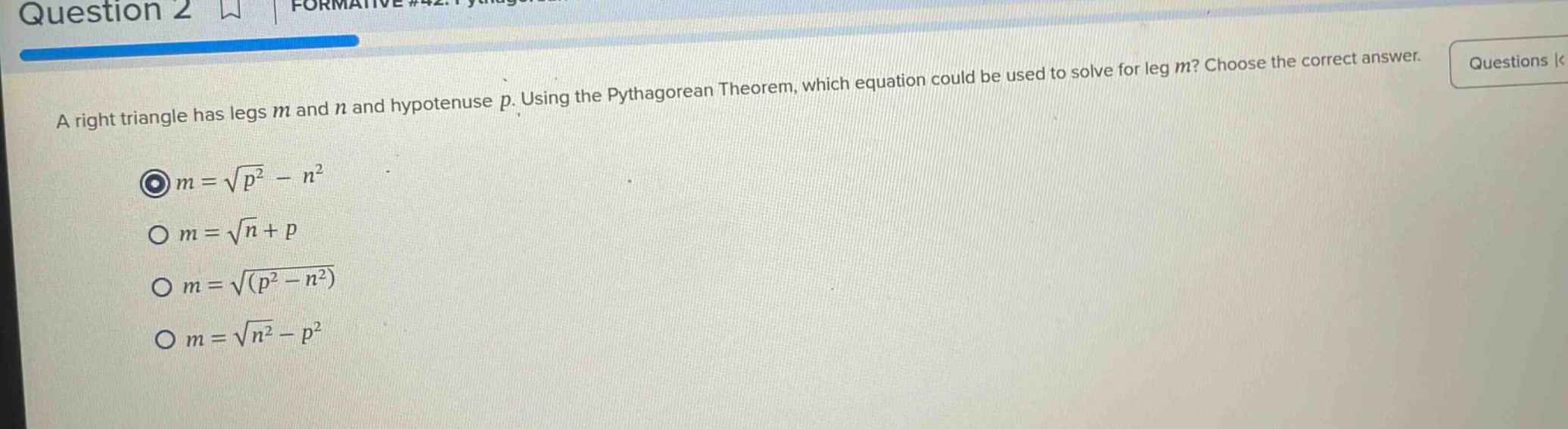
question 2 a right triangle has legs m and n and hypotenuse p. using the pythagorean theorem, which equation could be used to solve for leg m? choose the correct answer. m = √(p² − n²) m = √(n + p) m = √((p² − n²)) m = √(n² − p²)
Step1: Recall Pythagorean Theorem
The Pythagorean Theorem for a right triangle with legs \( m \), \( n \) and hypotenuse \( p \) is \( m^2 + n^2 = p^2 \).
Step2: Solve for \( m^2 \)
Subtract \( n^2 \) from both sides: \( m^2 = p^2 - n^2 \).
Step3: Solve for \( m \)
Take the square root of both sides: \( m = \sqrt{p^2 - n^2} \), which is equivalent to \( m = \sqrt{(p^2 - n^2)} \) (since \( \sqrt{a - b}=\sqrt{(a - b)} \) when \( a\geq b \) for real numbers). Now check the options:
- Option 1: \( m = \sqrt{p^2}-n^2 \) is incorrect (as \( \sqrt{p^2 - n^2}
eq\sqrt{p^2}-n^2 \)).
- Option 2: \( m = \sqrt{n + p} \) is incorrect (does not follow Pythagorean Theorem).
- Option 3: \( m = \sqrt{(p^2 - n^2)} \) is correct (equivalent to the derived formula).
- Option 4: \( m = \sqrt{n^2 - p^2} \) is incorrect (since \( p > n \) for a right triangle, \( n^2 - p^2 \) would be negative, and square root of negative number is not real in this context).

Snap & solve any problem in the app
Get step-by-step solutions on Sovi AI
Photo-based solutions with guided steps
Explore more problems and detailed explanations
C. \( m = \sqrt{(p^2 - n^2)} \) (assuming the third option is labeled C; if the original options were labeled as per the image, the correct option is the one with \( m = \sqrt{(p^2 - n^2)} \))