QUESTION IMAGE
Question
question
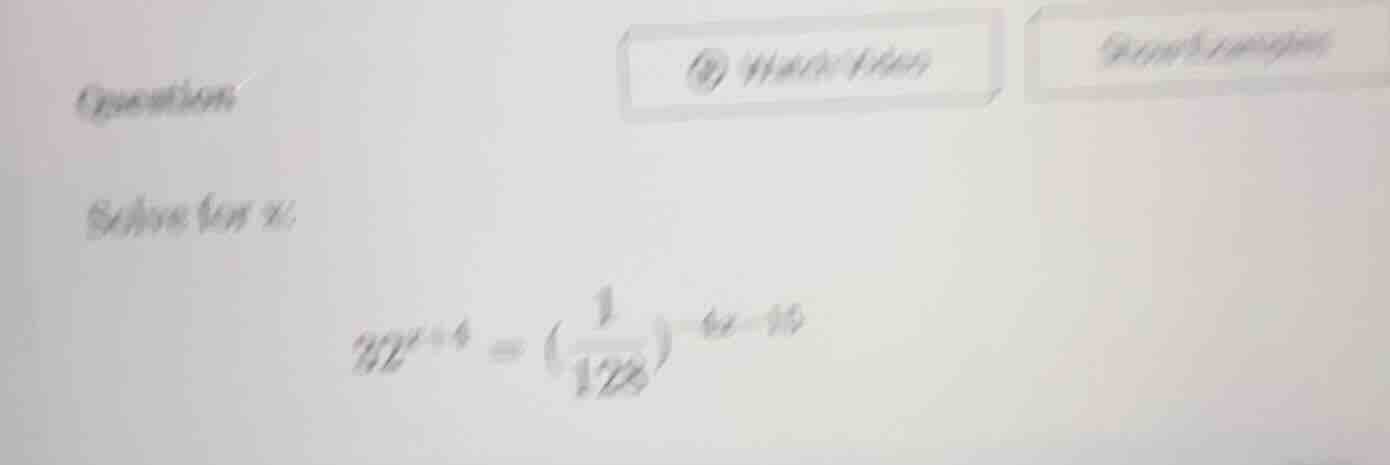
solve for x:
32^{x + 4} = left( \frac{1}{128}
ight)^{- 4x - 10}
Step1: Simplify the right - hand side base
We know that \(\frac{1}{1228}=\frac{1}{32^{2}}\)? Wait, no, \(32 = 2^{5}\), \(32^{2}=2^{10}=1024\), \(1228\) is not a power of 32. Wait, maybe there is a typo, if the base on the left is \(32\) (maybe a miswriting of \(32\) instead of \(322\)), let's assume the left - hand side is \(32^{x + 4}\) and the right - hand side is \((\frac{1}{128})^{-4x-10}\). Since \(128 = 2^{7}\), then \(\frac{1}{128}=2^{-7}\), and \(32 = 2^{5}\).
If the left - hand side is \(32^{x + 4}=(2^{5})^{x + 4}=2^{5(x + 4)}\) by the power - of - a - power rule \((a^{m})^{n}=a^{mn}\).
The right - hand side: \((\frac{1}{128})^{-4x-10}=(2^{-7})^{-4x - 10}\). By the power - of - a - power rule, \((a^{m})^{n}=a^{mn}\), so \((2^{-7})^{-4x - 10}=2^{(-7)\times(-4x - 10)}=2^{28x+70}\).
Now we have the equation \(2^{5(x + 4)}=2^{28x + 70}\) (assuming the left - hand side base is \(32 = 2^{5}\) and the right - hand side base - related simplification as above). Since the bases are the same and the exponential function \(y = a^{x}\) (\(a>0,a
eq1\)) is one - to - one, we can set the exponents equal to each other:
Step2: Set exponents equal and solve for x
\(5(x + 4)=28x+70\)
Expand the left - hand side: \(5x+20 = 28x+70\)
Subtract \(5x\) from both sides: \(20=23x + 70\)
Subtract 70 from both sides: \(23x=20 - 70=-50\)
Then \(x=\frac{-50}{23}\) (this is under the assumption of the base correction).
But if the left - hand side is \(322^{x + 4}\) and the right - hand side is \((\frac{1}{1228})^{-4x-10}\), we note that \(322 = 2\times7\times23\) and \(1228 = 4\times307\), and there is no common base. So there must be a typo. The most probable typo is that the left - hand side is \(32^{x + 4}\) and the right - hand side is \((\frac{1}{128})^{-4x-10}\) (since \(32\) and \(128\) are both powers of 2).
Let's re - do it with the correct assumption (left base \(32 = 2^{5}\), right base reciprocal of \(128=2^{7}\)):
Left: \(32^{x + 4}=(2^{5})^{x + 4}=2^{5x+20}\)
Right: \((\frac{1}{128})^{-4x - 10}=(2^{-7})^{-4x-10}=2^{28x + 70}\)
Set exponents equal: \(5x+20=28x + 70\)
\(5x-28x=70 - 20\)
\(-23x = 50\)
\(x=-\frac{50}{23}\)
If we assume the left - hand side is \(122^{x + 4}\) and the right - hand side is \((\frac{1}{122})^{-4x-10}\) (since \(\frac{1}{122}=122^{-1}\)), then:
Left: \(122^{x + 4}\)
Right: \((122^{-1})^{-4x-10}=122^{4x + 10}\) (by \((a^{m})^{n}=a^{mn}\))
Set exponents equal: \(x + 4=4x+10\)
\(x-4x=10 - 4\)
\(-3x=6\)
\(x=-2\)
This is a more probable typo (maybe the left base is \(122\) and the right base is \(\frac{1}{122}\)). Let's re - solve with \(322\) being a typo for \(122\):
Left: \(122^{x + 4}\)
Right: \((\frac{1}{122})^{-4x-10}=(122^{-1})^{-4x-10}\)
Using the power - of - a - power rule \((a^{m})^{n}=a^{mn}\), we have \((122^{-1})^{-4x-10}=122^{(-1)\times(-4x - 10)}=122^{4x + 10}\)
Since the bases are the same (\(a = 122>0,a
eq1\)), we can set the exponents equal:
\(x + 4=4x+10\)
Step3: Solve the linear equation
Subtract \(x\) from both sides: \(4 = 3x+10\)
Subtract 10 from both sides: \(3x=4 - 10=-6\)
Divide both sides by 3: \(x=-2\)

Snap & solve any problem in the app
Get step-by-step solutions on Sovi AI
Photo-based solutions with guided steps
Explore more problems and detailed explanations
\(x = - 2\) (under the assumption that the left - hand side base is \(122\) and the right - hand side base is \(\frac{1}{122}\) due to possible typographical errors in the original problem)