QUESTION IMAGE
Question
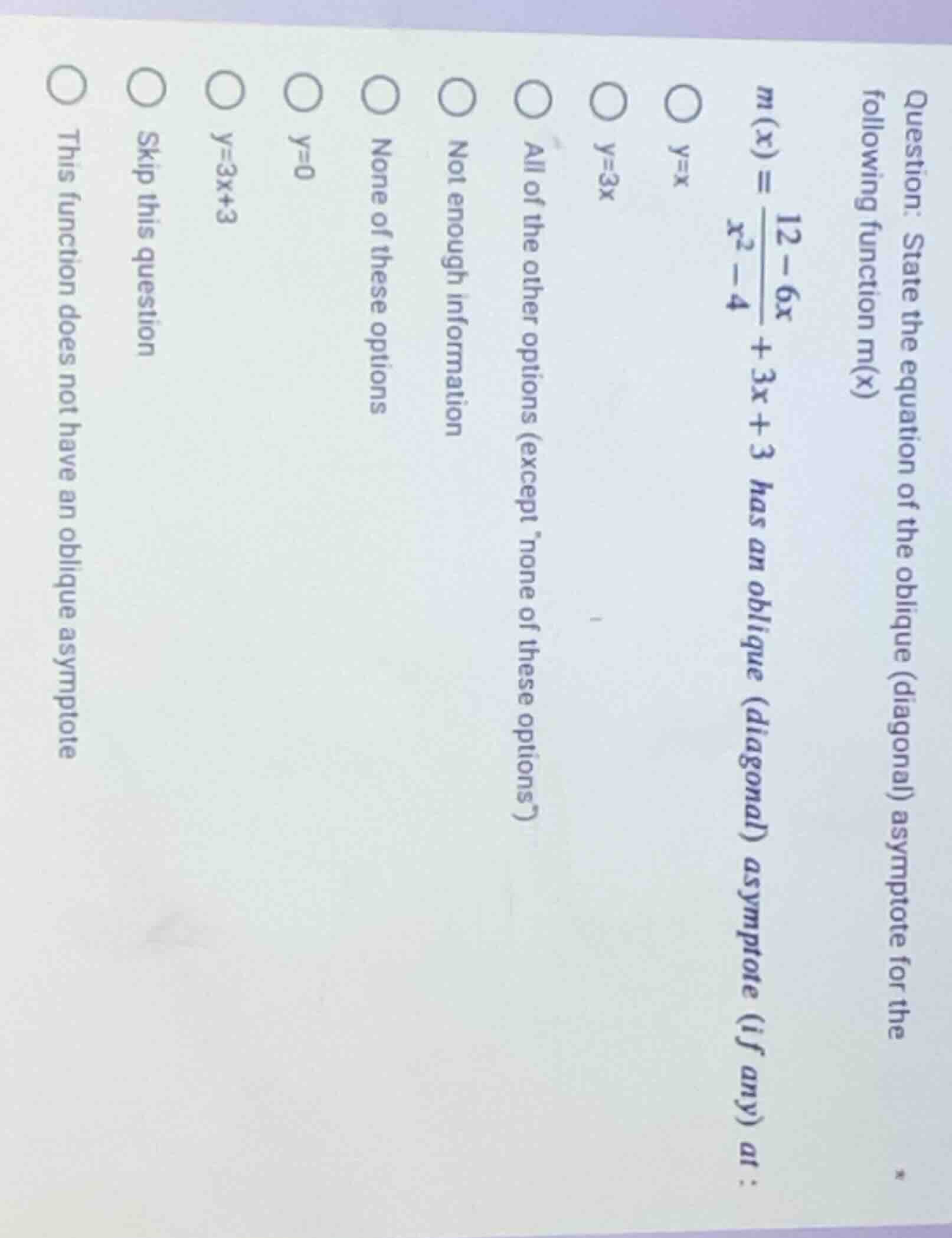
question: state the equation of the oblique (diagonal) asymptote for the following function m(x)
m(x) = \frac{12 - 6x}{x^2 - 4} + 3x + 3 has an oblique (diagonal) asymptote (if any) at :
\bigcirc y = x
\bigcirc y = 3x
\bigcirc all of the other options (except none of these options)
\bigcirc not enough information
\bigcirc none of these options
\bigcirc y = 0
\bigcirc y = 3x + 3
\bigcirc skip this question
\bigcirc this function does not have an oblique asymptote
Step1: Recall oblique asymptote rule
For a rational function \( m(x)=\frac{f(x)}{g(x)} \), if the degree of \( f(x) \) is equal to the degree of \( g(x) \), we use horizontal asymptote. If degree of \( f(x) \) is one more than \( g(x) \), we perform polynomial long division to find oblique asymptote. Here, \( m(x)=\frac{12 - 6x}{x^{2}-4}+3x + 3 \). First, combine the terms: \( m(x)=\frac{12 - 6x+(3x + 3)(x^{2}-4)}{x^{2}-4} \). Expand the numerator: \( (3x + 3)(x^{2}-4)=3x^{3}-12x + 3x^{2}-12 \). Then numerator becomes \( 12 - 6x+3x^{3}-12x + 3x^{2}-12=3x^{3}+3x^{2}-18x \). So \( m(x)=\frac{3x^{3}+3x^{2}-18x}{x^{2}-4} \). Now, perform polynomial long division of \( 3x^{3}+3x^{2}-18x \) by \( x^{2}-4 \).
Step2: Polynomial long division
Divide \( 3x^{3} \) by \( x^{2} \) to get \( 3x \). Multiply \( x^{2}-4 \) by \( 3x \): \( 3x(x^{2}-4)=3x^{3}-12x \). Subtract this from the numerator: \( (3x^{3}+3x^{2}-18x)-(3x^{3}-12x)=3x^{2}-6x \). Now, divide \( 3x^{2} \) by \( x^{2} \) to get \( 3 \). Multiply \( x^{2}-4 \) by \( 3 \): \( 3(x^{2}-4)=3x^{2}-12 \). Subtract: \( (3x^{2}-6x)-(3x^{2}-12)=-6x + 12 \). So the division gives \( 3x + 3+\frac{-6x + 12}{x^{2}-4} \). As \( x\to\pm\infty \), the remainder term \( \frac{-6x + 12}{x^{2}-4}\to0 \). But wait, the original function was \( \frac{12 - 6x}{x^{2}-4}+3x + 3 \), which we combined. Wait, maybe a mistake in combining. Wait, no: \( m(x)=\frac{12 - 6x}{x^{2}-4}+3x + 3=\frac{12 - 6x+(3x + 3)(x^{2}-4)}{x^{2}-4} \). Wait, but actually, when we have \( \frac{12 - 6x}{x^{2}-4} \) (degree of numerator is 1, denominator is 2) and \( 3x + 3 \) (degree 1). Wait, no, the correct way: oblique asymptote occurs when the rational part (the fraction) has numerator degree less than denominator (so it approaches 0) and the polynomial part is linear. Wait, no, the function is \( m(x)=3x + 3+\frac{12 - 6x}{x^{2}-4} \). As \( x\to\pm\infty \), \( \frac{12 - 6x}{x^{2}-4}\to0 \) (since degree of numerator 1 < degree of denominator 2). So the oblique asymptote is the linear part \( y = 3x+3 \)? Wait, no, wait the long division: Wait, no, the combined function's numerator after combining is \( 3x^{3}+3x^{2}-18x \), denominator \( x^{2}-4 \). So degree of numerator is 3, denominator is 2. So we do long division: \( 3x^{3}\div x^{2}=3x \), multiply \( x^{2}-4 \) by \( 3x \) gives \( 3x^{3}-12x \), subtract from numerator: \( (3x^{3}+3x^{2}-18x)-(3x^{3}-12x)=3x^{2}-6x \). Then \( 3x^{2}\div x^{2}=3 \), multiply \( x^{2}-4 \) by 3: \( 3x^{2}-12 \), subtract: \( (3x^{2}-6x)-(3x^{2}-12)=-6x + 12 \). So \( m(x)=3x + 3+\frac{-6x + 12}{x^{2}-4} \). As \( x\to\pm\infty \), the fractional part \( \frac{-6x + 12}{x^{2}-4}\to0 \) (since degree of numerator 1 < degree of denominator 2). Wait, but the oblique asymptote is the linear part from the division, which is \( y = 3x+3 \)? Wait, but let's check the options. Wait, no, wait the original function: \( m(x)=\frac{12 - 6x}{x^{2}-4}+3x + 3 \). Let's re - express: \( 3x + 3+\frac{12 - 6x}{x^{2}-4} \). The term \( \frac{12 - 6x}{x^{2}-4} \) has degree 1 numerator and 2 denominator, so as \( x\to\pm\infty \), it approaches 0. So the oblique asymptote is \( y = 3x+3 \)? Wait, but wait, the degree of the numerator of the combined function is 3 (from \( 3x^{3} \)) and denominator 2, so we do long division, and the quotient is \( 3x + 3 \), remainder \( -6x + 12 \). So as \( x\to\pm\infty \), \( m(x)\approx3x + 3 \), so the oblique asymptote is \( y = 3x+3 \). Wait, but let's check the options. One of the options is \( y = 3x+3 \). Wait, but wait, maybe I made a mistake. Wait, th…

Snap & solve any problem in the app
Get step-by-step solutions on Sovi AI
Photo-based solutions with guided steps
Explore more problems and detailed explanations
\( y = 3x+3 \) (the option: \( y = 3x+3 \))