QUESTION IMAGE
Question
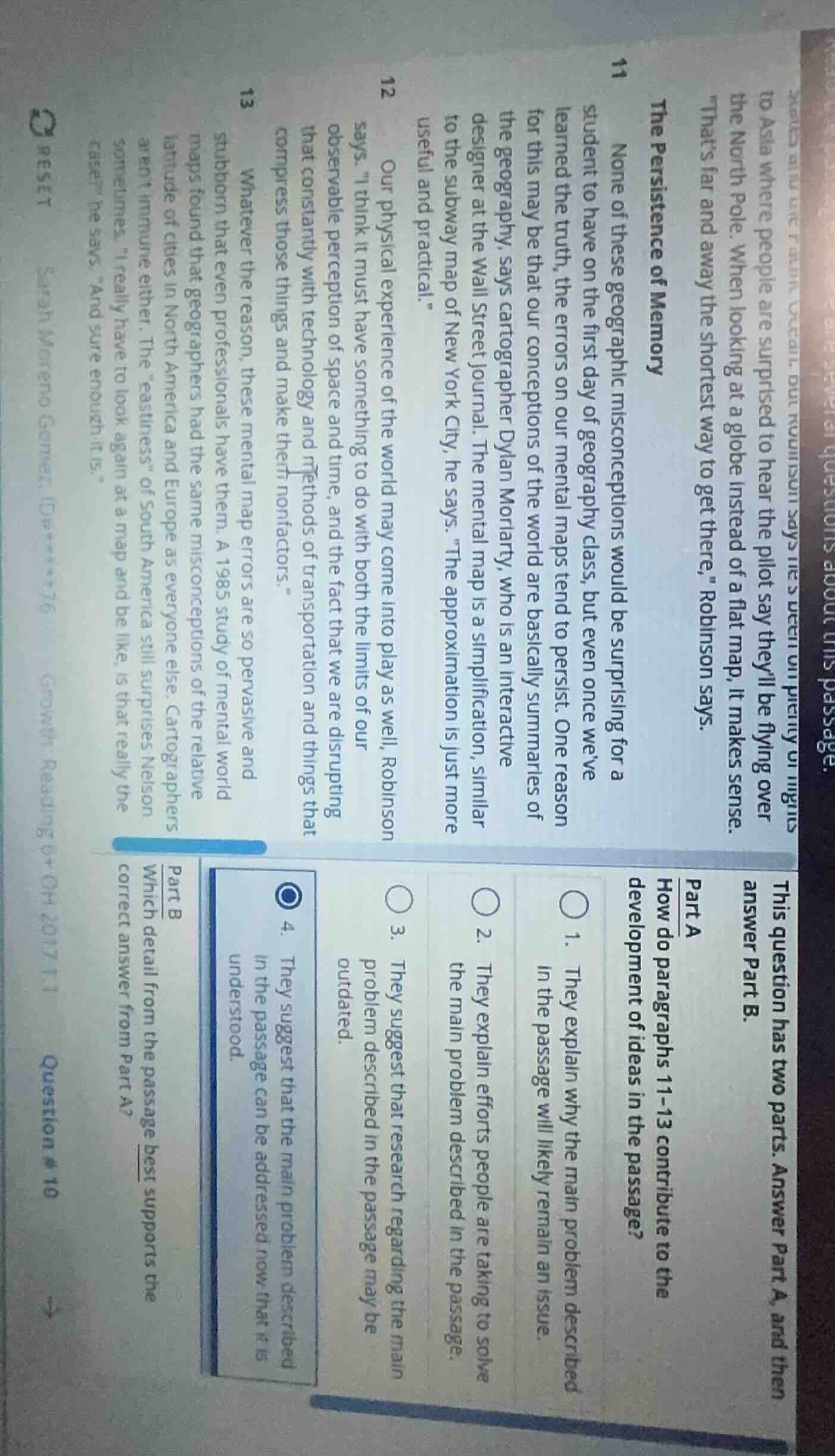
this question has two parts. answer part a, and then answer part b.
part a
how do paragraphs 11 - 13 contribute to the development of ideas in the passage?
- they explain why the main problem described in the passage will likely remain an issue.
- they explain efforts people are taking to solve the main problem described in the passage.
- they suggest that research regarding the main problem described in the passage may be outdated.
- they suggest that the main problem described in the passage can be addressed now that it is understood.
part b
which detail from the passage best supports the correct answer from part a?
the persistence of memory
none of these geographic misconceptions would be surprising for a student to have on the first day of geography class, but even once we’ve learned the truth, the errors on our mental maps tend to persist. one reason for this may be that our conceptions of the world are basically summaries of the geography, says cartographer dylan moriarty, who is an interactive designer at the wall street journal. the mental map is a simplification, similar to the subway map of new york city, he says. “the approximation is just more useful and practical.”
our physical experience of the world may come into play as well, robinson says. “i think it must have something to do with both the limits of our observable perception of space and time, and the fact that we are constantly with technology and methods of transportation and things that compress those things and make them nonfactors.”
whatever the reason, these mental map errors are so pervasive and stubborn that even professionals have them. a 1985 study of mental world maps found that geographers had the same misconceptions of the relative latitude of cities in north america and europe as everyone else. cartographers aren’t immune either. the “eastiness” of south america still surprises nelson sometimes. “i really have to look again at a map and be like, is that really the case?” he says. “and sure enough it is.”
Part A
To solve Part A, we analyze each option:
- Option 1: The paragraphs (11 - 13) discuss how mental map misconceptions persist (e.g., "errors on our mental maps tend to persist", "these mental map errors are so pervasive and stubborn"). This matches the idea that the problem (persistent mental map errors) will likely remain an issue.
- Option 2: The paragraphs don't focus on explaining efforts to solve the problem.
- Option 3: There's no indication the problem is outdated; it's about persistence.
- Option 4: The passage says the problem is "pervasive and stubborn" and doesn't suggest it can be easily addressed.
So the correct option for Part A is 1. They explain why the main problem described in the passage will likely remain an issue.
From the passage, details like "One reason for this may be that our conceptions of the world are basically summaries of the geography... the mental map is a simplification... the approximation is just more useful and practical" (paragraph 11), "Our physical experience of the world may come into play as well... we are disrupting that constantly with technology and methods of transportation..." (paragraph 12), and "these mental map errors are so pervasive and stubborn that even professionals have them" (paragraph 13) support that the problem (persistent mental map errors) is likely to remain. For example, the pervasiveness and stubbornness (even professionals have them) and the factors (physical experience, technology disrupting perception) that contribute to persistence show it's an ongoing issue.

Snap & solve any problem in the app
Get step-by-step solutions on Sovi AI
Photo-based solutions with guided steps
Explore more problems and detailed explanations
- They explain why the main problem described in the passage will likely remain an issue.