QUESTION IMAGE
Question
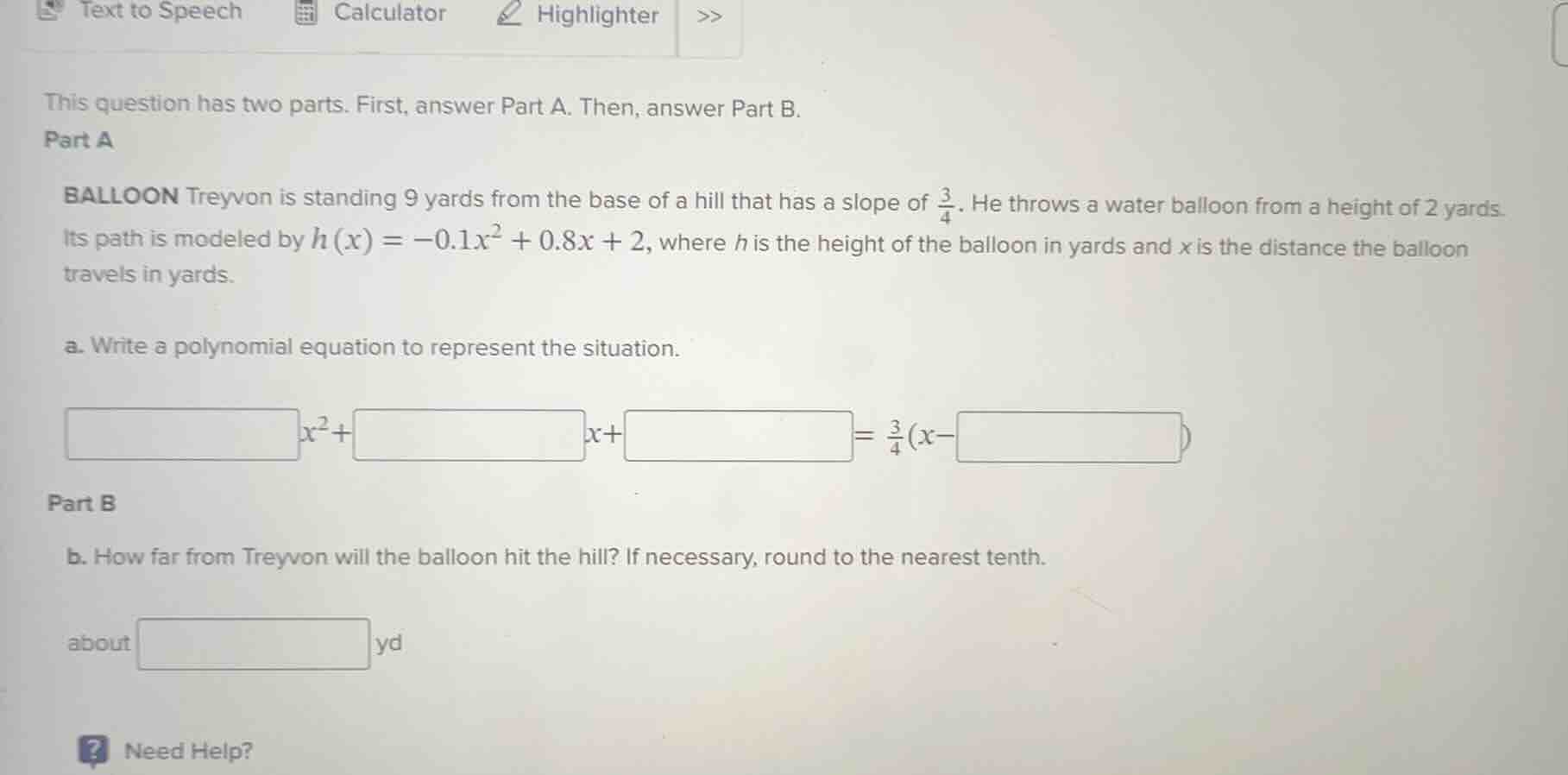
this question has two parts. first, answer part a. then, answer part b.
part a
balloon treyvon is standing 9 yards from the base of a hill that has a slope of \\(\frac{3}{4}\\). he throws a water balloon from a height of 2 yards. its path is modeled by \\(h(x) = -0.1x^2 + 0.8x + 2\\), where \\(h\\) is the height of the balloon in yards and \\(x\\) is the distance the balloon travels in yards.
a. write a polynomial equation to represent the situation.
\\(\square x^2 + \square x + \square = \frac{3}{4}(x - \square)\\)
part b
b. how far from treyvon will the balloon hit the hill? if necessary, round to the nearest tenth.
about \\(\square\\) yd
Step1: Define hill height function
The hill has a slope of $\frac{3}{4}$, and Treyvon is 9 yards from its base. For a horizontal distance $x$ from Treyvon, the horizontal distance from the hill's base is $x-9$. The height of the hill at this point is $h_{hill}(x)=\frac{3}{4}(x-9)$.
Step2: Set balloon height equal to hill height
Set the balloon's height function equal to the hill's height function:
$$-0.1x^2 + 0.8x + 2 = \frac{3}{4}(x-9)$$
Step3: Eliminate decimals (multiply by 10)
Multiply all terms by 10 to clear the decimal:
$$-x^2 + 8x + 20 = \frac{30}{4}(x-9)$$
Simplify $\frac{30}{4}$ to $\frac{15}{2}$, but to match the given form, rearrange the original equality to fit the blank structure:
$$-0.1x^2 + 0.8x + 2 = \frac{3}{4}(x-9)$$
Step4: Solve the quadratic equation
First, rewrite the equation in standard form:
$$-0.1x^2 + 0.8x + 2 = 0.75x - 6.75$$
$$-0.1x^2 + 0.8x - 0.75x + 2 + 6.75 = 0$$
$$-0.1x^2 + 0.05x + 8.75 = 0$$
Multiply by -20 to simplify:
$$2x^2 - x - 175 = 0$$
Use the quadratic formula $x=\frac{-b\pm\sqrt{b^2-4ac}}{2a}$, where $a=2$, $b=-1$, $c=-175$:
$$x=\frac{1\pm\sqrt{(-1)^2-4(2)(-175)}}{2(2)}$$
$$x=\frac{1\pm\sqrt{1+1400}}{4}$$
$$x=\frac{1\pm\sqrt{1401}}{4}$$
$$x=\frac{1\pm37.43}{4}$$
We discard the negative solution (distance can't be negative):
$$x=\frac{1+37.43}{4}=\frac{38.43}{4}\approx9.6$$

Snap & solve any problem in the app
Get step-by-step solutions on Sovi AI
Photo-based solutions with guided steps
Explore more problems and detailed explanations
Part a
$\boldsymbol{-0.1}x^2+\boldsymbol{0.8}x+\boldsymbol{2} = \frac{3}{4}(x-\boldsymbol{9})$
Part b
about $\boldsymbol{9.6}$ yd