QUESTION IMAGE
Question
question #7
which best describes an advantage of asexual reproduction?
a it requires a second partner
b it occurs quickly.
c it increases genetic diversity.
d it weakens immune functions.
question #8
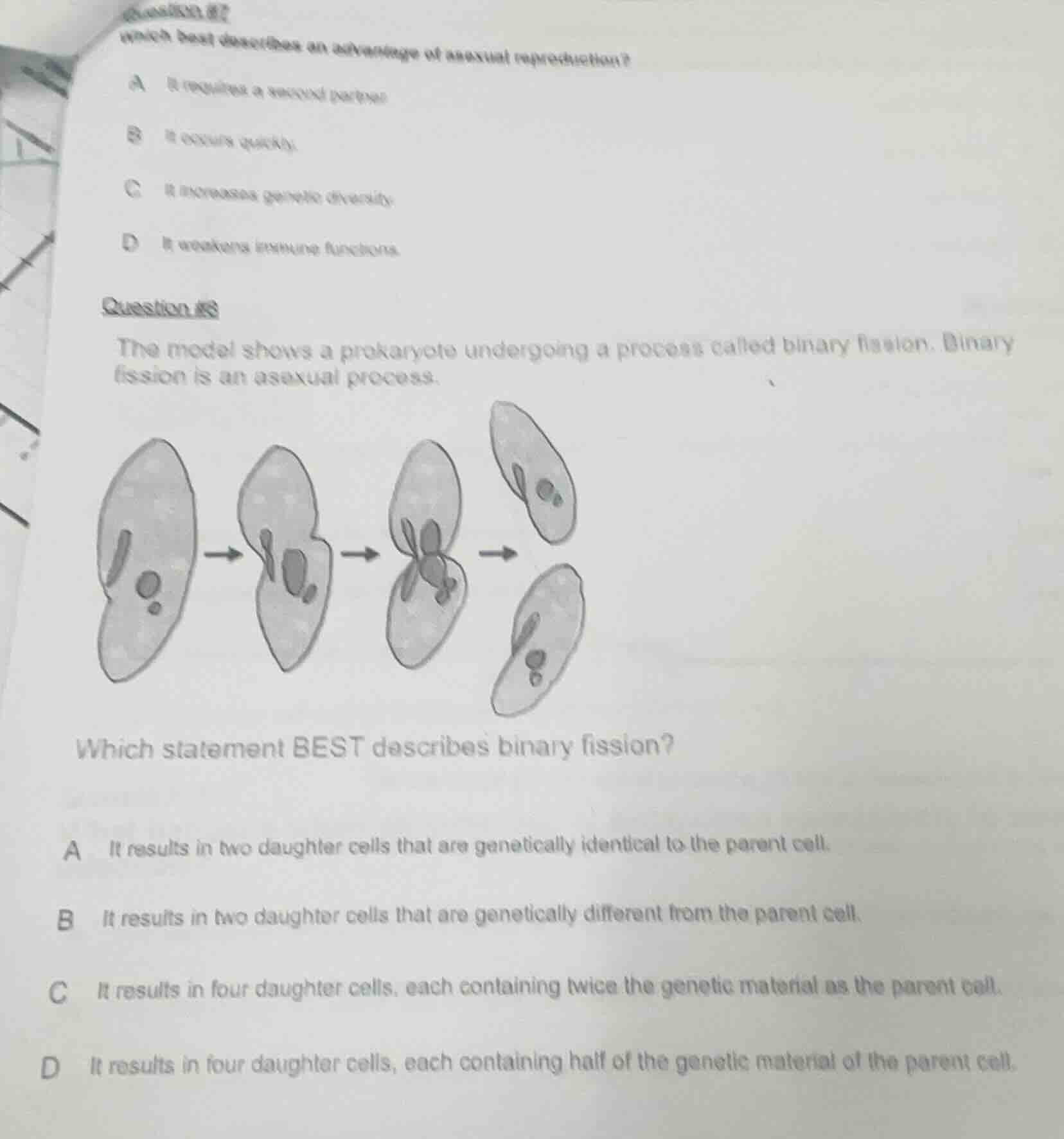
the model shows a prokaryote undergoing a process called binary fission. binary fission is an asexual process.
which statement best describes binary fission?
a it results in two daughter cells that are genetically identical to the parent cell.
b it results in two daughter cells that are genetically different from the parent cell.
c it results in four daughter cells, each containing twice the genetic material as the parent cell.
d it results in four daughter cells, each containing half of the genetic material of the parent cell.
For Question #7:
- Option A is incorrect because asexual reproduction does not require a second partner.
- Option B is correct: a key advantage of asexual reproduction is that it is a fast process, allowing organisms to rapidly produce offspring.
- Option C is incorrect because asexual reproduction produces genetically identical offspring, so it does not increase genetic diversity (this is an advantage of sexual reproduction).
- Option D is incorrect; asexual reproduction does not weaken immune functions.
For Question #8:
- Binary fission is an asexual reproductive process for prokaryotes. The parent cell replicates its genetic material, then splits into two identical daughter cells.
- Option A is correct: the two daughter cells have identical genetic material to the parent cell.
- Option B is incorrect because asexual processes like binary fission do not create genetically different offspring.
- Options C and D are incorrect because binary fission produces 2, not 4, daughter cells, and the genetic material amount matches the parent cell, not double or half.

Snap & solve any problem in the app
Get step-by-step solutions on Sovi AI
Photo-based solutions with guided steps
Explore more problems and detailed explanations
Question #7: B. It occurs quickly.
Question #8: A. It results in two daughter cells that are genetically identical to the parent cell.