QUESTION IMAGE
Question
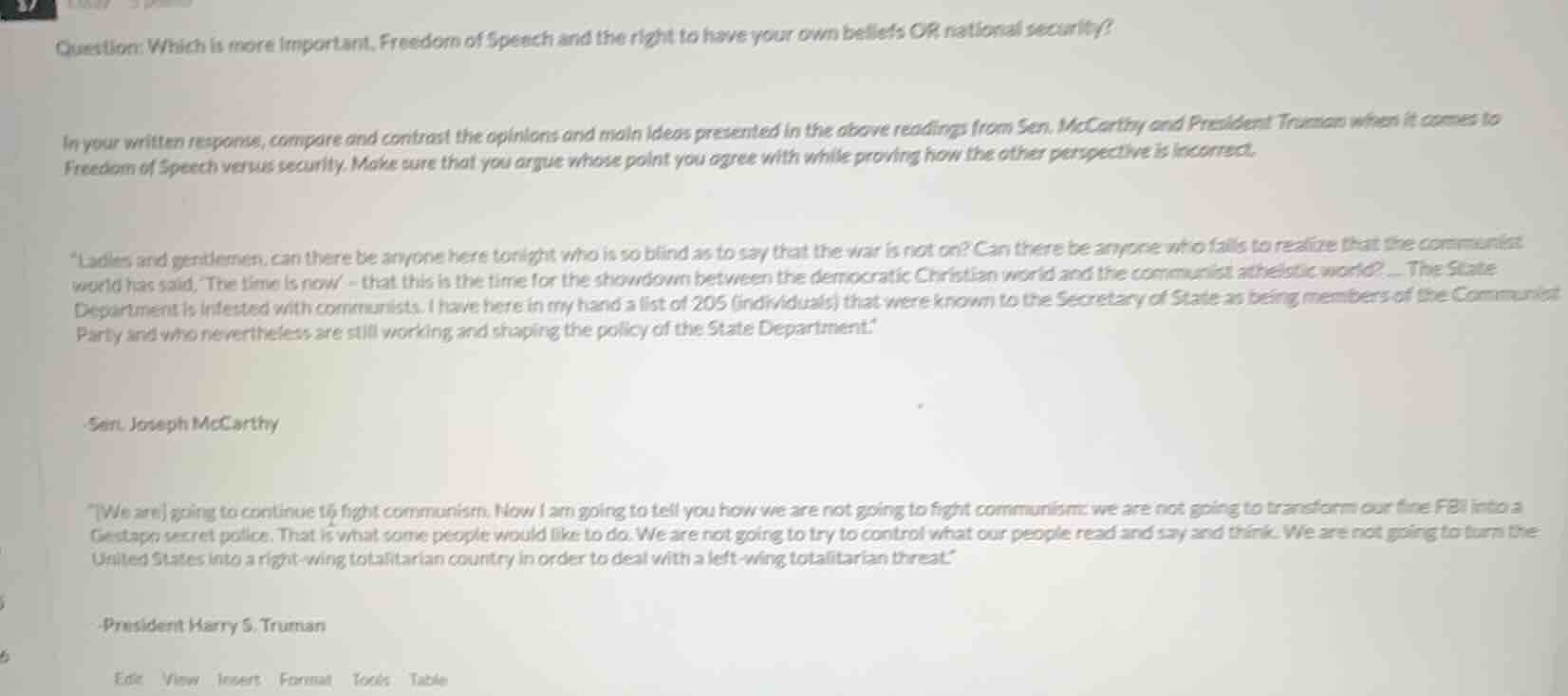
question: which is more important, freedom of speech and the right to have your own beliefs or national security? in your written response, compare and contrast the opinions and main ideas presented in the above readings from sen. mccarthy and president truman when it comes to freedom of speech versus security. make sure that you argue whose point you agree with while proving how the other perspective is incorrect. ladies and gentlemen, can there be anyone here tonight who is so blind as to say that the war is not on? can there be anyone who fails to realize that the communist world has said, the time is now - that this is the time for the showdown between the democratic christian world and the communist atheistic world? ... the state department is infested with communists. i have here in my hand a list of 205 (individuals) that were known to the secretary of state as being members of the communist party and who nevertheless are still working and shaping the policy of the state department. -sen. joseph mccarthy we are going to continue to fight communism. now i am going to tell you how we are not going to fight communism: we are not going to transform our fine fbi into a gestapo secret police. that is what some people would like to do. we are not going to try to control what our people read and say and think. we are not going to turn the united states into a right - wing totalitarian country in order to deal with a left - wing totalitarian threat. -president harry s. truman
- Compare the two perspectives:
- Sen. McCarthy frames the communist threat as an immediate, existential crisis within the U.S. government. He prioritizes national security over individual speech/belief rights, arguing that rooting out communists (even through unsubstantiated accusations and targeting individuals' political affiliations) is necessary to protect the nation.
- President Truman also acknowledges the need to fight communism, but rejects sacrificing civil liberties to do so. He prioritizes freedom of speech, thought, and belief, arguing that abandoning these core democratic values to combat a totalitarian threat would turn the U.S. into the same kind of oppressive state it opposes.
- Argue in favor of Truman's perspective:
- McCarthy's approach is inherently flawed: his unproven claims targeted innocent people, violated due process, and created a culture of fear that suppressed free speech. By equating political belief with treason, he undermined the democratic principle of allowing diverse (even unpopular) viewpoints.
- Truman's position upholds the foundational values of the U.S. Without protecting freedom of speech and belief, the nation loses the very identity it claims to defend against totalitarianism. Sacrificing civil liberties in the name of security erodes the democratic system rather than strengthening it.

Snap & solve any problem in the app
Get step-by-step solutions on Sovi AI
Photo-based solutions with guided steps
Explore more problems and detailed explanations
I agree with President Harry S. Truman's perspective.
Sen. Joseph McCarthy prioritized national security above all else, framing communist influence as an immediate, existential threat within the U.S. government. He advocated for aggressive, unsubstantiated purges of suspected communists, effectively dismissing the right to free speech and political belief for those targeted, as he viewed any communist affiliation as a direct threat to national safety.
President Truman, while acknowledging the need to oppose communism, rejected the idea of sacrificing civil liberties to do so. He argued that transforming law enforcement into a secret police force or controlling what citizens read, say, or think would turn the U.S. into a totalitarian state itself, betraying the democratic values the nation was supposed to defend.
McCarthy's perspective is incorrect because his tactics relied on fear and unproven accusations, violating the due process and free speech rights of countless innocent people. By equating political belief with treason, he undermined the core democratic principle of allowing diverse viewpoints. Truman's position is stronger because it recognizes that national security cannot exist without protecting the fundamental freedoms that define a democratic nation; sacrificing those freedoms in the name of security destroys the very identity of the country it claims to safeguard.