QUESTION IMAGE
Question
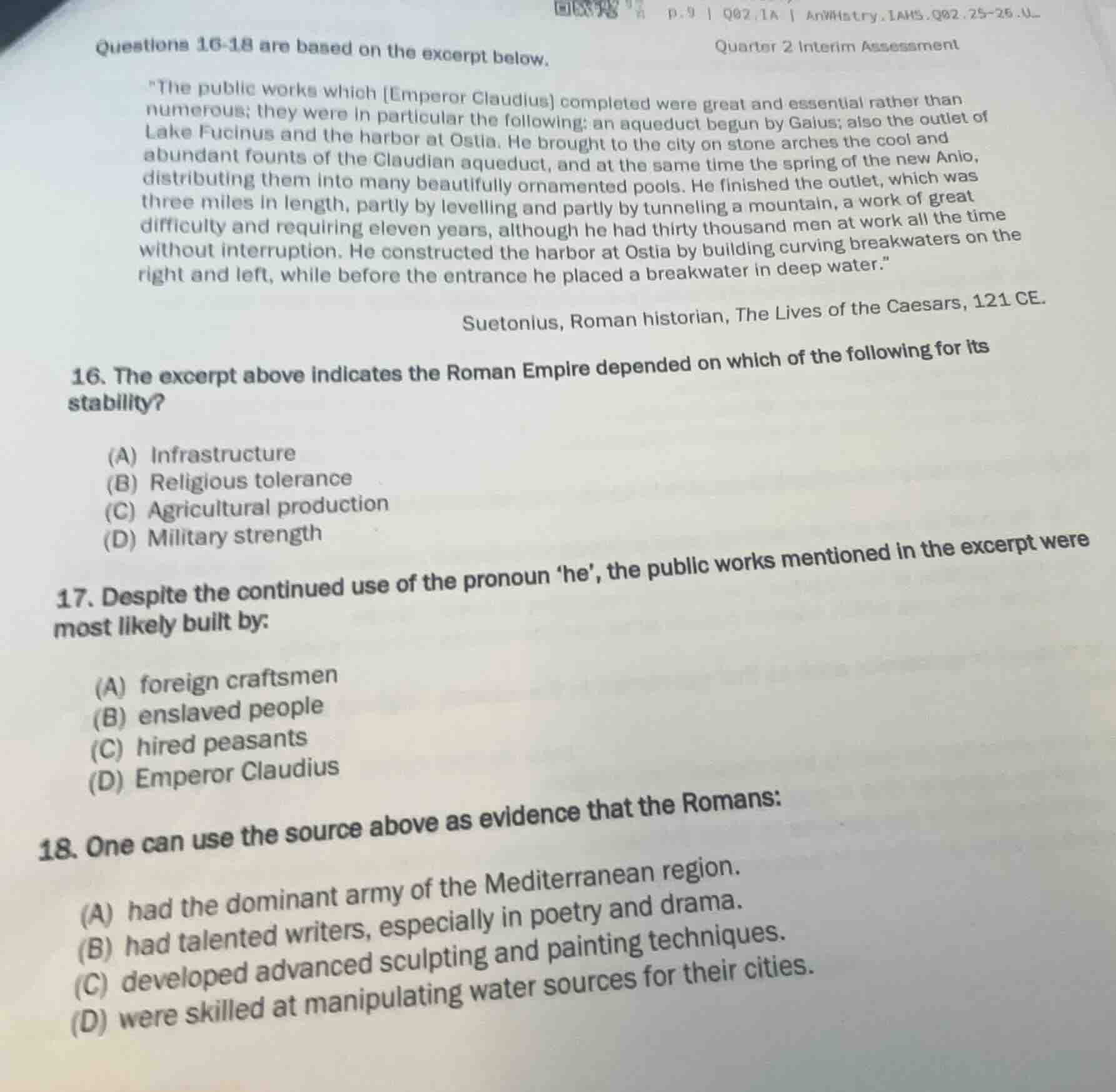
questions 16-18 are based on the excerpt below.
\the public works which emperor claudius completed were great and essential rather than numerous; they were in particular the following: an aqueduct begun by gaius; also the outlet of lake fucinus and the harbor at ostia. he brought to the city on stone arches the cool and abundant founts of the claudian aqueduct, and at the same time the spring of the new anio, distributing them into many beautifully ornamented pools. he finished the outlet, which was three miles in length, partly by levelling and partly by tunneling a mountain, a work of great difficulty and requiring eleven years, although he had thirty thousand men at work all the time without interruption. he constructed the harbor at ostia by building curving breakwaters on the right and left, while before the entrance he placed a breakwater in deep water.\
suetonius, roman historian, the lives of the caesars, 121 ce.
- the excerpt above indicates the roman empire depended on which of the following for its stability?
(a) infrastructure
(b) religious tolerance
(c) agricultural production
(d) military strength
- despite the continued use of the pronoun he, the public works mentioned in the excerpt were most likely built by:
(a) foreign craftsmen
(b) enslaved people
(c) hired peasants
(d) emperor claudius
- one can use the source above as evidence that the romans:
(a) had the dominant army of the mediterranean region.
(b) had talented writers, especially in poetry and drama.
(c) developed advanced sculpting and painting techniques.
(d) were skilled at manipulating water sources for their cities.
Question 16
The excerpt describes public works like aqueducts, outlets, and harbors. Infrastructure refers to such public works (buildings, systems) that support a society. Religious tolerance (B) is about accepting religions, not relevant. Agricultural production (C) is about farming, not here. Military strength (D) is about the army, not public works. So the Roman Empire’s stability depended on infrastructure.
In the Roman Empire, large public works like aqueducts and harbors were often built using enslaved people. Foreign craftsmen (A) were less likely as a primary labor source. Hired peasants (C) would not be the main labor for such massive projects. While the pronoun 'he' refers to Emperor Claudius, he would have used enslaved labor (not done the work himself, so D is wrong) to build these works.
The excerpt talks about aqueducts (bringing water) and water distribution. Option A is about the army, not in the excerpt. Option B is about writing, not here. Option C is about sculpting/painting, not mentioned. Option D: manipulating water sources (aqueducts, outlets) for cities matches the excerpt’s details about water systems.

Snap & solve any problem in the app
Get step-by-step solutions on Sovi AI
Photo-based solutions with guided steps
Explore more problems and detailed explanations
A. Infrastructure