QUESTION IMAGE
Question
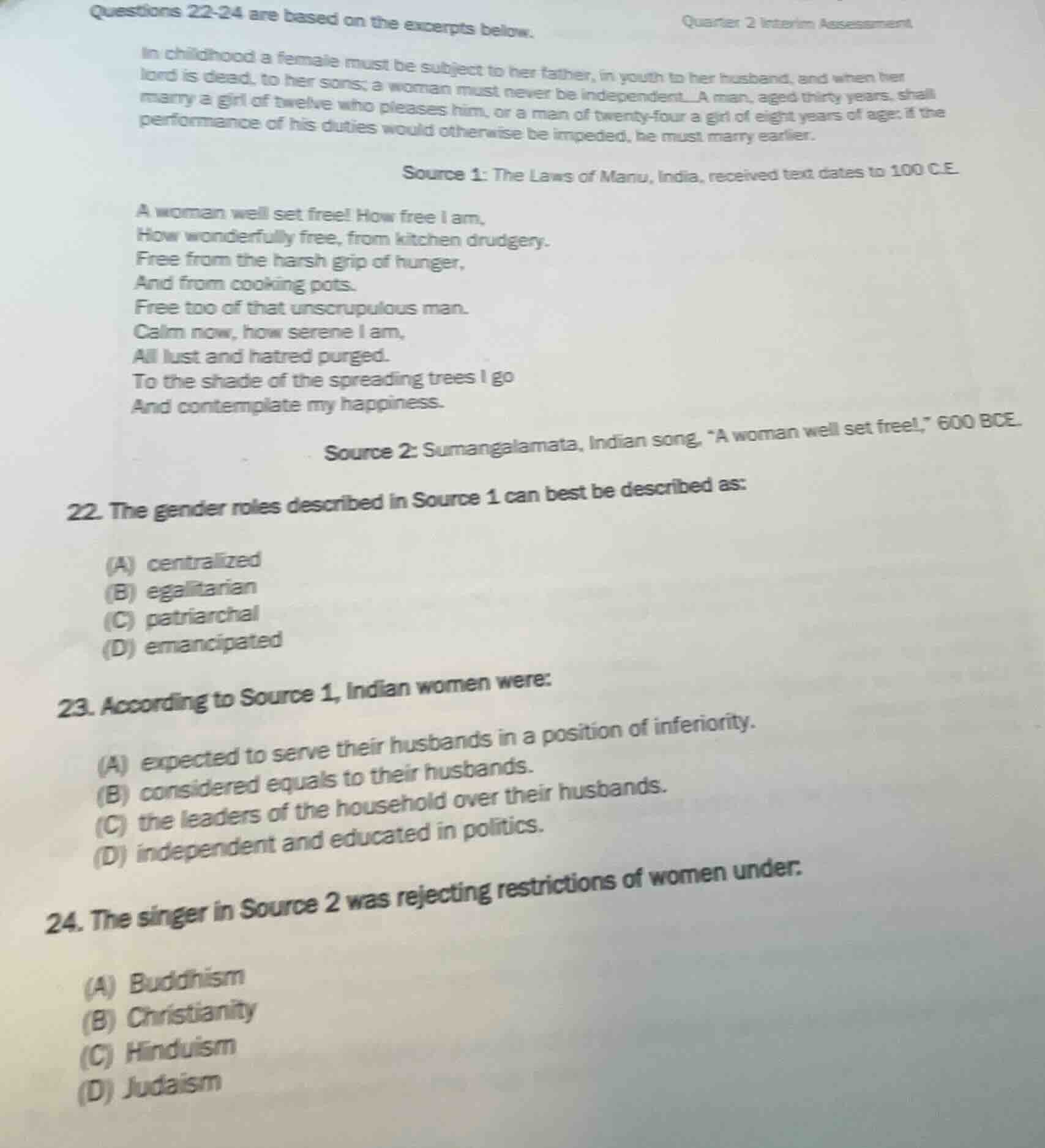
questions 22-24 are based on the excerpts below.
quarter 2 interim assessment
in childhood a female must be subject to her father, in youth to her husband, and when her lord is dead, to her sons; a woman must never be independent. a man, aged thirty years, shall marry a girl of twelve who pleases him, or a man of twenty - four a girl of eight years of age; if the performance of his duties would otherwise be impeded, he must marry earlier.
source 1: the laws of manu, india, received text dates to 100 c.e.
a woman well set free! how free i am,
how wonderfully free, from kitchen drudgery.
free from the harsh grip of hunger,
and from cooking pots.
free too of that unscrupulous man.
calm now, how serene i am,
all lust and hatred purged.
to the shade of the spreading trees i go
and contemplate my happiness.
source 2: sumangalamata, indian song, “a woman well set free!,” 600 bce.
- the gender roles described in source 1 can best be described as:
(a) centralized
(b) egalitarian
(c) patriarchal
(d) emancipated
- according to source 1, indian women were:
(a) expected to serve their husbands in a position of inferiority.
(b) considered equals to their husbands.
(c) the leaders of the household over their husbands.
(d) independent and educated in politics.
- the singer in source 2 was rejecting restrictions of women under:
(a) buddhism
(b) christianity
(c) hinduism
(d) judaism
Question 22
To solve this, we analyze Source 1: "In childhood a female must be subject to her father, in youth to her husband, and when her lord is dead, to her sons; a woman must never be independent..." This shows women are subordinate to men (father, husband, sons), which is a patriarchal (male - dominated) system. "Centralized" refers to a system with a central authority, not gender roles. "Egalitarian" means equality, which is opposite here. "Emancipated" means free from restraint, but Source 1 shows women are restricted. So the gender roles are patriarchal.
From Source 1: "In childhood a female must be subject to her father, in youth to her husband... a woman must never be independent." This implies women are expected to be subordinate to their husbands (serve in a position of inferiority). Option B (equals) is wrong as Source 1 shows subordination. Option C (leaders over husbands) is wrong as women are subject to husbands. Option D (independent and political) is wrong as Source 1 says women must never be independent and there's no mention of political education.
Source 1 is from "The Laws of Manu" which is associated with Hinduism. The song in Source 2 ("A woman well set free!") rejects restrictions. Buddhism was more egalitarian, but the restrictions in Source 1 are from Hindu - related traditions (Laws of Manu). Christianity and Judaism are not the main religious context of ancient India here. So the singer is rejecting restrictions under Hinduism.

Snap & solve any problem in the app
Get step-by-step solutions on Sovi AI
Photo-based solutions with guided steps
Explore more problems and detailed explanations
C. patriarchal