QUESTION IMAGE
Question
questions:
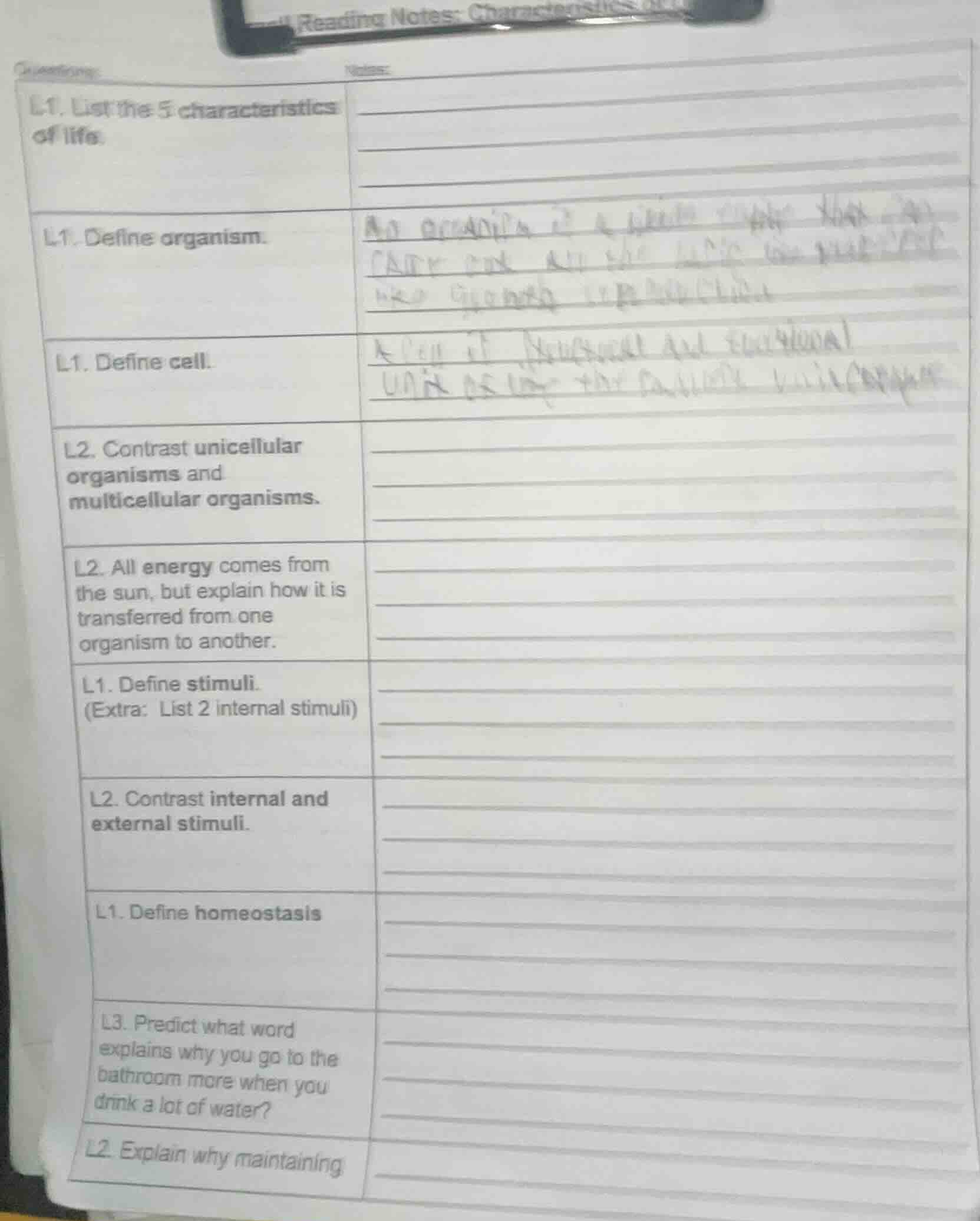
l1. list the 5 characteristics of life.
notes:
l1. define organism.
l1. define cell.
l2. contrast unicellular organisms and multicellular organisms.
l2. all energy comes from the sun, but explain how it is transferred from one organism to another.
l1. define stimuli. (extra: list 2 internal stimuli)
l2. contrast internal and external stimuli.
l1. define homeostasis
l3. predict what word explains why you go to the bathroom more when you drink a lot of water?
l2. explain why maintaining
L1. List the 5 characteristics of life.
The five characteristics of life are: 1. Made of cells (all living things are composed of one or more cells). 2. Reproduce (organisms produce offspring, either sexually or asexually). 3. Grow and develop (organisms increase in size and complexity over time). 4. Obtain and use energy (they take in energy from the environment and use it for life processes, like photosynthesis or cellular respiration). 5. Respond to stimuli (they react to changes in their internal or external environment).
An organism is a living entity that can carry out all the basic life processes (like growth, reproduction, energy use, response to stimuli, and maintaining homeostasis). It can be unicellular (e.g., bacteria) or multicellular (e.g., plants, animals, fungi) and is made of one or more cells.
A cell is the basic structural and functional unit of life. All living organisms are made of cells (unicellular: one cell; multicellular: many cells). Cells carry out processes like metabolism, growth, and reproduction, and they can be prokaryotic (no nucleus, e.g., bacteria) or eukaryotic (with a nucleus, e.g., plant/animal cells).

Snap & solve any problem in the app
Get step-by-step solutions on Sovi AI
Photo-based solutions with guided steps
Explore more problems and detailed explanations
- Made of cells
- Reproduce
- Grow and develop
- Obtain and use energy
- Respond to stimuli