QUESTION IMAGE
Question
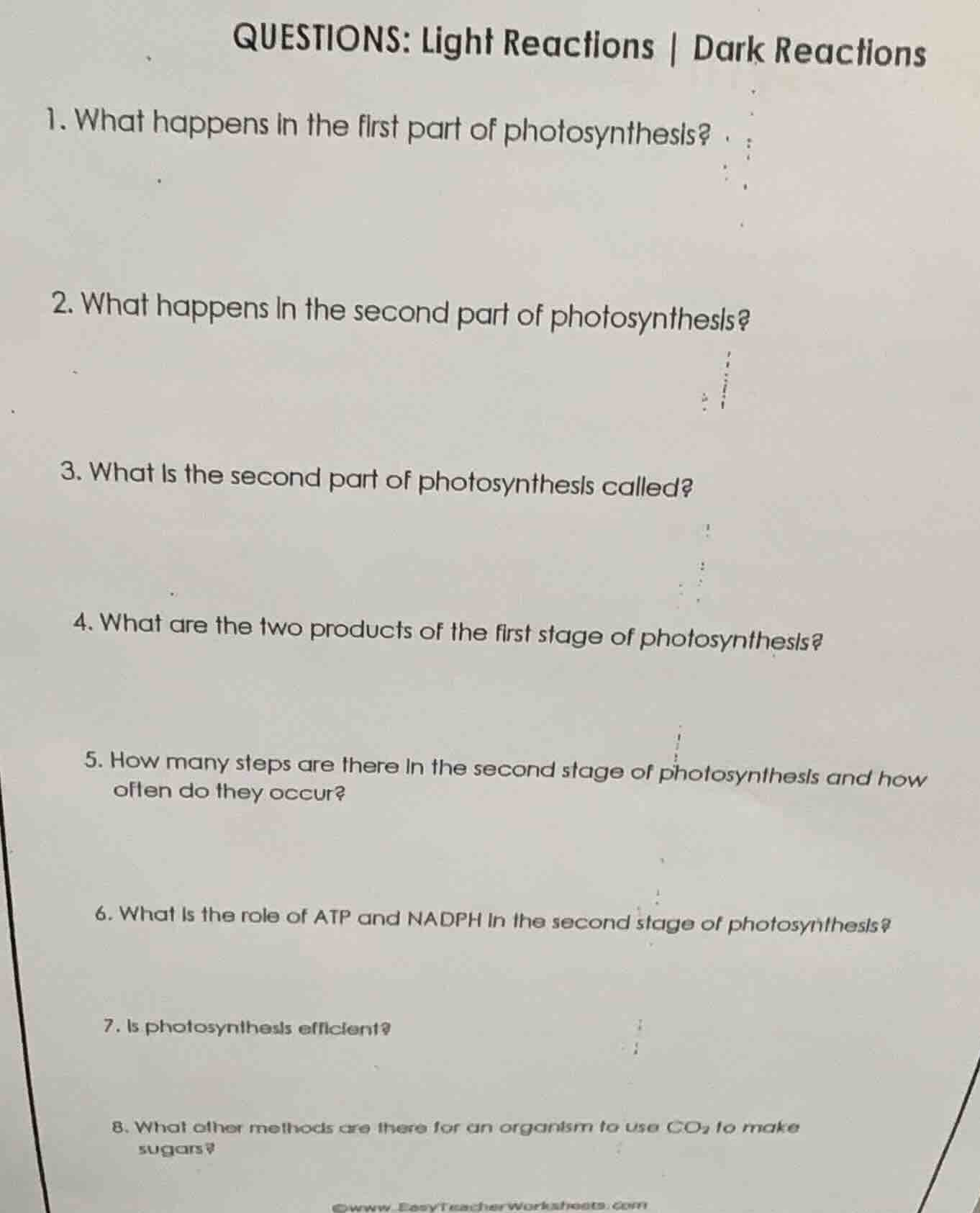
questions: light reactions | dark reactions
- what happens in the first part of photosynthesis?
- what happens in the second part of photosynthesis?
- what is the second part of photosynthesis called?
- what are the two products of the first stage of photosynthesis?
- how many steps are there in the second stage of photosynthesis and how often do they occur?
- what is the role of atp and nadph in the second stage of photosynthesis?
- is photosynthesis efficient?
- what other methods are there for an organism to use co₂ to make sugars?
Brief Explanations
- The first part of photosynthesis uses light energy to split water, produce ATP, NADPH, and release oxygen.
- The second part uses ATP/NADPH to turn CO₂ into glucose.
- The second part is named for not needing light directly.
- The first stage makes energy carriers and releases oxygen.
- The second stage's core cycle repeats to build glucose.
- ATP/NADPH provide energy and electrons for sugar building.
- Photosynthesis has low energy conversion efficiency.
- Alternative pathways fix CO₂ in specific environments.

Snap & solve any problem in the app
Get step-by-step solutions on Sovi AI
Photo-based solutions with guided steps
Explore more problems and detailed explanations
- In the first part (light reactions), chlorophyll captures light energy, splits water molecules ($\ce{H2O}$) into oxygen, hydrogen ions, and electrons. This energy is used to produce ATP (adenosine triphosphate) and NADPH (nicotinamide adenine dinucleotide phosphate), which are energy carriers.
- In the second part, the ATP and NADPH from the first stage are used to convert carbon dioxide ($\ce{CO2}$) into glucose (a sugar molecule) through a series of chemical reactions.
- The second part of photosynthesis is called the Calvin Cycle (or dark reactions/light-independent reactions).
- The two main products of the first stage are ATP and NADPH; oxygen is also a byproduct.
- The second stage (Calvin Cycle) has 3 main steps, and the cycle must repeat 6 times to produce one molecule of glucose.
- ATP provides the chemical energy needed for the chemical reactions in the Calvin Cycle, while NADPH provides the high-energy electrons required to convert carbon dioxide into glucose.
- No, photosynthesis is not very efficient. Only about 1-2% of the light energy that reaches plants is actually converted into chemical energy in glucose.
- Other methods include C4 photosynthesis (used by plants like corn and sugarcane in hot, dry environments) and CAM (Crassulacean Acid Metabolism) photosynthesis (used by succulents like cacti, which open stomata at night to take in $\ce{CO2}$).