QUESTION IMAGE
Question
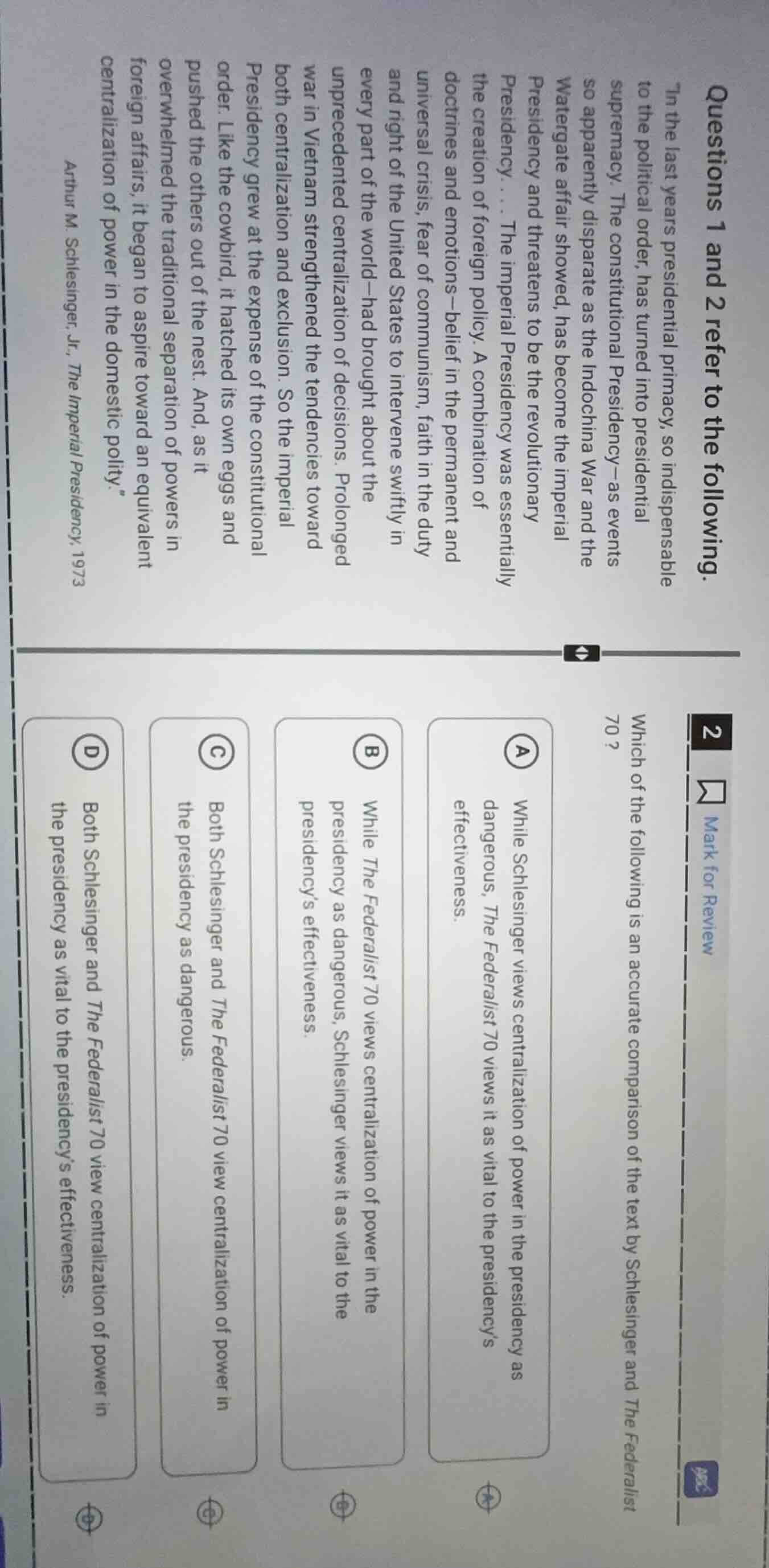
questions 1 and 2 refer to the following.\in the last years presidential primacy, so indispensable to the political order, has turned into presidential supremacy. the constitutional presidency—as events so apparently disparate as the indochina war and the watergate affair showed, has become the imperial presidency and threatens to be the revolutionary presidency. . . . the imperial presidency was essentially the creation of foreign policy. a combination of doctrines and emotions—belief in the permanent and universal crisis, fear of communism, faith in the duty and right of the united states to intervene swiftly in every part of the world—had brought about the unprecedented centralization of decisions. prolonged war in vietnam strengthened the tendencies toward both centralization and exclusion. so the imperial presidency grew at the expense of the constitutional order. like the cowbird, it hatched its own eggs and pushed the others out of the nest. and, as it overwhelmed the traditional separation of powers in foreign affairs, it began to aspire toward an equivalent centralization of power in the domestic polity.\arthur m. schlesinger, jr., the imperial presidency, 19732 mark for reviewwhich of the following is an accurate comparison of the text by schlesinger and the federalist 70 ?a while schlesinger views centralization of power in the presidency as dangerous, the federalist 70 views it as vital to the presidencys effectiveness.b while the federalist 70 views centralization of power in the presidency as dangerous, schlesinger views it as vital to the presidencys effectiveness.c both schlesinger and the federalist 70 view centralization of power in the presidency as dangerous.d both schlesinger and the federalist 70 view centralization of power in the presidency as vital to the presidencys effectiveness.
Schlesinger's text critiques the "imperial Presidency," arguing that centralized presidential power (from crises like Vietnam and Watergate) threatens the constitutional order, framing this centralization as dangerous. The Federalist 70 advocates for a strong, unified executive, stating that centralized power in the presidency is vital for effective governance and decisive action.

Snap & solve any problem in the app
Get step-by-step solutions on Sovi AI
Photo-based solutions with guided steps
Explore more problems and detailed explanations
A. While Schlesinger views centralization of power in the presidency as dangerous, The Federalist 70 views it as vital to the presidency's effectiveness.