QUESTION IMAGE
Question
radical functions and introduction to proof
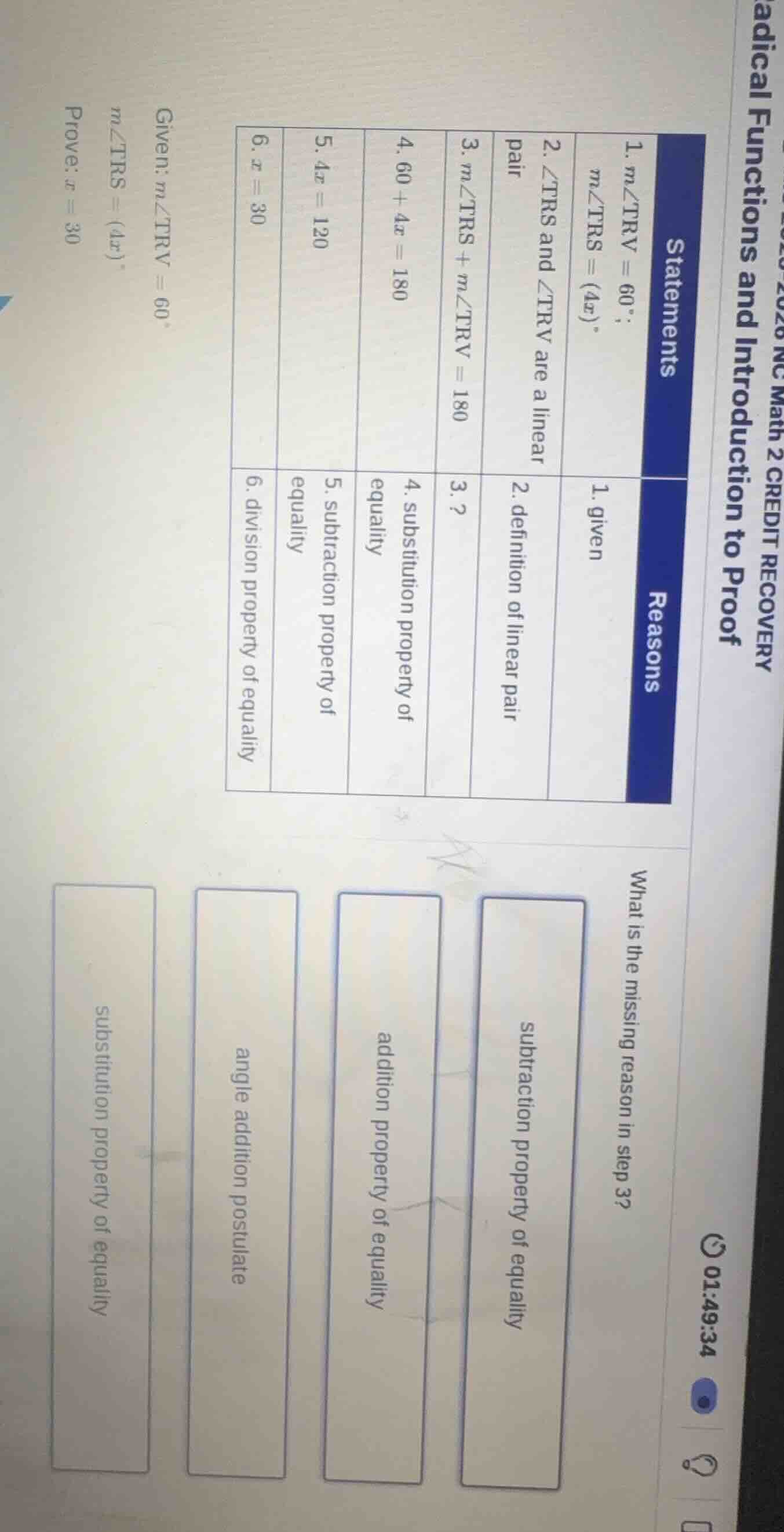
- given: ( mangle trv = 60^circ ); ( mangle trs = (4x)^circ )
- ( angle trs ) and ( angle trv ) are a linear pair
reason: definition of linear pair
- ( mangle trs + mangle trv = 180 )
reason:?
- ( 60 + 4x = 180 )
reason: substitution property of equality
- ( 4x = 120 )
reason: subtraction property of equality
- ( x = 30 )
reason: division property of equality
prove: ( x = 30 )
what is the missing reason in step 3?
options: subtraction property of equality, addition property of equality, angle addition postulate, substitution property of equality
Step1: Analyze the Proof Structure
We know that \( \angle TRS \) and \( \angle TRV \) are a linear pair (from step 2, by the definition of a linear pair). For a linear pair of angles, the sum of their measures is \( 180^\circ \) (this is a postulate in geometry called the linear pair postulate, which is also related to the angle addition postulate in the context of forming a straight line).
Step2: Identify the Missing Reason
The statement in step 3 is \( m\angle TRS + m\angle TRV = 180 \). Since \( \angle TRS \) and \( \angle TRV \) form a linear pair (they are adjacent and their non - common sides form a straight line), the reason for the equation \( m\angle TRS + m\angle TRV = 180 \) is the angle addition postulate (or the property of linear pairs which is derived from the angle addition postulate for a straight angle, where the sum of angles on a straight line is \( 180^\circ \)). Among the given options, "angle addition postulate" is the correct reason for step 3.

Snap & solve any problem in the app
Get step-by-step solutions on Sovi AI
Photo-based solutions with guided steps
Explore more problems and detailed explanations
angle addition postulate