QUESTION IMAGE
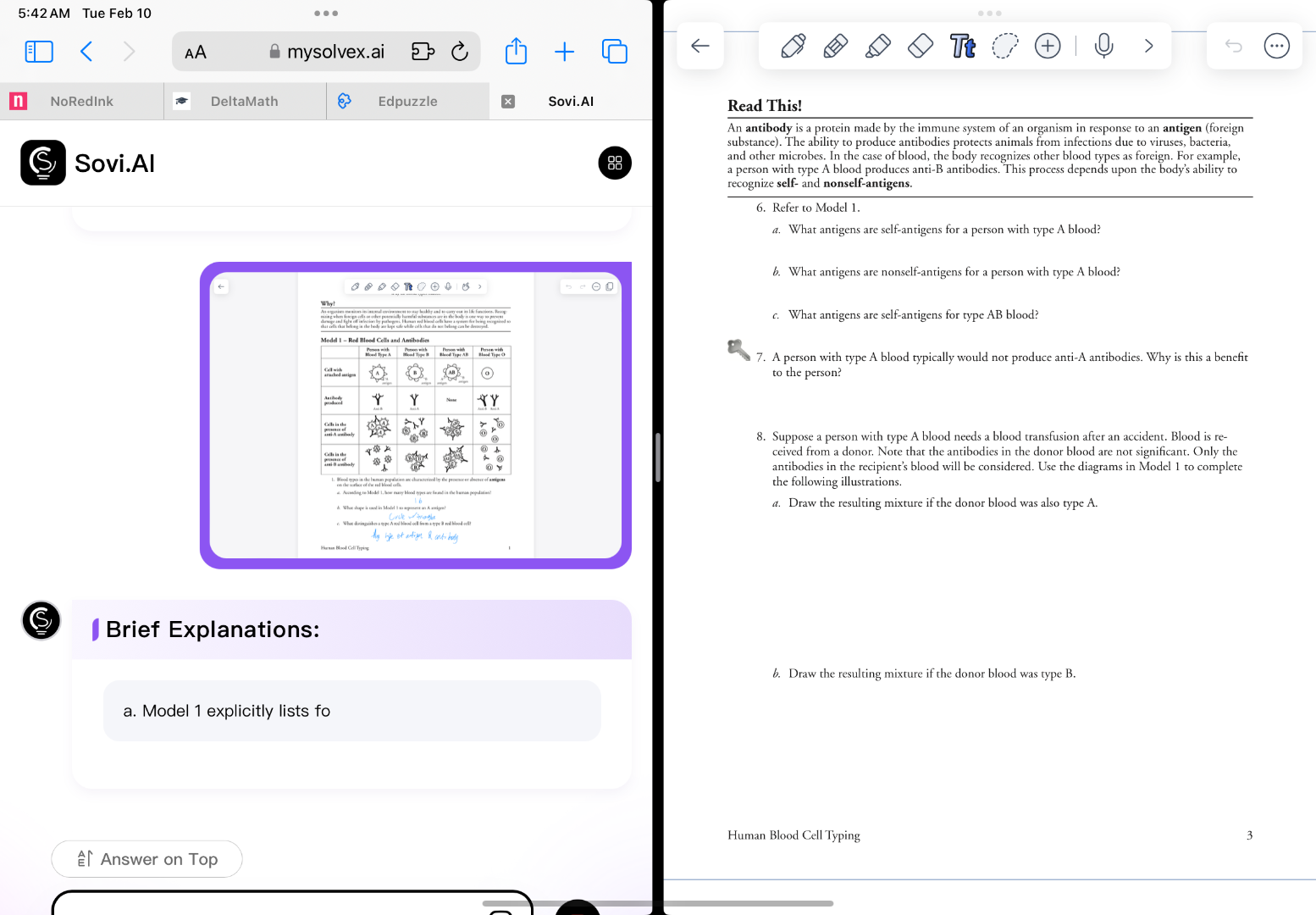
Question
read this!
an antibody is a protein made by the immune system of an organism in response to an antigen (foreign substance). the ability to produce antibodies protects animals from infections due to viruses, bacteria, and other microbes. in the case of blood, the body recognizes other blood types as foreign. for example, a person with type a blood produces anti-b antibodies. this process depends upon the bodys ability to recognize self- and nonself-antigens.
- refer to model 1.
a. what antigens are self-antigens for a person with type a blood?
b. what antigens are nonself-antigens for a person with type a blood?
c. what antigens are self-antigens for type ab blood?
- a person with type a blood typically would not produce anti-a antibodies. why is this a benefit to the person?
- suppose a person with type a blood needs a blood transfusion after an accident. blood is received from a donor. note that the antibodies in the donor blood are not significant. only the antibodies in the recipients blood will be considered. use the diagrams in model 1 to complete the following illustrations.
a. draw the resulting mixture if the donor blood was also type a.
b. draw the resulting mixture if the donor blood was type b.
human blood cell typing
- a. Self-antigens are those the body recognizes as its own; type A blood has A antigens on its red blood cells, so these are self.
- b. Nonself-antigens are foreign to the body; type A blood does not have B antigens, so B antigens are foreign.
- c. Type AB blood has both A and B antigens on its red blood cells, so both are recognized as self.
- If anti-A antibodies were produced, they would bind to the A antigens on the person's own red blood cells, causing clumping (agglutination) and destruction of their own blood, which would be life-threatening. Avoiding this prevents self-harm to the circulatory system.
- a. Donor type A blood has the same A antigens as the recipient; the recipient's anti-B antibodies do not recognize A antigens, so no clumping happens.
- b. Donor type B blood has B antigens, which are foreign to the type A recipient. The recipient's anti-B antibodies bind to the B antigens on the donor's red blood cells, causing the cells to clump together.

Snap & solve any problem in the app
Get step-by-step solutions on Sovi AI
Photo-based solutions with guided steps
Explore more problems and detailed explanations
- a. A antigens
- b. B antigens
- c. A and B antigens
- Preventing self-attack of own blood cells
- a. (Diagram: Type A red blood cells with A antigens mixed with recipient plasma containing anti-B antibodies; no clumping occurs, cells remain dispersed)
- b. (Diagram: Type B red blood cells with B antigens mixed with recipient plasma containing anti-B antibodies; visible clumping/agglutination of red blood cells occurs)