QUESTION IMAGE
Question
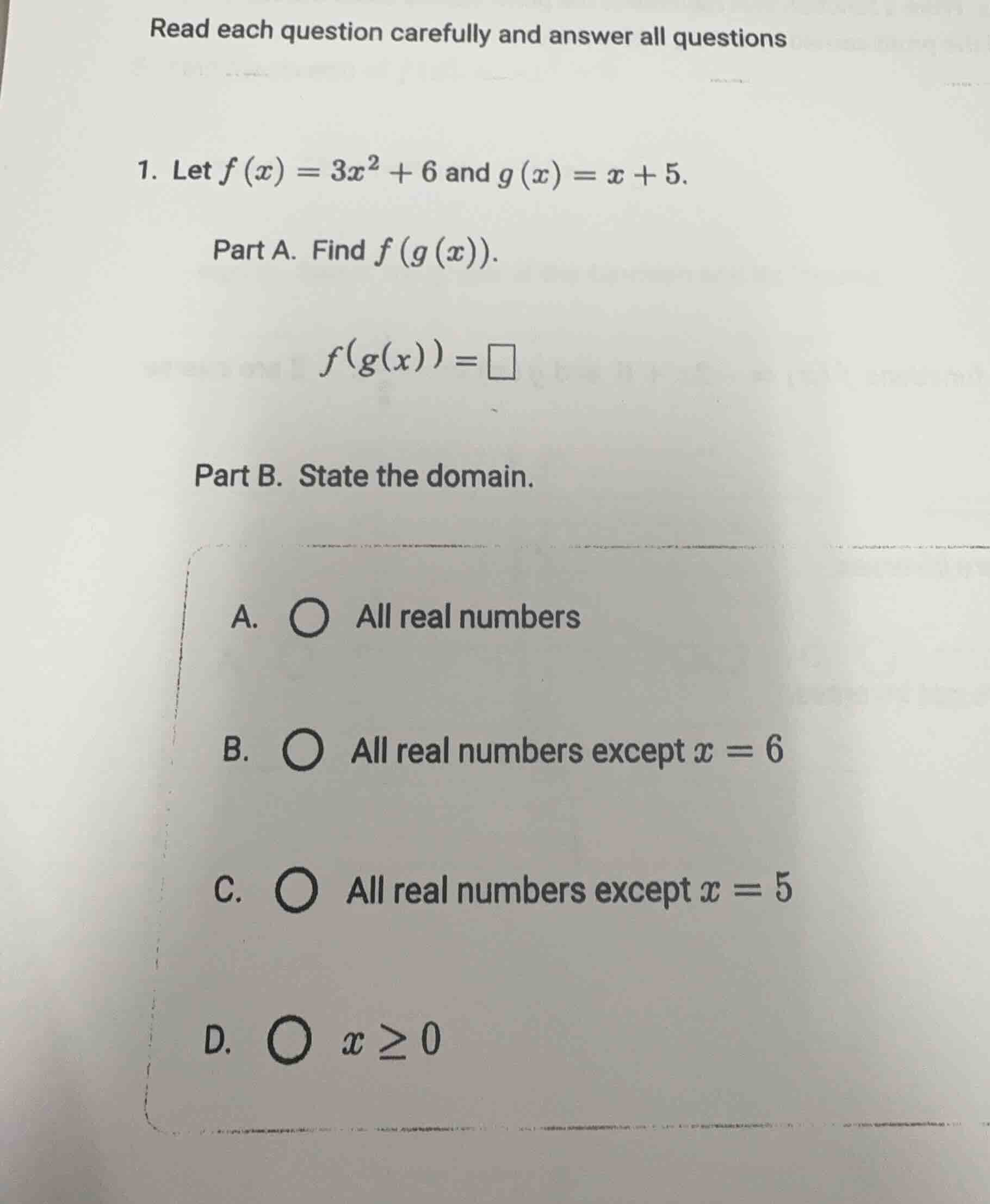
read each question carefully and answer all questions
- let $f(x) = 3x^2 + 6$ and $g(x) = x + 5$.
part a. find $f(g(x))$.
$f(g(x)) = \square$
part b. state the domain.
a. $\bigcirc$ all real numbers
b. $\bigcirc$ all real numbers except $x = 6$
c. $\bigcirc$ all real numbers except $x = 5$
d. $\bigcirc$ $x \geq 0$
Part A
Step1: Substitute \( g(x) \) into \( f(x) \)
We know \( f(x) = 3x^2 + 6 \) and \( g(x) = x + 5 \). To find \( f(g(x)) \), we replace \( x \) in \( f(x) \) with \( g(x) = x + 5 \). So we get \( f(g(x)) = 3(x + 5)^2 + 6 \).
Step2: Expand \( (x + 5)^2 \)
Using the formula \( (a + b)^2 = a^2 + 2ab + b^2 \), where \( a = x \) and \( b = 5 \), we have \( (x + 5)^2 = x^2 + 10x + 25 \). Then \( f(g(x)) = 3(x^2 + 10x + 25) + 6 \).
Step3: Distribute the 3
Multiply each term inside the parentheses by 3: \( 3x^2 + 30x + 75 + 6 \).
Step4: Combine like terms
Add 75 and 6: \( 3x^2 + 30x + 81 \).
The function \( f(g(x)) = 3x^2 + 30x + 81 \) is a quadratic function. Quadratic functions are polynomials, and the domain of all polynomial functions (including quadratics) is all real numbers because there are no restrictions (like division by zero or square roots of negative numbers) that would exclude any real number \( x \).

Snap & solve any problem in the app
Get step-by-step solutions on Sovi AI
Photo-based solutions with guided steps
Explore more problems and detailed explanations
\( 3x^2 + 30x + 81 \)