QUESTION IMAGE
Question
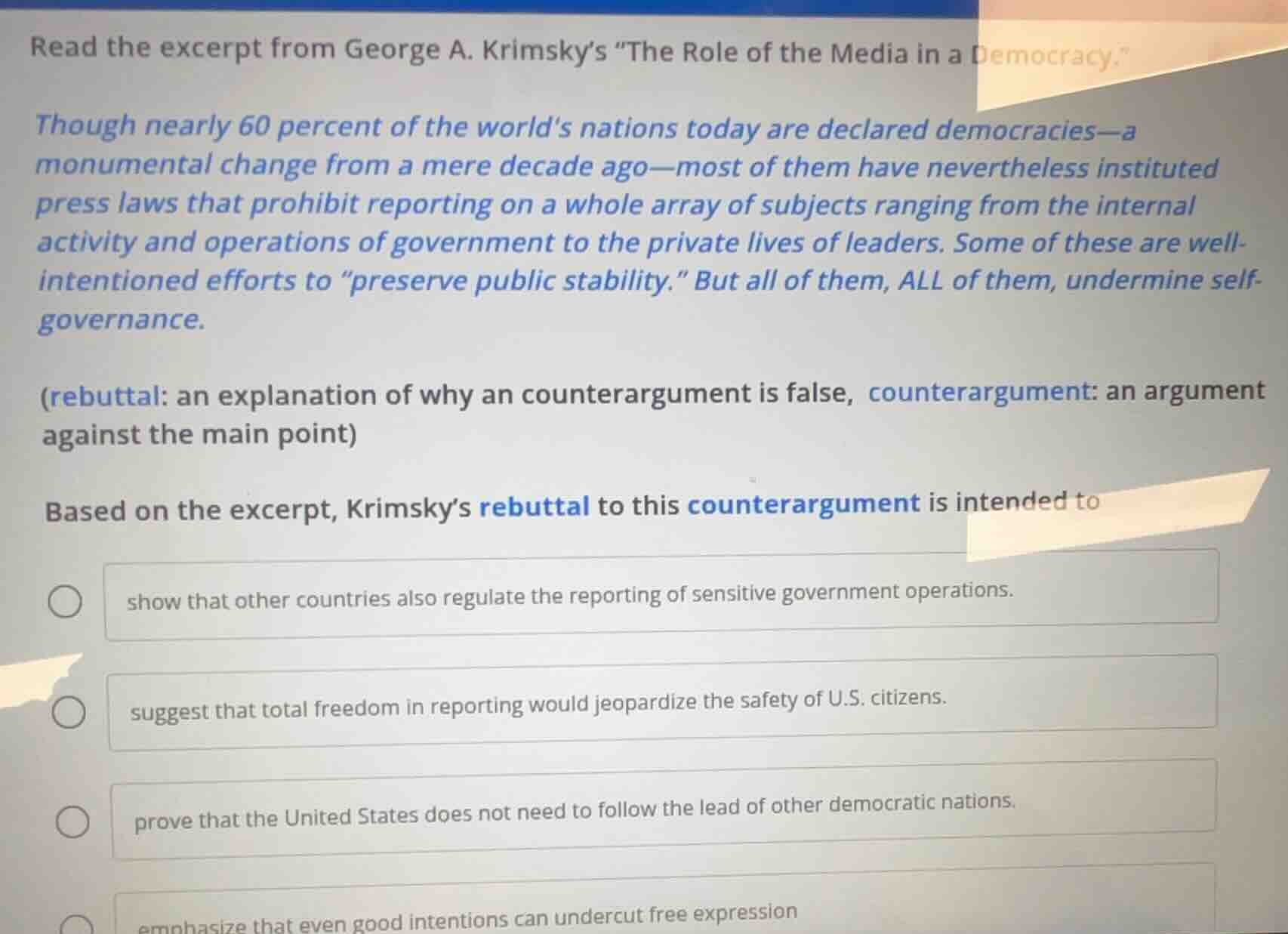
read the excerpt from george a. krimsky’s “the role of the media in a democracy.”
though nearly 60 percent of the world’s nations today are declared democracies—a monumental change from a mere decade ago—most of them have nevertheless instituted press laws that prohibit reporting on a whole array of subjects ranging from the internal activity and operations of government to the private lives of leaders. some of these are well - intentioned efforts to “preserve public stability.” but all of them, all of them, undermine self - governance.
(rebuttal: an explanation of why an counterargument is false, counterargument: an argument against the main point)
based on the excerpt, krimsky’s rebuttal to this counterargument is intended to
○ show that other countries also regulate the reporting of sensitive government operations.
○ suggest that total freedom in reporting would jeopardize the safety of u.s. citizens.
○ prove that the united states does not need to follow the lead of other democratic nations.
○ emphasize that even good intentions can undercut free expression
The counterargument here is that press laws are well-intentioned to "preserve public stability." Krimsky's rebuttal is that all these laws, even those with good motives, undermine self-governance (a core part of which is free expression for a democracy). Matching this, the correct option addresses how even good-intentioned restrictions harm free expression. The other options are irrelevant: no mention of other countries' regulation as a point, no focus on U.S. citizen safety, and no discussion of the U.S. following other nations.

Snap & solve any problem in the app
Get step-by-step solutions on Sovi AI
Photo-based solutions with guided steps
Explore more problems and detailed explanations
D. emphasize that even good intentions can undercut free expression