QUESTION IMAGE
Question
read the following passage carefully before you choose your answers.
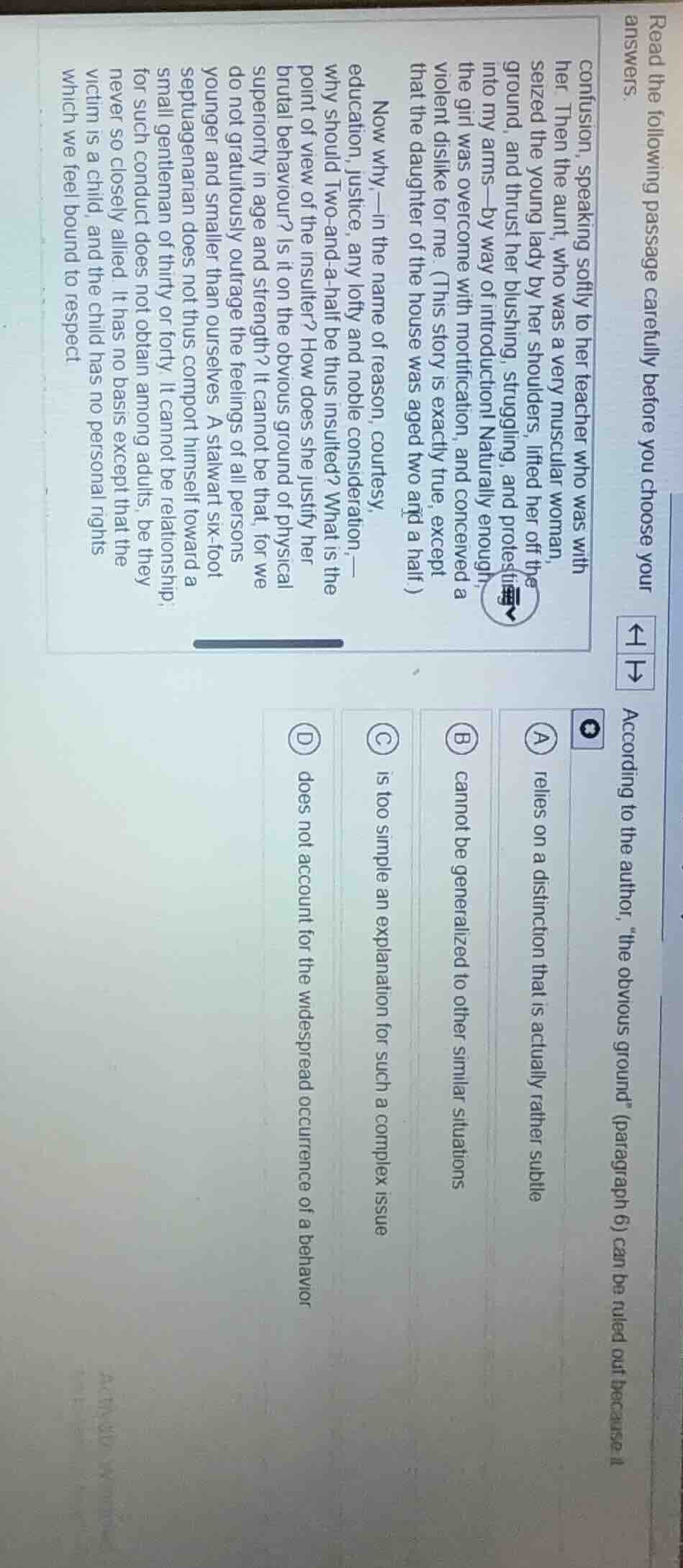
confusion, speaking softly to her teacher who was with her. then the aunt, who was a very muscular woman, seized the young lady by her shoulders, lifted her off the ground, and thrust her blushing, struggling, and protesting into my arms—by way of introduction! naturally enough, the girl was overcome with mortification, and conceived a violent dislike for me. (this story is exactly true, except that the daughter of the house was aged two and a half.)
now why—in the name of reason, courtesy, education, justice, any lofty and noble consideration,—why should two-and-a-half be thus insulted? what is the point of view of the insulter? how does she justify her brutal behaviour? is it on the obvious ground of physical superiority in age and strength? it cannot be that, for we do not gratuitously outrage the feelings of all persons younger and smaller than ourselves. a stalwart six-foot septuagenarian does not thus comport himself toward a small gentleman of thirty or forty. it cannot be relationship, for such conduct does not obtain among adults, be they never so closely allied. it has no basis except that the victim is a child, and the child has no personal rights which we feel bound to respect.
according to the author, “the obvious ground” (paragraph 6) can be ruled out because it
a relies on a distinction that is actually rather subtle
b cannot be generalized to other similar situations
c is too simple an explanation for such a complex issue
d does not account for the widespread occurrence of a behavior
The author argues that physical superiority (the "obvious ground") cannot justify the behavior, as it does not apply to all people (e.g., a large older person would not act this way toward a smaller younger one) and only applies when the victim is a child (a narrow case). This means it fails to explain why this behavior is widespread across adult interactions.

Snap & solve any problem in the app
Get step-by-step solutions on Sovi AI
Photo-based solutions with guided steps
Explore more problems and detailed explanations
D. does not account for the widespread occurrence of a behavior