QUESTION IMAGE
Question
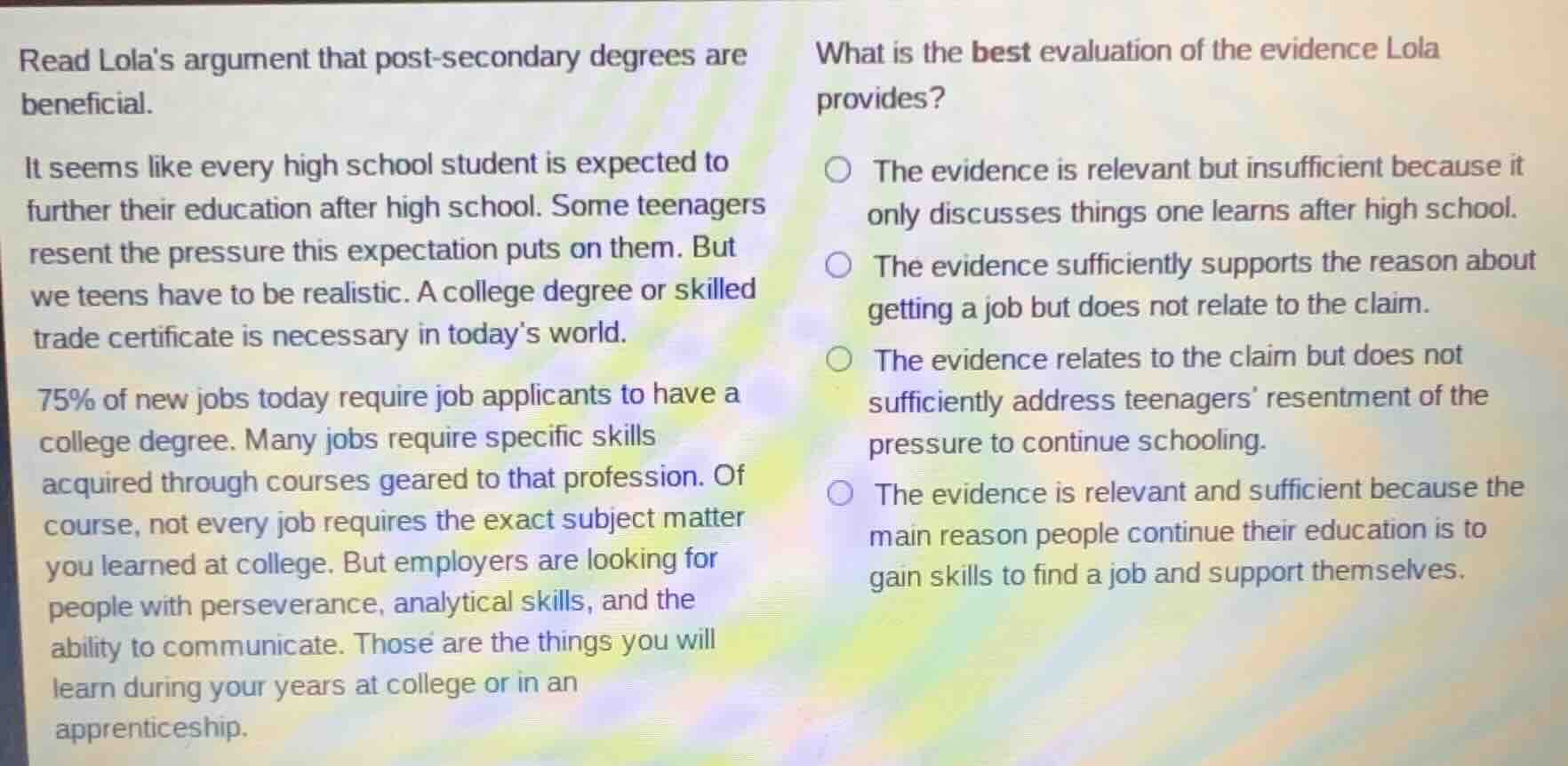
read lolas argument that post-secondary degrees are beneficial.
it seems like every high school student is expected to further their education after high school. some teenagers resent the pressure this expectation puts on them. but we teens have to be realistic. a college degree or skilled trade certificate is necessary in todays world.
75% of new jobs today require job applicants to have a college degree. many jobs require specific skills acquired through courses geared to that profession. of course, not every job requires the exact subject matter you learned at college. but employers are looking for people with perseverance, analytical skills, and the ability to communicate. those are the things you will learn during your years at college or in an apprenticeship.
what is the best evaluation of the evidence lola provides?
- the evidence is relevant but insufficient because it only discusses things one learns after high school.
- the evidence sufficiently supports the reason about getting a job but does not relate to the claim.
- the evidence relates to the claim but does not sufficiently address teenagers resentment of the pressure to continue schooling.
- the evidence is relevant and sufficient because the main reason people continue their education is to gain skills to find a job and support themselves.
Lola's claim is that post - secondary degrees are beneficial. Her evidence focuses on job requirements (75% of new jobs need a college degree, jobs need specific skills from post - secondary education, and employers look for skills learned in post - secondary) which relates to the claim as it shows why post - secondary is beneficial for jobs. But her evidence does not address the teenagers' resentment of the pressure to continue schooling. Let's analyze each option:
- Option 1: The evidence is about job - related benefits of post - secondary, not just "things one learns after high school", so this is incorrect.
- Option 2: The evidence does relate to the claim (post - secondary is beneficial) as it shows job - related benefits, so this is incorrect.
- Option 3: This matches our analysis. The evidence shows how post - secondary helps with jobs (relates to the claim) but does not talk about teenagers' resentment.
- Option 4: The evidence does not fully cover all aspects of why people continue education (and the claim is about post - secondary being beneficial, not just job - related reasons for continuing education), and it also does not address the resentment, so it's not sufficient.

Snap & solve any problem in the app
Get step-by-step solutions on Sovi AI
Photo-based solutions with guided steps
Explore more problems and detailed explanations
The evidence relates to the claim but does not sufficiently address teenagers’ resentment of the pressure to continue schooling.