QUESTION IMAGE
Question
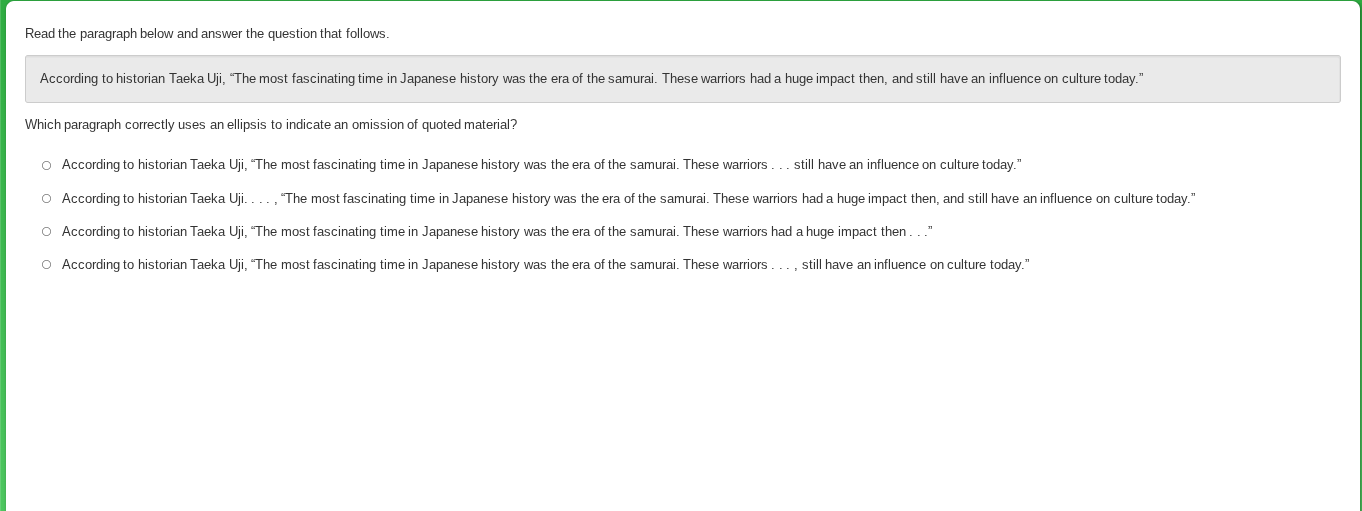
read the paragraph below and answer the question that follows.
according to historian taeka uji, \the most fascinating time in japanese history was the era of the samurai. these warriors had a huge impact then, and still have an influence on culture today.\
which paragraph correctly uses an ellipsis to indicate an omission of quoted material?
○ according to historian taeka uji, \the most fascinating time in japanese history was the era of the samurai. these warriors . . . still have an influence on culture today.\
○ according to historian taeka uji. . . . , \the most fascinating time in japanese history was the era of the samurai. these warriors had a huge impact then, and still have an influence on culture today.\
○ according to historian taeka uji, \the most fascinating time in japanese history was the era of the samurai. these warriors had a huge impact then . . .\
○ according to historian taeka uji, \the most fascinating time in japanese history was the era of the samurai. these warriors . . . , still have an influence on culture today.\
An ellipsis (...) correctly indicates omitted quoted material when it replaces removed words from the original quote, with proper spacing and placement.
- The first option omits "had a huge impact then, and" from the original, placing the ellipsis between the remaining parts of the sentence with correct spacing, matching the rule for omitting middle sentence content.
- The second option places the ellipsis after the historian's name, which is not part of the quoted material, so it is incorrect.
- The third option's ellipsis at the end does not clearly show a meaningful omission of quoted content (it truncates the sentence without a logical omitted section).
- The fourth option uses an unnecessary comma after the ellipsis, which is not standard for indicating omitted quoted material.

Snap & solve any problem in the app
Get step-by-step solutions on Sovi AI
Photo-based solutions with guided steps
Explore more problems and detailed explanations
A. According to historian Taeka Uji, "The most fascinating time in Japanese history was the era of the samurai. These warriors . . . still have an influence on culture today."