QUESTION IMAGE
Question
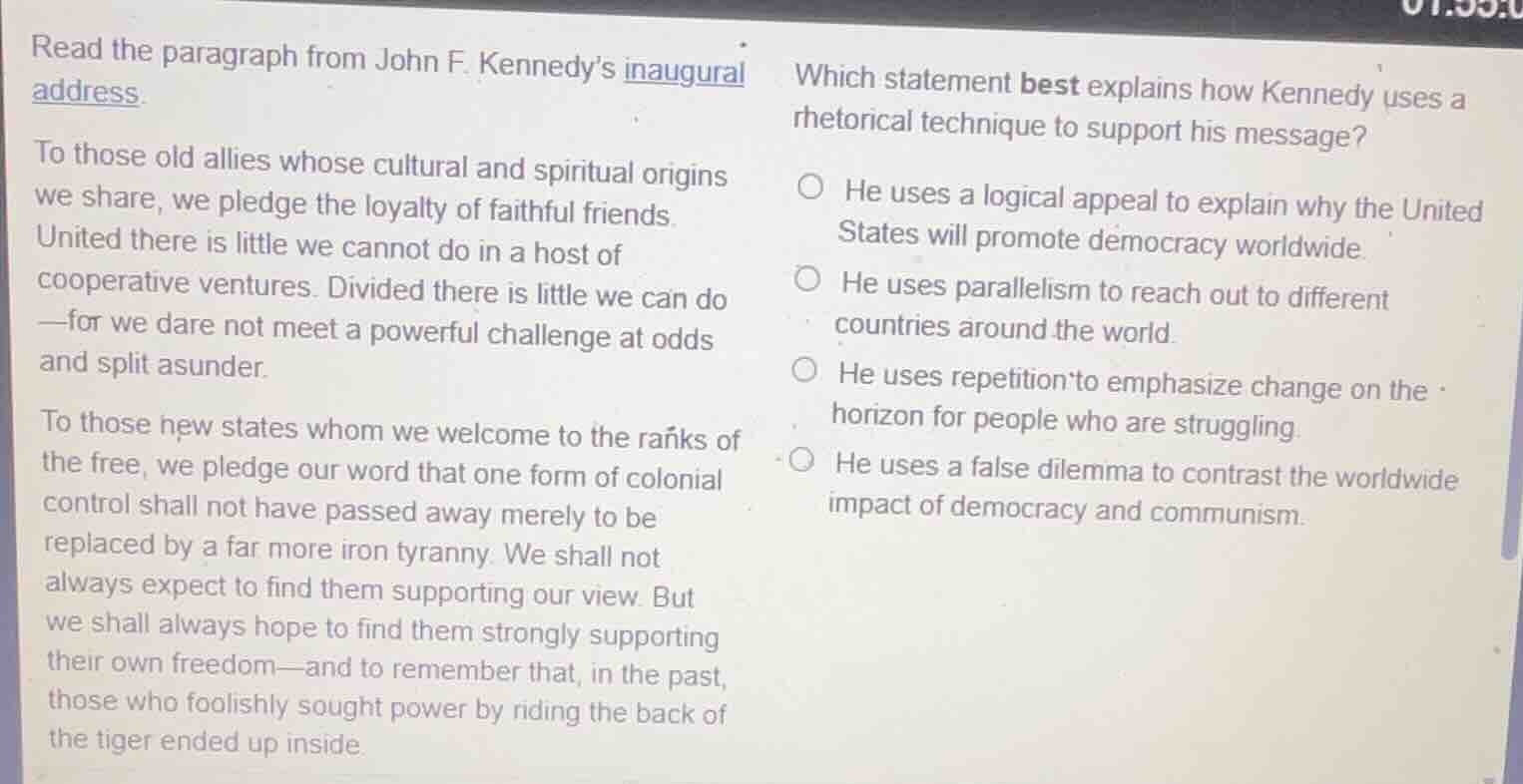
read the paragraph from john f. kennedys inaugural address.
to those old allies whose cultural and spiritual origins we share, we pledge the loyalty of faithful friends. united there is little we cannot do in a host of cooperative ventures. divided there is little we can do —for we dare not meet a powerful challenge at odds and split asunder.
to those new states whom we welcome to the ranks of the free, we pledge our word that one form of colonial control shall not have passed away merely to be replaced by a far more iron tyranny. we shall not always expect to find them supporting our view. but we shall always hope to find them strongly supporting their own freedom—and to remember that, in the past, those who foolishly sought power by riding the back of the tiger ended up inside.
which statement best explains how kennedy uses a rhetorical technique to support his message?
○ he uses a logical appeal to explain why the united states will promote democracy worldwide.
○ he uses parallelism to reach out to different countries around the world.
○ he uses repetition to emphasize change on the horizon for people who are struggling.
○ he uses a false dilemma to contrast the worldwide impact of democracy and communism.
Parallelism is seen in the structure "To those old allies... we pledge..." and "To those new states... we pledge...", which repeats a grammatical framework to address different groups of countries. The other options are incorrect: there is no logical appeal focused on democracy promotion, no repetition emphasizing struggle-related change, and no false dilemma contrasting democracy and communism in the provided text.

Snap & solve any problem in the app
Get step-by-step solutions on Sovi AI
Photo-based solutions with guided steps
Explore more problems and detailed explanations
He uses parallelism to reach out to different countries around the world.