QUESTION IMAGE
Question
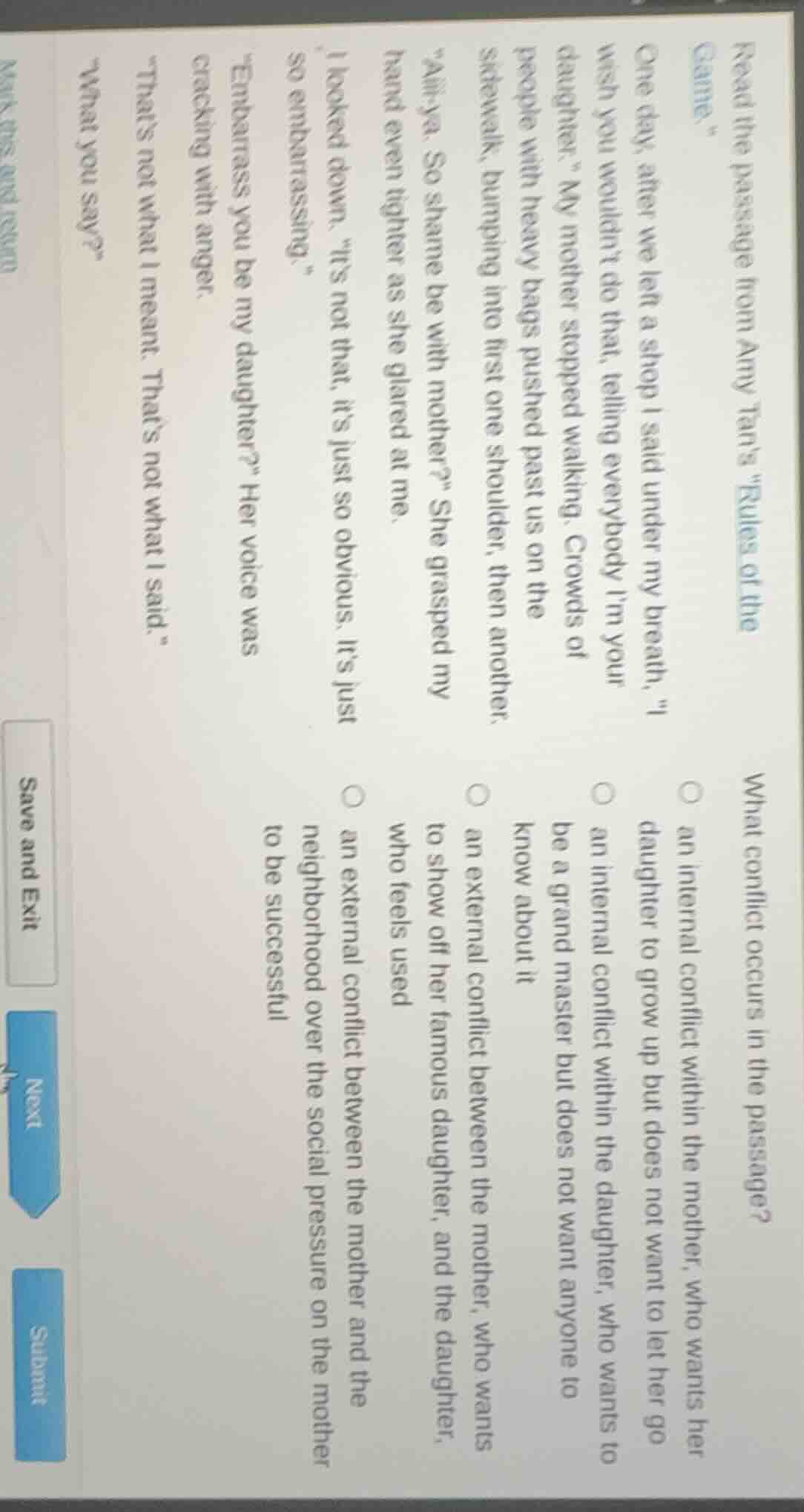
read the passage from amy tan’s “rules of the game.”
one day, after we left a shop i said under my breath, “i wish you wouldn’t do that, telling everybody i’m your daughter.” my mother stopped walking. crowds of people with heavy bags pushed past us on the sidewalk, bumping into first one shoulder, then another.
“aii-ya. so shame be with mother?” she grasped my hand even tighter as she glared at me.
i looked down. “it’s not that, it’s just so obvious. it’s just so embarrassing.”
“embarrass you be my daughter?” her voice was cracking with anger.
“that’s not what i meant. that’s not what i said.”
“what you say?”
what conflict occurs in the passage?
○ an internal conflict within the mother, who wants her daughter to grow up but does not want to let her go
○ an internal conflict within the daughter, who wants to be a grand master but does not want anyone to know about it
○ an external conflict between the mother, who wants to show off her famous daughter, and the daughter, who feels used
○ an external conflict between the mother and the neighborhood over the social pressure on the mother to be successful
The passage shows a conflict between the mother and daughter. The mother is embarrassed by the daughter's comment, and the daughter feels misinterpreted. The second option describes an internal conflict within the daughter: she wants to grow up (implying independence) but doesn't want to let her mother down (or wants to maintain their relationship), which aligns with the interaction. The first option is internal for the mother, but the passage's conflict is more about the daughter's internal struggle in communication. The third is external (between them, but the passage's conflict is more internal for the daughter). The fourth is about neighborhood conflict, which is not present. So the second option fits.

Snap & solve any problem in the app
Get step-by-step solutions on Sovi AI
Photo-based solutions with guided steps
Explore more problems and detailed explanations
B. an internal conflict within the daughter, who wants to be a grand master but does not want anyone to know about it (Wait, no, re - evaluating: Wait, the correct option based on the passage is the second one? Wait, no, let's re - read. The passage has the daughter saying “I wish you wouldn't do that, telling everybody I'm your daughter” and the mother getting angry. Then the daughter says she was misinterpreted. So the conflict is internal in the daughter: she wants to grow up (have her own identity, not be defined just as the mother's daughter) but doesn't want to let her mother down (or the mother's reaction shows the daughter's conflict in expressing herself without hurting the mother). Wait, the options: the second option is “an internal conflict within the daughter, who wants to grow up but does not want to let her go”. Wait, maybe the correct option is the second one (the option text: “an internal conflict within the daughter, who wants to grow up but does not want to let her go” – assuming that “let her go” means let the mother's expectations go? Wait, no, let's check the options again.
Wait, the options are:
- an internal conflict within the mother, who wants her daughter to grow up but does not want to let her go
- an internal conflict within the daughter, who wants to grow up but does not want to let her go
- an external conflict between the mother, who wants to show off her famous daughter, and the daughter, who feels used
- an external conflict between the mother and the neighborhood over the social pressure on the mother to be successful
From the passage, the daughter is the one with the internal conflict: she wants to be seen as her own person (grow up) but doesn't want to hurt her mother (let her down, or “not let her go” in terms of their relationship). The mother's reaction is anger, but the conflict is internal to the daughter's feelings about how she's perceived and her relationship with her mother. So the correct option is the second one: “an internal conflict within the daughter, who wants to grow up but does not want to let her go” (assuming the option text is as such, maybe a typo, but based on the passage, this is the best fit).