QUESTION IMAGE
Question
read the passage. then answer the question below.
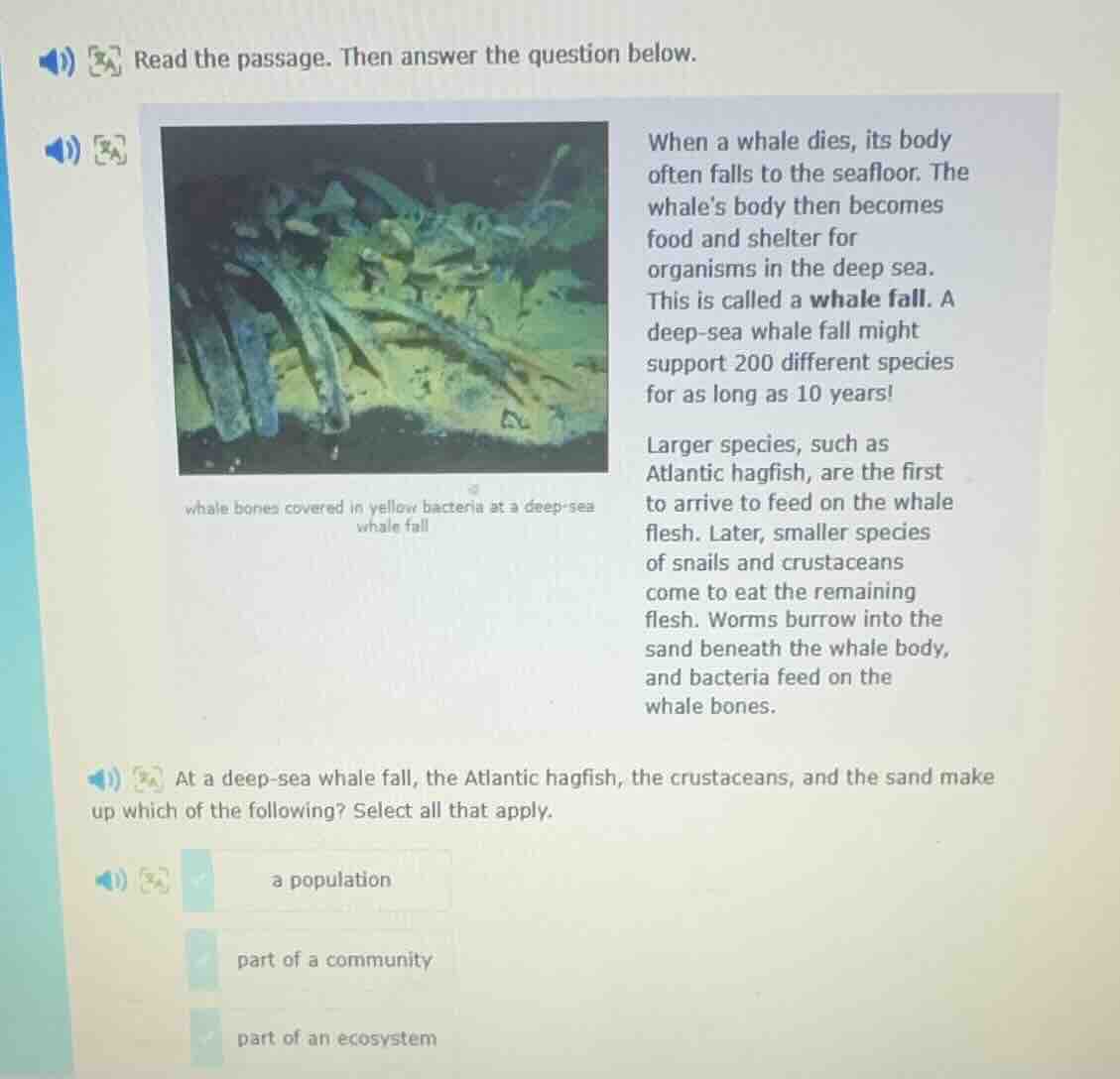
image: whale bones covered in yellow bacteria at a deep - sea whale fall
when a whale dies, its body often falls to the seafloor. the whale’s body then becomes food and shelter for organisms in the deep sea. this is called a whale fall. a deep - sea whale fall might support 200 different species for as long as 10 years!
larger species, such as atlantic hagfish, are the first to arrive to feed on the whale flesh. later, smaller species of snails and crustaceans come to eat the remaining flesh. worms burrow into the sand beneath the whale body, and bacteria feed on the whale bones.
at a deep - sea whale fall, the atlantic hagfish, the crustaceans, and the sand make up which of the following? select all that apply.
- a population
- part of a community
- part of an ecosystem
- Population: A population is a group of individuals of the same species in a given area. Here, Atlantic hagfish (one species), crustaceans (a group of species, not a single species' population), and sand (non - living) don't all form a population. But if we consider each species: Atlantic hagfish alone could be a population, crustaceans as a group are not a single species' population, and sand is abiotic. However, the question is about the combination. But let's analyze the other options.
- Community: A community is all the different populations of organisms in a given area. Atlantic hagfish, crustaceans (along with other organisms like worms, bacteria, snails) form a community. So the Atlantic hagfish and crustaceans are part of the community at the whale fall.
- Ecosystem: An ecosystem includes all the biotic (living) and abiotic (non - living) components in a given area. The Atlantic hagfish (biotic), crustaceans (biotic), and sand (abiotic) are all part of the ecosystem at the whale fall.
So the correct options are "part of a community" and "part of an ecosystem". (Note: The "a population" option is incorrect because the group includes multiple species and a non - living component. If we considered only one species, like Atlantic hagfish, it could be a population, but the question includes crustaceans (multiple species) and sand (non - living), so "a population" is not correct for the entire group.)

Snap & solve any problem in the app
Get step-by-step solutions on Sovi AI
Photo-based solutions with guided steps
Explore more problems and detailed explanations
B. part of a community
C. part of an ecosystem